Video

Meet the Press with Wayne Selden

Wayne Selden is currently rated as a 1st round pick (22nd DX, 21st ESPN) and I’m not sure why.  He was the 13th RSCI recruit in his freshman class, which is a range that yields more busts than players who go on to have long NBA careers.  The early signs have been indicating that Selden is a bust as he has not performed well for Kansas, and his stock has not dropped nearly as much as it should have.  One of his greatest flaws is turnovers.  Here are 4 of his 5 turnovers that he committed vs Oklahoma State, where he seemed to have particular trouble with their full court press:

Sure he’s only 19 and still has plenty of time to pull his act together and carve out an NBA career, but until he at least proves to be useful as a college player I don’t think he merits much discussion as a draft prospect.

Video

Joel Embiid’s Peaks and Valleys vs Oklahoma State

Tags

, ,

Joel Embiid is rapidly cementing himself as the #1 pick in the eyes of the public, as nearly every game he puts on a show with his surprising coordination, offensive skill, and defensive rim presence.  I compiled this video to focus on the latter, along with the mistakes that he is prone to on defense that demonstrate how he remains somewhat raw in spite of his high level of skill and production:

Note that I give audio commentary to describe each play as opposed to having a table of contents this time.

Key points
1) Embiid is better at contesting shots without fouling than people realize. People see his exorbitant foul rate and assume that it largely stems from contesting shots, but he racks up fouls in a variety of ways, including battling for position in the post, going over the back on rebounds, committing technicals (which count as personal fouls in college), and in this game a perimeter handcheck. He also does foul on contests, but 8 blocks and several other solid contests without fouling against a top team is extremely impressive, even if it is an outlier performance.

2) In spite of his errors on offense, Embiid still made a huge positive impact on defense. Oklahoma State shot 14/38 on 2 pointers, attempted just 16 FT’s, and had to resort to bombing 3’s and hitting 12/28 to stay in the game and eventually lose by 2.

3) As an NBA rookie he won’t be able to dominate as much on natural ability, but if he even shows an average ability to learn and grow he has favorable odds of being good on both ends. Based on signs thus far that he was able to be better than expected and was able to quickly pick up on the simple detail that Oklahoma State was using Murphy as a passer to keep him away from the rim, he has shown enough to set himself apart from the Javale McGee/DeAndre Jordan low IQ types.  And if he proves to be a fast learner and hard worker, he will inevitably become one of the all time greats.

This is just one game where he did set a career high in blocks, but overall his stats measure up favorably to the historically elite defensive big man prospects in their final season of college. This is with Kansas having played the 2nd toughest schedule in the nation thus far:

Player Season Dreb% Steal% Block%
Anthony Davis Fr 23.7 2.5 13.7
Joel Embiid Fr 23.7 2.2 12.7
Greg Oden Fr 23.6 1.1 12.6
Hasheem Thabeet Jr 22.0 1.1 11.9
Emeka Okafor Jr 22.2 1.8 11.0
Roy Hibbert Sr 17.0 1.3 9.8
Tim Duncan Sr 29.7 1.2 8.7
Andrew Bogut So 30.9 1.8 6.2

These players were all drafted 1st or 2nd overall with the exclusion of Hibbert who went 18th.  Defensive stats are not the ultimate indicator of NBA success (see: Thabeet), but Embiid is making plays against tough competition as much as anybody else has, and he has the physical tools to translate as he stands 7′ 250 pounds with a 7’5 wingspan and nimble feet.

His offensive game merits similar analysis that I will offer in the future, but for now suffice it to say that it mirrors his current defensive disposition.  He offers great skill, college production, and a world of upside, but he also has plenty of fat to be trimmed with his exorbitant turnover rate.

Overall he has elite two way player upside, and it’s easy to see why he is rapidly emerging as the obvious #1 pick in the draft.  There is plenty of uncertainty with respect to his learning ability, but this uncertainty doesn’t necessarily mean that he is a significant bust risk.  Given that he is already this good this soon, it is difficult to envision him not becoming a competent NBA player.  He may not be a lock to become a superstar, but I do not believe he carries the same downside risk of players such as Thabeet or Darko who were merely NBA bodies that never demonstrated much basketball skill or acumen.  Embiid does carry the same injury risk that everybody else does, and it is possible his fiery personality will cause issues along the way.  But there is far too much working in his favor for him to be a complete flop, and I believe he has the highest floor in the draft on top of the highest ceiling.  As far as I am concerned he should be locked into the #1 pick, even if he tears his ACL or is revealed to be 22 years old.

Video

KJ McDaniels vs. Rodney Hood

Tags

, , ,

Rodney Hood of Duke and KJ McDaniels of Clemson have a number of similarities: they are both going to be 21 on draft night (KJ is 3.5 months younger), they are similarly sized SF prospects (Hood is 2 inches taller, 1-2 inches shorter wingspan), they play in the same conference, they both employ a slashing game but lack advanced ball handling skills, and they both have shot and scored well this year.  Both players posted good box score lines in their recent matchup, but a closer analysis of the game tape highlights their differences.

I compiled a video of the matchup (embedded below).  It is a near comprehensive look at the two players, which includes all possessions where Hood and McDaniels are matched up on each other, all made baskets when they were not matched up, and all other notably good or bad defensive possessions.

Pay attention to how well each player performs defensively in terms of staying in front of their man, fighting through screens, and generally forcing their matchup into difficult shot attempts.

A table of contents has been included in the “about” description on the video’s youtube page, which describes each play with timestamps. It also has been posted to the site and can be accessed here.

Box Score: http://espn.go.com/ncb/boxscore?gameId=400502786

Conclusions:
This game gives a nice snapshot of each prospect. Hood is a great shooter who can drive and finish against weaker defensive players. He also is a defensive liability, as both his quicks and instincts are suboptimal. If anybody is wondering why there is no “Hood other defense” section, it is because defense isn’t exactly something Hood does. His lack of quicks also cause him to struggle to drive past a defensive player of KJ’s caliber, so he likely will not be able to get to the rim against NBA caliber defenses on a regular basis.

KJ demonstrated his full array of strengths in this matchup. Defensively he completely took away Hood’s driving ability, and was also able to cut off Quinn Cook’s drive 2 out of 3 times. This speaks well for his lateral quicks as Cook is a quick point guard who is fringe NBA caliber. He showed off the various situations in which he blocks shots (transition, help, and man to man) as he leads the ACC in blocks at 2.8 per game in spite of being a wing. Duke screened him often, and while he was slowed down on occasion, he was able to fight through them on multiple occasions. Overall he showed excellent NBA wing tools with good size (6’6), length (6’9.5 wingspan), strength to fight through screens, quicks to hang with guards, and explosive athleticism at the rim. Combined with good defensive effort (in spite of playing 36 minutes with a heavy offensive workload), instincts, and awareness he clearly has upside to be a good defensive wing in the NBA. He does not project to be a primary option offensively, but he did show the ability to attack both smaller and slower matchups and finish at the rim. While his shooting form is imperfect and he has yet to prove himself as a shooter over a large sample size, he has improved his shot each year at Clemson.

Hood’s advantage lies in shooting and passing, McDaniels in physical tools and defensive acumen.  Here is an assist and shooting comparison with KJ’s numbers on the left and Hood’s on the right (Hood redshirted during 12-13 after transferring from Mississippi State to Duke):

Season AST% 3PA 3P% FTA FT% AST% 3PA 3P% FTA FT%
2011-12 5.2 25 0.280 38 0.579 11.9 129 0.364 41 0.659
2012-13 6.5 96 0.333 79 0.684
2013-14 8.4 60 0.350 78 0.859 12.2 81 0.457 85 0.847
Career 6.9 181 0.331 195 0.733 12 210 0.400 126 0.786

KJ’s improved shot hasn’t been proven over a large sample (he is unlikely to sustain an 86% FT this season), his steady improvement in both 3’s and FT’s strongly suggest that he has been working on his shot and it has genuinely improved over each offseason.  Shooting is a major point of inflection for him, as developing a decent NBA 3 point shot would allow him to fit in most offenses and likely be a useful pro.  Hood has also clearly improved over his redshirt season, and also has shown the ability to shoot off the dribble as only 70% of his made 3’s this season have been assisted (KJ has been assisted 81% and the NCAA average is 84%). Now if we compare defense and rebounding numbers with KJ again on the left:

Season ORB% DRB% STL% BLK% ORB% DRB% STL% BLK%
2011-12 13.4 8.9 2.1 7.5 3.5 13.3 0.8 1.3
2012-13 7.8 14 2.7 8.3
2013-14 8.9 16.8 2.5 9.7 4.2 11.7 1.3 0.7
Career 9.2 14 2.5 8.6 3.7 12.7 1.0 1.1

These comport with the highlights in that KJ makes plays on defense and Hood doesn’t. KJ has a good steal rate and an exceptional block rate that hasn’t been seen from a wing prospect since Dominic McGuire blocked 10.1% of opponent two point attempts for Fresno State as a junior in 2006-2007 (for inquiring minds: McGuire couldn’t stick as an NBA player due to lack of shooting ability). Hood needs to significantly improve his defensive fundamentals and awareness to offer a positive return on a 1st round pick, as he is nowhere near ready to play defense in the NBA and does not have high upside on that end with mediocre tools and questionable acumen.

In terms of overall offense, Hood has been better thus far but it is too soon for a meaningful comparison since Clemson has yet to play most of the tough defensive teams on its schedule. McDaniels did have his two highest scoring outputs vs two of Clemson’s toughest matchups vs Duke and at Arkansas and did so with excellent efficiency (in sum 51 pts on 32 FGA 16 FTA 2 TOV). His future NBA team will not rely on him to create and score nearly as much as Clemson does, so he has the benefit of trimming some of the fat to his offensive game and focusing more of his energy on defense.

For those who are unfamiliar with each player’s respective pro stock, it may surprise you to discover that Hood is rated drastically higher (13th DX, 12th ESPN) than McDaniels (57th DX, not in ESPN’s top 100). This is largely because Hood plays for a higher profile program and there is a bias toward offensive performance, as defensive discrepancies are not readily apparent to the casual observer. With a closer look, there is strong evidence that they belong in the same class of prospect, and I currently believe that McDaniels is superior (this could change as information is gained over the course of ACC play).  Hood belongs in the 1st round but is overrated as a lottery pick as his offense is not elite enough to make his defense tolerable at such a high draft slot.  KJ has a good shot of elevating his stock into the 1st round should he choose to declare, and with a strong enough performance in conference play he may even enter lottery discussion.

McDaniels vs Hood video directory

McDaniels guarding Hood
0:04 Hood drives on KJ. Help is there, KJ is there, Hood attempts the layup anyway and gets blocked. Bad decision by Hood.
0:08 Hood sets a screen and then receives a screen that slows down KJ. Hood gets a wide open jumper and misses.
0:14 Hood gets a screen at the top of the key. KJ goes under and his teammate switches but Hood rolls in the 3 point shot.
0:21 KJ fights around a screen to contest a Hood 3 pointer that is made. Excellent defense by KJ, impressive shot by Hood.
0:27 Hood drives into KJ but cannot get past him, so instead steps back and misses a 3 pointer.
0:40 KJ gets screened, 6’10 Landry Nnoko switches onto Hood, and Hood nicely hits a short jumper over the big man’s outstretched arms.
0:46 KJ begins guarding point guard Quinn Cook. First he denies Cook the ball, then on a second attempt Cook receives it. KJ fights around a screen to stay with him, and cuts off his drive. Then he helps on Hood’s shot attempt, and even though he bites on the pump fake he reaches his other hand back to contest and Hood misses. Excellent effort by KJ.
1:07 Hood tries to drive on KJ but simply can’t get past him and has to pull up for a contested hook shot and misses. More great defense by KJ.
1:20 Hood catches ball behind the arc, KJ closes out nicely and Hood rushes his move and loses control of the ball. To Hood’s credit, he hustles to save the ball to Jabari Parker for a good look from 3 that misses.
1:30 Hood begins to drive on KJ but by now he has discovered he can’t get past him and swings it back to Cook

Hood guarding McDaniels
1:39 KJ drives on Hood and pulls up. Hood keeps going way too far and gives KJ several feet of space. KJ makes the short, open jumper.
1:45 Hood stands too close to KJ and KJ blows by him for a layup and a foul.
2:04 KJ drives on Hood, and Hood does a decent job of staying in front of him but gets called for a foul.  KJ gets free throws.
2:09 Hood gets screened and KJ pulls up and bricks a long 2 as Jabari Parker contests on the switch.
2:14 KJ catches Hood ball watching, cuts to the hoop, gets a nice feed, and finishes.

Hood Other Offense
2:27 Hood drives into Ibrahim Djambo and finishes through the contact for a basket and foul.
2:34 Hood hits a catch and shoot 3 pointer.
2:39 Damarcus Harrison dares the lefty Hood to go right, Hood obliges by blowing by him for a dunk.
2:47 Hood drives on Jaron Blossomgame and pulls up and hits the short jumper

McDaniels Other Defense
3:04 KJ switches onto PG Quinn Cook, Cook blows by him and dishes to a cutting Jabari Parker for an easy dunk.
3:12 KJ shows quick hands to poke away a pass for a steal that officially gets credited to Jaron Blossomgame who caught the tip.
3:18 KJ cuts off Cook’s baseline drive on the switch, which forces Cook to make a tough behind the back pass to Amile Jefferson who gets fouled for FT’s.
3:27 KJ unsuccessfully crashes the offensive boards, but still gets back to block the transition layup attempt by Cook.
3:37 KJ helps on a Jabari Parker drive to block the shot. He shows excellent timing as he waits until Parker is committed to the layup and then explodes to the rim.
3:44 KJ matches up on guard Rasheed Sulaimon who drives to the rim, but KJ hangs with him and uses his size advantage and timing to block his layup attempt.

McDaniels Other Offense
3:55 KJ blows by Andre Dawkins (who may be Duke’s only worse defensive player than Hood) for an easy layup.
4:01 KJ cannot get by Rasheed Sulaimon, but is able to pull up and shoot over him and hit the short jumper.
4:10 Once again KJ cannot get by Sulaimon but is bailed out with a borderline foul call and gets free throws.
4:19 KJ hits a catch and shoot 3 pointer.
4:24 KJ blows by point guard Tyler Thornton for a layup and a foul.
4:31 KJ caps off Clemson’s victory with an explosive tip dunk.

The Draft Starts With Defense: The Curious Case of Doug Mc-No-D

Tags

, ,

Image

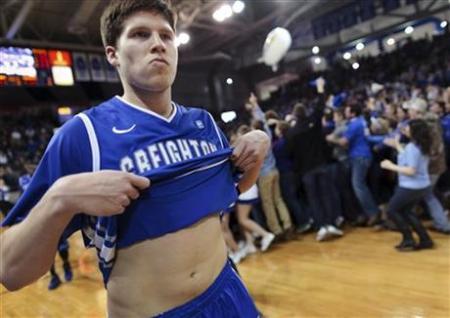
For those who appreciate statistics, Creighton senior forward Doug McDermott oozes appeal.  He has posted a PER of at least 31.0 in each of his sophomore, junior, and senior seasons.  This year he is carrying a whopping 32.9% usage rate with just an 11.6% turnover rate and a 62.3% TS.  He is shooting 52.6% on 2’s, 43.4% on 3’s, and 89.6% from the line, and his 3 point percentage is actually down from his past two seasons where he shot 49% behind the arc.  That is an incredible combination of volume and efficiency and he has solid rebounding and assist totals as well, so it’s easy to see why both ESPN and DraftExpress have him as a lottery pick (he is 14th and 12th respectively on their big boards).

In spite of all of his offensive goodness, his most amazing statistics may be his steal and block totals.  In 127 college games averaging 30.9 minutes per game, he has a grand total of 31 steals and 12 blocks.  It is dumbfoundingly rare for him to make a play on the defensive end.  While Creighton does not often gamble on defense, he has ranked comfortably last on the team in steal rate in each of his sophomore through senior seasons.  His steal percentages from his sophomore through senior seasons have been 0.4%, 0.4%, and 0.5% respectively.  Among his teammates who have played 300 or more minutes in any of those seasons, the next lowest steal rate was from Gregory Echenique in 11-12 at 0.9%.  While an effective college player, Echenique was a doughy, lumbering big man who lacked great length and was nowhere near an NBA prospect.  Yet he had more than twice as many steals as McDermott, as did the rest of his largely unathletic, non-prospect teammates.  And in spite of being 6’8, McDermott is not setting himself apart with blocks, accruing just 1 per every 327 minutes of college play.  This is all with Creighton being a mid-major that has not played an especially difficult schedule.

Recently there have been studies claiming a strongly positive correlation between college steal rates and NBA success, and it’s easy to see the underlying logic.  If a player has the tools and instincts to be a good NBA defender, he should be able to create turnovers against inferior college competition without habitually gambling.  Steals are not perfect and must be adjusted for context, but they serve as a decent approximation of a prospect’s defensive playmaking ability.


McDermott is 6’8 with a 6’8.5 wingspan and is listed at 225 pounds, which leaves him incapable of regularly defending NBA PF’s since most can both bully him and shoot over him given his lack of length and strength.  This leaves SF as his likely position, where on the perimeter his lack of quicks and athleticism will be a major issue.  No matter whom he tries to defend in the NBA his physical disadvantages will be glaring,  as there may not be a player in the league who is more physically ill equipped to guard anyone.  It is a serious concern that he will become the worst defensive player in the entire league, which would negate whatever offensive value he brings and leave him as a replacement level player at best.  On the upside, he reputedly does work hard on defense and is a smart team defender.  Any team who drafts him would have to be confident that these strengths can mitigate his weaknesses to justify a 1st round selection.  But optimism should be curbed, as there is no precedent of an NBA prospect who is so poor at both forcing turnovers and altering shots, let alone of one succeeding.  Here is a comparison of his steal and block rates to past high skill, questionable tool prospects:

Player Steal% Block%
Kyle Korver 2.9 1.9
Jimmer Fredette 2.3 0.1
JJ Redick 1.8 0.1
Matt Bonner 1.6 2
Wally Szczerbiak 1.6 2.5
Luke Babbitt 1.5 2
Adam Morrison 1.3 0.4
Steve Novak 1.1 0.3
Ryan Anderson 0.9 0.5
Doug McDermott 0.5 0.3

Korver is a common comparison for McDermott since both are white players and great shooters who played four seasons at Creighton, and that comparison is misguided.  Part of the reason why Korver is such a useful pro is that he plays respectable defense and doesn’t negate his offensive value on that end.  His steal and block totals indicated this as a possibility, and it is insane that he slid to 51st overall in the draft. Even Steve Novak, who is arguably the worst defensive player in the NBA produced over twice as many steals as McDermott and has a clearer niche as a PF being 2 inches taller. JJ Redick is the only successful current pro without any positive tools for his position, but his vastly superior steal rate against tougher competition suggests that perhaps he is not quite as athletically challenged for his position.  And he did have to spend first three seasons in the league developing his game before becoming rotation caliber, and he didn’t become a solid starter until his 6th or 7th season in the league.

It could be argued that Ryan Anderson inspires hope for McDermott, as he has become a valuable NBA player who plays acceptable defense and has far exceeded his draft slot EV without racking up steals and blocks in college.  But Randerson had the tools to play PF as he is 6’10 240, and he still achieved nearly twice the steal and block rate in college.  This is a detail that Anderson himself noted after McDermott participated in the USA basketball mini-camp this past summer.  Per CBS:

“Anderson pointed out that McDermott’s future position is also a question. Will he be a slower small forward, or a shorter power forward?”

When even your below the rim brethren question your tools to perform at the next level, it may be a sign that you are a cut below the threshold for success.

McDermott’s defensive projection in the NBA ranges from downright horrific to moderately bad.  Is it really that big a deal since he has far better offensive stats than anybody else in the pool?  The answer is yes, because his defensive concerns are correlated with concerns regarding his ability to translate his scoring repertoire to the NBA.  He is a great shooter, and shooting always translates to the pros.  But he’s a worse shooter than Steve Novak, and Novak’s defense prevents him from being a regular rotation player.  Here is a shooting comparison with Novak’s college stats on the left and McDermott’s on the right:

3PA/40

3p%

FT%

3PA/40

3p%

FT%

Freshman

8.5

0.505

0.939

4.1

0.405

0.746

Sophomore

9

0.43

0.912

4

0.486

0.796

Junior

8.3

0.461

0.905

5.5

0.49

0.875

Senior

9.9

0.467

0.974

7.3

0.434

0.896

Career

9

0.461

0.931

4.9

0.458

0.831

Not only did Novak have a much higher FT% each season and a slightly higher 3p% overall, but he also attempted a greater volume of 3’s.  It is likely that his average quality of 3 point shot was lower, as he had nearly double the career attempts per minute with both teams playing at similar paces.  Jeff Van Gundy coached Novak in Houston and has called him the best 3 point shooter he has ever seen, and the stats justify that assertion as reasonable.  Yet he is still roughly replacement level as an NBA player since his defense is so bad and his offensive game is otherwise limited.

For McDermott to succeed as a pro, he needs to be more than a spot up shooter.  While his odds may seem reasonable given that he is far more effective inside the arc as a college player than Novak, the same lack of tools that limit him defensively also inhibit his ability to translate his paint scoring to the pros.  He will struggle to get his shot up over any NBA big men with his lack of reach, he won’t be able to outmuscle any of them, and he remains an eternal underdog to ever leap over any of them.  71% of his points this year have come inside the arc or at the free throw line, and that enormous chunk of production will largely get diluted or evaporate altogether in the NBA.  Further, he struggles to create his own shot and does not shoot well off the dribble. As a senior, 72.5% of his rim FG attempts and 60.6% of his non-rim 2 point attempts have been assisted.  In a way this is good since he will often be playing off the ball as a pro, but the downside is there is no fat to be trimmed off his game that will cause a better than expected translation.  Perhaps he will get an occasional bucket on a cut when rim traffic is limited, but it is not clear how he can achieve either high volume or high efficiency in the paint.

To get a sense for the impression his game left on NBA players at team USA mini-camp, here are some quotes:

“There’s always a place for a shooter,” Barnes said. “He can make shots with the best of them.”

“He’s a confident player. He’s a confident shooter, a confident scorer,” New Orleans Pelicans forward Ryan Anderson said. “I think a college guy can come in here and be intimidated, but he wasn’t. He accepted the challenge.”

“He can shoot the shit out of the basketball,” Detroit Pistons big man Andre Drummond said. “It’s incredible. I was surprised he didn’t come out for the draft this year, but he’s going to make a lot of money the way he shoots.”

“He’s going to be a great shooter in this league,” Golden State Warriors guard Klay Thompson added.

Other than Anderson calling him a confident scorer (after first going with confident shooter), nobody seems impressed with anything other than his shooting.

Taken altogether, McDermott’s lack of tools drastically inhibit his draft value.  Not only do they guarantee that he will be bad defensively, but they also ensure that a significant portion of his offensive dominance will be lost in translation.  He needs to overperform expectations to be passably bad instead of a nightmare on defense and he needs to bring a second dimension to his offensive game other than shooting.

Given the success of JJ Redick it is not fair to write off McDermott entirely, as high IQ and work ethic can overcome a surprising amount of physical deficiency.  But even Redick is merely a good role player after achieving his upside, so it is not as if the GM’s who passed on him must now live with tremendous regret.  The bottom line is both McDermott’s ceiling and floor are underwhelming.  In a reasonably deep draft, it will be questionable to use a 1st rounder on him and laughable to expend a lottery pick.  Perhaps a naive team who is newly discovering the wonders of TS% and PER will be seduced by his stats, but I would wager that smart front offices will resist drafting Ougie Fresh in the 1st round.