An Attempt To Quantify the Meaning Of Marcus Smart Shoving a Fan

Tags

,

In the waning seconds of Saturday night’s Texas Tech-Oklahoma State game, a Texas Tech fan said something to arouse the ire of Marcus Smart, and Smart confronted and shoved him.  Smart’s side of the story is that the Texas Tech super fan dropped a racial slur on him.  It was costly for Smart’s team, as they had an outside shot of winning the game down 2 with 6 seconds left and Texas Tech heading to the line for two free throws.  And the brunt of the incident will be the 3 game suspension he received with his team’s tourney hopes suddenly looking uncertain.  Various people will have various takes on what this says about Smart’s character, and none of them will be particularly illuminating.  He erred, a price will be paid, people will get over it as time passes, and discussing it any further is both uninteresting and uncomfortable.  After all, my goal is to perceive his value as a future NBA player rather than judge his morality as a human being.  So the question of the day is: should we adjust the consensus opinion that Smart has elite intangibles and downgrade his draft stock in light of this incident?

First, let’s look at the NBA incident that most closely parallels this: the Malice at the Palace.  While a quick shove pales in comparison to Ron Artest and Stephen Jackson going into the stands to fight fans, and Jermaine O’Neal punching a fan in the jaw after a running start, it’s what we have to work with for the line between players and fans being crossed.   So let’s take a look at each player’s draft slot, their career win shares, and where they rank all time for win shares at their draft slot:

Pick Win Shares Slot Rank
Ron Artest 16 61.3 3
Jermaine O’Neal 17 64 4
Stephen Jackson 42 36.1 1

There have been 60 selections at 16th or 17th overall and 59 at 42nd in NBA history.  In spite of being crazy enough to physically fight fans and draw enormous suspensions, these 3 players were among the all-time best values for their slot.  There is some selection bias at work, as this analysis isn’t completely fair to the draft busts who couldn’t stay on an NBA roster long enough to have the opportunity to storm into the stands and beat up Detroit area residents.  But the fact remains that being crazy enough to fight fans does not equate to being too crazy to develop into a better NBA player than expected.

There are not many similar incidents to draw from for a thorough analysis.  The next most similar incident that comes to mind is Dennis Rodman kicking the camera man, and he has the most career win shares for 27th overall draft picks.  So to assess a broader range of players, I resorted to the universal measure of NBA player volatility: technical fouls!  Rasheed Wallace is the poster boy for technicals, as he holds the record both single season (41) and career (317) technicals, and he proved to be good value at 4th overall with the 5th most career win shares for the slot all-time.  In any season the technical foul leaderboard it is littered with players who were good draft values.  But again there are selection bias issues, as players need to spend time on the floor to rack up technicals, which prevents bench players and flame-outs from standing out in this regard.

To give the busts and their outbursts fair consideration, I analyzed the correlation between technical frequency and various advanced statistics.  I used season long samples from 2002-2003, 2007-2008, and 2012-2013.  For each season, I calculated the correlation coefficient between technical fouls per minute and RAPM, PER, and Win Shares.  I split RAPM and Win Shares into offense and defense, and I also included Win Shares per 48 minutes.  Here are the correlations:

Statistic 2002-03 2007-08 2012-13
oRAPM 0.025 0.090 0.038
dRAPM 0.224 0.286 0.243
RAPM 0.180 0.276 0.212
PER 0.167 0.149 0.172
OWS 0.102 0.132 0.071
DWS 0.235 0.209 0.180
WS 0.167 0.176 0.123
WS/48 0.186 0.147 0.122

There is a positive correlation across the board between a density of technical fouls and on court production.  This intuitively makes sense, as it is often the most fiery competitors who pick up the most technicals.  The defensive correlation is much stronger than the offensive one, which again makes sense due to defensive value having a greater correlation with effort.  There have been plenty of successful players who don’t get an insane amount of technicals, so I’m not advocating to draft all hotheads and pass up the players who contain their emotions.  But the numbers clearly suggest that volatile players on average contribute more value than the complacent ones.

I do not mean to spin Smart’s outburst as a positive- his competitive spirit was already priced into his draft stock and it would have been preferable if he hadn’t crossed the boundary that he did.  But since we live in a society where following the rules is regarded as important, this may be incorrectly magnified into a notable red flag.  It parallels to Chris Paul’s elite intangibles being questioned when he punched Julius Hodge below the belt in ACC play, and this concern has proven to be misplaced as he became an excellent leader and star player in the NBA.

People are welcome to judge exactly how wrong Smart was to their heart’s content, but they are flat out wrong if they think this adversely affects his ability to contribute value to an NBA team.  By all accounts he is a great leader and teammate, and even if you want to now downgrade those assessments (I do not) he is not a bad teammate by any stretch.  If GMs picking in the middle of the lottery have an inclination to pass him up because of this, I would expect Smart to reward the first team with the good sense to look past the ESPN narrative and realize this is nothing more than a small price to pay for an elite competitor.
Searching For Bobby Portis: The Invisible 5 Star Freshman

Tags

, , ,

It seems that being a 5 star freshman can buy prospects indefinite hype as a possible 1st round pick.  After all, Wayne Selden is still ranked 24th at ESPN and 26th at DraftExpress after showing little indication that he has any clue how to play basketball over a 22 game sample.  Selden was only the #13 RSCI freshman, so it would logically follow that #14 RSCI freshman Bobby Portis should be entering the 1st round discussion after demonstrating far more basketball playing ability with over twice the PER thus far (25.8 vs 12.8).  But neither DraftExpress nor ESPN even have Portis in their top 100.

This is incredible to me.  He had a higher RSCI rank than Joel Embiid, he has almost as good of a PER (25.8 vs 26.8), yet he’s not on anybody’s radar.  This could imply that he has some irreparable malfunction to preclude him from being a successful pro, but his tools seem fine.  He’s listed at 6’10” with a 7’1.5″ wingspan and 242 pounds, so he has pretty good size for an NBA PF.  His athleticism and mobility don’t stand out, but they aren’t bad either.  His tools appear to be average for an NBA PF across the board- nothing stands out and makes scouts drool, nor does anything significantly inhibits his odds of NBA success.

As a freshman he is only averaging 13.3 points and 6.6 rebounds per game, so perhaps scouts are not wowed by his bulk stats.  But that comes in just 26.7 minutes per game with solid efficiency and low turnovers, which is strong production.  In fairness Arkansas played a high volume of doormat opponents in non-conference, and Portis did get off to a slow start in SEC play.  But he had been good enough to hover on my radar as I had him 34th on my inaugural big board, and recently he has started to find his stride.

After averaging just 8.2 points per game on poor shooting in his first 5 conference games, it may have appeared that he is nothing more than a big guy who owns doormats.  But then he went on a 3 game stretch vs Auburn, vs Missouri, and @LSU where he averaged 16.3 pts 7.0 rebs on 18/31 FG 13/16 FT and committed just 5 turnovers.  So when it looked like he may be starting to turn the corner, he dropped this monster game on Alabama:

FG FGA FT FTA ORB TOV BLKS PTS
Portis 14 17 6 6 3 0 6 35
Not Portis 8 30 14 17 7 10 3 30

Portis won this game for Arkansas singlehandedly.  Alabama isn’t a world beater, they are the 112th kenpom team with the 100th ranked defense.  But they aren’t a doormat and were good enough to cause a heap of trouble for his teammates.  Portis scored in a variety of ways: jump shots, transition, cuts, putbacks.  There wasn’t much isolation at all- I believe he scored on one drive to the hoop and didn’t post up at all.  He appears to be a natural at scoring within the flow of the offense.  And contributing 6 blocks on the other end isn’t too bad either.

It appears that Portis’s malfunction is that he doesn’t have a single trait that scouts can latch onto and drool over.  He projects to score well in a complementary role, but is not a go to scorer who will average 20 points per game in the NBA.  He also shows decent potential defensively, but isn’t a stopper on this end.  He is a good shooter for such a young big as he hits 77.6% of his free throws, but his 3 point range may not be developed as he is just 4 for 21 on 3’s thus far.  But he also doesn’t have any glaring weaknesses that will preclude him from success.  He is skilled, plays hard, has good feel for the game, shows potential to be solid on both ends, and he has plenty of room to grow as he turns 19 in 2 days.

I am possibly the only person on the planet who believes Portis makes for an interesting comparison with Julius Randle.  They are both skilled 5 star freshman PF’s who play in the SEC.  Their tools are not far apart, as Portis has more length (7’1.5″ vs 6’11” wingspan), Randle has more strength, and their athleticism and mobility appear to be similar (although perhaps Randle’s spryness would stand out if he trimmed down).  Their offensive ratings adjusted for SOS and usage is close with Randle having a slim 1.8 point advantage.   In a world that interprets draft related information with reasonable efficiency, a Portis vs. Randle debate would be raging right now.  Yet ESPN and DraftExpress have Randle in the top 5 and Portis not top 100.

Note that SOS is average opponent adjusted defensive rating as per kenpom.com.  FTR is FTA/FGA:

Usage O-Rtg eFG FTR FT% SOS
Portis 21.2 122.2 55.9% 0.363 77.6% 103.8
Randle 28.0 113.5 53.0% 0.798 73.5% 102.1
ORB% DRB% STL% BLK% AST% TOV%
Portis 10.2 16.1 2.1 5.9 10.6 11.0
Randle 14.9 21.7 1.0 2.6 11.6 20.9

Portis has superior defensive awareness and his length enables him to make more plays.  I believe he clearly projects to be better on this end in spite of inferior rebounding.  Offensively, Randle is a superior offensive rebounder and gets to the line far more, but Portis has a considerably lower turnover rate.  Also Randle creates for himself far more, with a higher usage and a lower dependency on assists (Randle assisted on 32.7% of 2’s, Portis assisted on 57.7%).  Randle’s ability to be the go to guy likely plays a large role in his luster to scouts, but his offensive workload is already taking a hit in SEC play and he may never be good enough to be a go to scorer in the NBA.  Portis’s lack of isolation scoring puts a cap on his upside, but the flipside is that he will be an easier fit into NBA lineups as he can make a positive impact playing off the ball.  And since he has longer arms and doesn’t operate in traffic quite as often, he’s less of a translation risk.  In my estimation they offer similar net value offensively, and Portis gets the overall edge due to not being such a defensive liability.

I could be wrong to prefer Portis, but I am not wrong that it is a subject worthy of debate.  Randle simply doesn’t have an obvious advantage once the prospects are placed side by side.  This goes to show exactly how inefficient the expert rankings are at this juncture of the season.  It is insane that Randle is being discussed as a creme de la creme prospect while Portis is entirely off the radar.  This is why the RSCI rankings and early mock drafts should be taken with an enormous grain of salt. The same people who anointed players such as Wiggins and Randle as the next big things are the same folks who thought that Darko, Shabazz Muhammad, Austin Rivers, etc were going to be great.  Give them credit for being right a decent portion of the time, but the fact remains that they are laughably wrong quite a bit as well.  Any intelligent prospect analysis should necessarily assume that this is a perpetual possibility.  Otherwise we are nothing more than lemmings following louder, wronger lemmings to unfortunate conclusions.  Fortunately it isn’t a matter of life or death, but then again I doubt that death is all that much worse than rooting for the next Darko after your team lost on purpose for a season in order to acquire him.

If Aaron Gordon Is So Smart, Why Does He Play Like Josh Smith?

Tags

, , , ,

As an advocate of prospect intelligence, I would like to clarify that the optimal measurement should not derive from a player’s ability to give an impressive interview or ace an IQ test.  It should stem from how well the player implements his intelligence on the basketball court.  There are plenty of intelligent people who allow their intelligence to be undermined by whatever wants they have as a human being, and consequently do dumb things.  Conversely, PJ Hairston’s intelligence could be questioned given his inability to stay out of trouble this summer.  But he is smart enough to grasp that when he has enough space to get off a 3 pointer, it is a good decision to pull the trigger.  Consequently he scores with a combination of volume and efficiency that is reserved for high IQ players, so his basketball IQ deserves credit for this aspect of his game.

Aaron Gordon often gets lauded for his intelligence, and I do agree that he conveys such in interviews when he speaks with poise and confidence.  But he also has a reputation as an intelligent basketball player, as his coach declared “Aaron’s greatest intelligence lies in his mind” and DraftExpress lists “Very intelligent and mature player, despite his age” as a strength.  I take exception to these assertions based on his shot selection:

Split Makes Attempts %
Rim 73 97 75.3%
Non-Rim 2’s 26 107 24.3%
3’s 7 26 26.9%
FT 46 109 42.2%

He is averaging 5.8 shots per game away from the rim with an eFG of 27.4%, as well as a historically bad FT% of 42.2%.  Consequently, he has a putrid TS% of 47.0% in spite of his scintillating rim finishing ability.  For reference the next lowest TS% among projected 1st rounders is James Young @ 53.5%.  He idolized Magic Johnson as a kid, and he values versatility as he does not want to get pigeonholed to one spot.  Unfortunately for him, there is only one spot on the floor from which he scores effectively, so perhaps he should warm up to the possibility of self-pigeonholing.

It could be argued that he’s young and he is trying to develop his shooting ability to become a more complete player, such that he is an effective shooter in his prime.  I would counter that he should abandon all hope of ever becoming a useful long range shooter in the NBA, because his shot is irreparably broken.  I cannot find any past prospect who shot < 50% at the free throw line as a college freshman and went on to become a successful NBA shooter.  40something FT%’s are reserved for the most woefully inept shooters of all time.  Even Josh Smith shot 68.8% from the line as an NBA rookie.  Dwight Howard shot 67.1% and Shaq shot 55.6% as a college freshman.  Ben Wallace is the worst NBA free throw shooter of all time (min 500 attempts) and he barely had a lower freshman FT% than Gordon at 40.7%.  The 2nd through 5th worst shooters: DeAndre Jordan (43.7%), Chris Dudley (46.7%), Eric Montross (61.2%), and Steven Hunter (70.7%) all sported better FT%’s than Gordon.

Given how historically inept Gordon’s shooting ability is, consider how insane it is that he attempts nearly 6 jump shots per game.  If any of the aforementioned bricklayers ever attempted a jump shot they likely would have been benched, yet Gordon includes it as a regular part of his game.

Blake Griffin is often cited as his upside comparison, but Gordon’s propensity to launch bricks away from the hoop leaves his production miles below that of Griffin as a freshman.  Note that SOS is kenpom.com’s average defensive rating of opponents:

Player Usage O-Rtg eFG% FT% AST% TOV% SOS
Blake 28.6 109.5 56.7 58.9% 16.6 17.4 98.6
Gordon 22.6 102.5 47.6 42.2% 10.4 12.3 101.8

Not only did Griffin convert a higher % of his shots, he got off a higher volume of quality looks.  Gordon is light years behind freshman Blake, and that’s before Blake made a huge leap as a sophomore and went on to be selected #1 overall.  And even though Blake is not regarded as much of an NBA defensive player, he did get more blocks (3.3% vs 3.0%) and steals (2.1% vs 1.2%) than Gordon.

To offer a more realistic comparison, Gordon’s freshman stats are eerily similar to those of Josh Smith as an NBA rookie.  Note that usage and turnover calculations vary at different sources.  Earlier I compared Gordon to Griffin based on statsheet.com stats, now I will compare him to Smith based on sports-reference.com stats for the sake of maintaining like comparisons.

USG% TOV% TS% ORB% DRB% AST% STL% BLK%
Gordon 22.8 10.2 47.0 11.4 19.0 10.4 1.2 3.0
Smith 18.4 16.0 50.6 7.9 18.6 10.2 1.5 5.4

This comparison should absolutely frighten GM’s interested in Gordon.  While being just 9 months older, Smith posted a better TS% on not much worse usage + turnovers considering the competition rift.   While Gordon is lauded for his passing ability, it is also the strength of Smith’s perimeter game.  This does not bode well, seeing that Smith was playing vastly superior competition and still is a major drag offensively today.  In my recent podcast with Robert Eckstut and Seth Partnow, I mentioned Smith as a Gordon comparison and Robert astutely noted that does not sound good.  Smith is only a useful player because of his elite defensive playmaking ability, without a significantly positive impact on that end he would be worthless.

Gordon has contributed toward Arizona having the best defense in the country (as per kenpom.com), and he has the physical tools to be a positive defensive player in the pros.  But in spite of the credit Gordon deserves for his role in Arizona’s awesome defensive scheme of funneling opponent shot attempts to the midrange, this is not enough to project him as a Josh Smith level difference maker, as both his steal and block rates are inferior to that which Smith posted as an NBA rookie.  If Gordon becomes a neutral or slight positive defensively in the NBA, that will not nearly make his offense worth stomaching at any draft slot, let alone a top 10 one.

Gordon’s prospective value lies in the possibility that his NBA coach convinces him to abandon his appalling shot and operate strictly in the post.  He needs to let go of his desire to be Magic Johnson, accept his role as an elite rim finisher, and start adding muscle and working on his post moves.  It is difficult to assess the likelihood of such an outcome, as it has been a common perception that Josh Smith would be great if he fell out of love with his shot for his entire career.  Yet here we are in his 10th NBA season, and Kirk Goldsberry is making Smith shot charts that are as hilarious as ever.

Teams interested in Gordon will need to explore his coachability and flexibility via interview and feedback from his coach.  But without an expressed willingness to abandon his perimeter pursuits, I simply wouldn’t draft him.  For now it’s worth wondering what he brings that other toolsy dunkers lacking range such as Montrezl Harrell and Jerami Grant do not.  Their lack of range may be problematic for their NBA value, but at least they don’t exacerbate it by insisting on being perimeter players.  The world already has one Josh Smith, and I don’t see the particular need to add another.

Video

The Exum Factor: How High is Dante’s Peak?

Tags

, , , ,

Now that Dante Exum has officially declared for the draft, I figured it’s time to put him under the microscope to see whether his hype is justified.  I analyzed his performance vs Spain in the FIBA u19 games this summer to try to get a feel for what he brings to the table as a prospective NBA player.  Note that this game occurred the week before he turned 18:

This was Exum’s best scoring game, so perhaps not all of his weaknesses were fully exposed.  I looked at DraftExpress’s scouting report to see if they listed any weaknesses that may not have been on display.  Their list:

-Perimeter shooting- this is the one that everybody acknowledges
-TO Prone/PG Skills- this took my by surprise- I’ll touch on this below
-Shot selection- easy to see why, although I don’t think it is a significant weakness.
-Strength- this is the other obvious one on top of shooting.

With respect to turnovers, they claimed that he sometimes plays out of control which is true to an extent- one or two of his turnovers this game could have been qualified as such.  Also against the US he was benched due to playing out of control after committing 4 turnovers in 11 minutes, as Australia went on to lose 94-51.  But he still only had 21 total turnovers in 9 games over the tournament, which is excellent.

Let’s compare his FIBA stats to those of Tyler Ennis.  Ennis played for Canada which was a similar caliber team (Canada finished 6th, Australia finished 4th, the teams shared a 4-5 record, and Australia had a slightly better PD +1.8 vs +0.6).  Differences of note are that Australia played a tougher schedule (both teams played the US once, but Australia played the second best team in Serbia twice while Canada didn’t play them at all), and Ennis had Trey Lyles on his team as a second big time scorer to draw defensive attention.  Ennis led the u19 games scoring 20.9 points per game, Lyles was third with 20.3.  Australia’s second leading scorer was Dane Pineau who averaged 11.8 pts/game.  Also Australia was slightly better defensively (97.2 D-Rating vs 98.2) so it’s not like Exum had the benefit of a hugely pro-offense team construction that Ennis did not:

Mins FG FGA FT FTA Ast TOVs Pts
Ennis 279 74 159 36 51 25 24 188
Exum 266 54 121 39 64 34 21 164

As a freshman at Syracuse, Ennis is averaging 34.4 mpg 12.1 ppg 5.6 apg 1.5 topg playing as more of a distributor than scorer.  That is an excellent turnover rate for any point guard, let alone a college freshman and it will be a large reason why he is likely a lottery pick.  Yet at the FIBAs, Exum had more assists and fewer turnovers against a tougher schedule with just a slightly larger scoring load, and DraftExpress gleaned that turnovers and PG skills is a weakness!

On one hand they are doing their due diligence to list everything that can be perceived as inadequate for an unproven player vying for such a high draft slot.  And it’s possible that he got lucky to have a low number, as 9 games is a small sample and I noted in the video that the scorekeeper miscredited one of his turnovers vs Spain.  But even after you add up the out of control possessions and the lazy low leverage passes that went awry, his bottom line result was excellent.  He clearly is doing something correct to avoid them, and I believe it is a testament to his ball handling, passing, and basketball IQ.  Against Spain he repeatedly got into the lane and made beautiful passes to his teammates, but of his pile of turnovers only one of them came on a drive and kick when his pass was deflected.

DX’s qualm with his PG skills is that sometimes he misses teammates and forces shots, which is a perspective I understand after seeing some of his forced shots in the paint vs Spain.  But in that game, he did much more finding teammates than he did missing them.  I’m not sure if it was an above average distribution game where his teammates did a below average job of converting.  But he was credited with 4 assists and averaged 3.8 for the tournament, and it’s inevitable that his teammates failed to convert some significant amount of quality looks created by Exum in other games.

With respect to shot selection, I again do not think he was particularly bad.  He should inevitably attempt some bad shots with such a great disparity between his talent and that of his teammates, and his intelligence inspires confidence that he will learn to improve his shot selection with better NBA teammates.  Also DX takes exception to his volume of 3 point attempts, but he shot 33.3% for the tournament so again the bottom line does not look bad.  It would be more upsetting if he instead insisted on launching long 2 pointers.

Taken altogether, I’d qualify all things efficiency and basketball IQ related (turnovers, PG skills, shot selection) to be a distinct positive.  The fact that DraftExpress listed this as a weakness is a testament to the fact that there’s so little to dislike about Exum.   His actual weaknesses are his shot and strength, and he is reportedly investing significant effort to improve both.  My next biggest qualm is that while he is a fluid athlete, he is not particularly explosive.

Even without great strength or explosiveness, his tools are decidedly positive as he brings elite speed, quicks, height, and length to the PG position.  Even without a great shot, his combination of ball handling, passing, and touch around the rim offer promise as a future offensive centerpiece, especially if surround by good shooting.  He projects to be a positive defensively as well.  The only thing that could prevent him from becoming good is poor development, but he reputedly has an excellent work ethic.

Exum idolizes Derrick Rose, which is sensible as the players offer similar value.  They both have a great combination of size and speed for the PG position.  Rose is stronger and more explosive, but Exum is taller and longer as he is 6’6 with a 6’9 wingspan vs Rose’s 6’2.5 with a 6’8 wingspan.  They share questionable shooting as their weakness, as Rose’s shooting improvement played a large role in his winning MVP in his 3rd season in the league.  While Rose’s freshman season was good, his ability to grow was what made him such an appealing prospect and successful NBA player until derailed by injury.  While Exum’s future growth rate is a mystery, his work ethic and intelligence are two strong points in favor of it being good.  Even his college stats parallel closely to Exum’s FIBA stats:

MPG PPG APG TOPG SPG 2p% 3p% FT%
Rose 29.2 14.9 4.7 2.7 1.2 52.1% 33.7% 71.2%
Exum 29.6 18.2 3.8 2.3 1.7 52.9% 33.3% 60.9%

This is not an apples to apples comparison by any stretch, but you can see the similarities in their mold.  It’s possible that Exum would have been worse than Rose with a season in college, but he also may have been better and I don’t think he would be at risk of being as bad as Andrew Harrison.  Also Exum will be a year younger on draft night than Rose was.  It’s fair to give Rose the edge as an overall prospect due to his edge in athleticism and his excellent performance in the NCAA tournament, but I do not believe Exum is particularly far behind.

Exum’s value largely hinges on his performance in workouts. If he is as working as hard on his shot and body as people around him indicate, he will likely boost his stock and vault into the top 3.  Exum is perceived as the mystery box of the draft, but with Andrew Wiggins’ underwhelming freshman performance he is no longer a can’t miss star.  Even if you assign a Marvin Williams level floor to Wiggins, that’s hardly much consolation for a top 3 pick.  I doubt that Williams becoming a semi-useful pro makes Billy Knight feel particularly better about selecting him over Chris Paul.  Especially at the top of the lottery, a player’s value is almost entirely driven by his upside and his odds of achieving it.  While Wiggins has shown better outside touch and more potential as a complementary piece on offense, Exum’s upside as an offensive centerpiece is more attractive.  I don’t think Wiggins has a significant enough (if any) defensive edge to offset this.  As of right now, I rate Exum as the 2nd best prospect overall in this draft, with Jabari Parker having the best shot of supplanting him with a strong finish to his season.

The worst thing that can be said about Exum is that he is young and needs to spend time developing before making a large impact as a pro.  But I believe in his upside, and I believe that he is unlikely to flop completely.  Indications are that this mystery box just might contain a boat after all, and you know how much we wanted one of those.

Video

Rodney Hood’s Defense vs Lamar Patterson: Don’t Believe Everything Jay Bilas Tells You

Tags

, , ,

When Pittsburgh All-American candidate Lamar Patterson struggled offensively in a home loss to Rodney Hood and the Duke Blue Devils, the immediate media reaction was to applaud Hood’s defensive performance. He spent most of the game guarding Patterson, who finished with 14 pts 4-14 FG 5-6 FT 1 Ast 5 TOVs, which is a decidedly bad line for a normally efficient scorer.

It’s natural to assume that some significant portion of credit goes to Hood, and it raises the possibility that I have been underrating his defense and/or he has improved throughout the season.  The team as a whole has recently been playing better on that end, so it’s fair to wonder if Rodney Hood is transforming from a sieve to a passable defensive player.

I compiled the key plays to display how Duke shut Patterson down:

Conclusions:
-Hood was only guarding Patterson for 1 of his 5 turnovers, and it was when Marshall Plumlee came to help for the trap. It does not require much defensive acumen to force a turnover in that situation.
-Pitt’s bad spacing and elite help defense neutralized Patterson almost every time he penetrated. He got all the way to the rim only twice when Jabari Parker failed to cut off his drive and fouled him for free throws.
-Did anybody notice Hood doing anything impressive? He contested a couple of shots and he ripped away the ball on the trap, but that’s it. None of his good plays are indicative of an ability to hang with NBA SF’s
-There were four occasions on which Patterson badly faked out Hood. Aside from having questionable tools to hang with NBA SF’s, Hood exacerbates his projection by being easily juked. Consequently he gets blown by regularly, only this game he had Amile Jefferson at his back to keep him from looking too bad.

Overall this shows why measuring defense by counterpart performance is entirely worthless. The main credit goes to Coach K for finding a way to mitigate the impact of Hood’s defensive deficiencies, and Amile Jefferson for playing good help defense. At both the NCAA and NBA level defense is a team effort, and Hood’s role against Patterson could have been fulfilled by any wing draft prospect. In the NBA Hood will once again be reliant on help from his teammates, except it will be more difficult to find a solution when all of the good NBA offenses have far better spacing than the Pittsburgh Panthers.

Richard Sherman Is Awesome And We Can Learn From Him

Tags

, , , , , , ,

Recently Richard Sherman has garnered much attention, as he frightened Erin Andrews when he angrily declared himsef the best corner in the game and called Michael Crabtree a “sorry receiver” after Sherman’s Seahawks defeated Crabtree’s 49ers in the NFC championship game.

As a casual NFL fan, this was my first exposure to Sherman.  While people had varying reactions to his postgame mini-rant, I had an inkling that he was one of the more awesome human beings on this planet and did some digging.  Last year he went on ESPN’s First Take and told Skip Bayless “I’m better at life than you,” which is painfully true.  He also demonstrated commendable word choice when he called Bayless an “ignorant, pompous, egotistical cretin.”

But Richard Sherman is more than just an elite troll.  After his 2nd NFL season, he was voted by the AP to the NFL All-Pro 1st team.  Now in his 3rd NFL season, he is widely considered a top 2 NFL cornerback.  He’s on the fast track to become an all-time great, yet in the 2011 NFL Draft he was chosen in the 5th round, 154th overall.  His draft stock was deflated because he started off his college career as a wide receiver, and only had two years experience as a cornerback entering the draft.  He was considered raw, which was something that Sherman himself acknowledged.  But he has good tools and is insanely smart and driven to succeed, so it shouldn’t be surprising that he achieved the heights that he did.  Check out how cerebral his approach to the game is:

And much like Paul George, he had his sights set on extreme goals.  Per an SB Nation interview:

“Doesn’t matter where I play I just want to be a great player.  I don’t want to be a guy that’s in the league a few years, makes a ton of money and has nothing else.  I want to go down as one of the best.I want to prove other NFL Draft websites wrong that say I am the 52nd ranked CB prospect in their eyes.”

The fact that there was a player with the tools to be great and had such an intelligent and dedicated approach to the game yet was passing up multiple times by every team is amazing to me.  Richard Sherman is the archetype of player that both NFL and NBA GM’s should be pursuing, and the fact that he slipped to the 154th overall shows the inefficiencies of the NFL Draft that I believe remain present in the NBA Draft as well.

The NBA player who stands out as the most Richard Sherman like personality is Chris Paul.  He went 4th overall, as he was a polished NCAA superstar, but he neverthless made the GM’s who drafted Andrew Bogut, Marvin Williams, and Deron Williams ahead of him look foolish.  He thrives off of his otherworldly basketball IQ, and there was concern that he was too competitive as he punched Julius Hodge in the crotch during an ACC game.  I feel that he was one of the all-time underrated draft prospects in spite of going at a high slot, as his lack of an extra inch of height got too much attention and his intelligence received far too little.

Players like Richard Sherman and Chris Paul are one of a kind, and most draft classes will not have anybody who compares.  But these personality types are so underrated, part of the prospect evaluation process should be to identify players who show similar characteristics.  It is built from thin slices from afar, but here’s my early list of players to monitor who have shown signs of possible elite drive, confidence, and intelligence.

6) Joel Embiid-  His personality is slippery to assess, as he is still learning the English language and the game of basketball which makes it difficult to fully convey his intelligence.  On the other hand it also makes it difficult to grasp for his mental limitations since there’s an excuse for most of his mistakes. But his massive overperformance when he wasn’t expected to make an impact, and also his demonstration of a basic ability to learn are positive signs early.   Also noteworthy with Embiid is that he seems to have a fiery passion to his game as he already has 3 technical fouls on the season. Some may view this as a negative, but prefer it to his teammate Andrew Wiggins’s passive approach by a comfortable margin.

5) Tyler Ennis- He has an insanely low turnover rate for a freshman PG, and he has been at his best against good competition as some of his worst games have come against the dregs of Syracuse’s schedule.  Further, his stats in the final 5 minutes of games are better than sooner.

4) Dante Exum- he’s outwardly quiet but reputed to be confident and an extremely hard worker.  Derrick Rose is his role model and they seem to have similar deameanors.  He won me over a little bit with an incredibly sharp assessment regarding the pressure of being a high draft pick:

“Being told that you’re going to be a franchise player doesn’t mean anything, honestly they can say what they’d like and it’s just an opinion and it doesn’t mean it’s going to come true…Dealing with I guess that pressure, it doesn’t really matter to me because I know I’m just going to do what I can to get to that.”

That’s an impressive perception for an 18 year old kid, and it should inch NBA teams toward taking the mystery box over the boat.

3) Spencer Dinwiddie- He may not declare for the draft after his ACL tear, but he is an obviously intelligent person in interviews.  In a DX interivew, he cited that he wanted to improve his efficiency last offseason, and demonstrated a solid vocabulary when touched on his capacity to be an “auxiliary scorer.”  He also expressed an inclination to be a franchise point guard but accepted the possibility of a supporting role.  To me, he reminisces of Shane Battier with PG skills.

2) Marcus Smart- he occasionally makes a bad decision on the floor as he is prone to force bad shots, which may be a sign that he does not have elite intelligence.  But overall he demonstrates good feel for the game, especially defensively.  And from watching interviews he seems to back up his name with above average intelligence.  Moreover he demonstrates uniquely good intangibles and leadership skills as I noted in my Embiid breakdown.  He recently had a mini-meltdown where he outwardly demonstrated frustration during a poor game, and had a good apology afterward where he expressed desire to avoid similar behavior in the future. Willingness to accept feedback and learn from mistakes is how people grow, so it’s encouraging to see the reaction from him even though the meltdown wasn’t particularly bad.

1) Nik Stauskas- He strikes me as the complete package in terms of intangibles.  He is a highly intelligent player, and his work ethic must be incredible given the offseason work he put in on both his body and his skills.  He has a confident demeanor as he does things like blow kisses to the Michigan State crowd after a crucial road win.  His coach also acknowledged that Stauskas showed leadership by holding him back from the refs after a missed call.  His physical limitations place a ceiling on his upside, but that ceiling might be higher than common wisdom would suggest.

Note that the list is not comprehensive, and I hope to identify other attractive personalities as the season progresses.  My analysis of on court performance and statistics certainly carries more weight, but personalities can’t be excluded from prospect assessment altogether so this is a subject I will touch on sporadically.  Consider the assessment of the personality underlying each player to be a skill that I am developing as a side project.  In the interim, I will be rooting for Richard Sherman and the Seattle Seahawks to win that football game that is apparently happening tonight.

Is Andrew Wiggins Really Passive? Let’s Check The Dunk Stats.

Tags

, , ,

A large part of a player’s development is naturally his personality.  Derrick Coleman has admitted after retirement that he never liked playing basketball, whereas successful players such as Michael Jordan and Kobe Bryant give off the impression that succeeding as an NBA superstar is as important to them as breathing air.

A common critique of Andrew Wiggins has been that he is plays too passively, as he is not dominating nearly as much as projected.  It could be counter argued that he playing within himself and merely needs more time to develop before taking the world by storm with his basketball abilities.  My impression from watching him play has been that the former is the case.  But there’s a limit to which Wiggins or any prospect can be assessed from afar, as they only offer brief glimpses into their personalities.  While I enjoy attempting to thin slice such things, it is not nearly as reliable as a statistical analysis or breakdown of on court performance.  So in this case I sought a quantitative means of analyzing Wiggins’s personality: dunk stats!

A large part of Wiggins’s prospect appeal is his physical tools, as he stands 6’8″ with a 7’0″ wingspan and elite explosiveness.  There are few (if any) prospects in this year’s class who are better equipped to dunk with extreme frequency than Wiggins.  The only thing that may hold him back from unleashing a fury of slams is his personality, so I compiled dunk rates as a percentage of rim attempts that culminate in made dunks.  I included a total of 25 prospects of varying sizes and athleticism to offer frames of reference:

Player Height Dunks Attempts Dunk%
Glenn Robinson 6’6″ 23 53 43.4%
Montrezl Harrell 6’8″ 48 118 40.7%
KJ McDaniels 6’6″ 30 83 36.1%
Aaron Gordon 6’9″ 33 92 35.9%
Zach LaVine 6’5″ 22 64 34.4%
Michael Qualls 6’5″ 22 75 29.3%
Joel Embiid 7’0″ 23 89 25.8%
Julius Randle 6’9″ 23 97 23.7%
Jabari Parker 6’8″ 26 114 22.8%
Nik Stauskas 6’6″ 9 40 22.5%
Jerami Grant 6’8″ 17 79 21.5%
Andrew Wiggins 6’8″ 16 83 19.3%
Rodney Hood 6’8″ 11 58 19.0%
Noah Vonleh 6’8″ 17 98 17.3%
Sam Dekker 6’7″ 17 102 16.7%
Keifer Sykes 5’11” 21 130 16.2%
Marcus Smart 6’4″ 13 92 14.1%
TJ Warren 6’8″ 16 150 10.7%
Gary Harris 6’4″ 7 70 10.0%
Spencer Dinwiddie 6’6″ 4 49 8.2%
Semaj Christon 6’3″ 9 176 5.1%
Kyle Anderson 6’8″ 3 58 5.2%
Doug McDermott 6’8″ 4 131 3.1%
Tyler Ennis 6’2″ 1 81 1.2%
Jordan Adams 6’5″ 0 80 0.0%

Glenn Robinson is shooting an astounding 92.5% at the rim, which is made possible by his high % of attempts dunked.  Montrezl Harrell is a funky prospect whose offensive game is largely built around offensive rebounding and dunking, but his volume and frequency show the freakish athleticism that he possesses and make me question having him as low as #24 on my big board.  KJ McDaniels re-asserts my feeling that he has NBA level tools by appearing in the same range as known leapers Aaron Gordon and Zach LaVine.

The players that are lower than expected are Jerami Grant, Andrew Wiggins, and Noah Vonleh, as they all appear in the same range as Rodney Hood, Nik Stauskas, and 5’11” Keifer Sykes (who is rapidly rising up my big board) in spite of reputations as toolsy prospects.

Jordan Adams offers insight as to why his stats are so disparate from his draft stock, as he has 0 dunks on the season.  His lack of athleticism causes him to struggle at the rim against good defenses, and his ability to translate is in question.

The problem with these stats as a whole is that not all dunk opportunities are created equally.  It is far easier to dunk on a wide open fast break than it is against a set defense.  So using ESPN play by play (which is not perfect, but not so poor so as to be wrong enough to possibly alter the narrative), I split up dunk rates into transition and halfcourt splits.  Let’s look at the transition splits first:

Player Height Dunks Attempts Dunk%
Montrezl Harrell 6’8″ 14 20 70.0%
Aaron Gordon 6’9″ 10 18 55.6%
KJ McDaniels 6’6″ 10 19 52.6%
Michael Qualls 6’5″ 12 26 46.2%
Glenn Robinson 6’6″ 9 21 42.9%
Zach LaVine 6’5″ 18 44 40.9%
Noah Vonleh 6’8″ 7 18 38.9%
Nik Stauskas 6’6″ 3 8 37.5%
Rodney Hood 6’8″ 4 11 36.4%
Julius Randle 6’9″ 8 23 34.8%
Marcus Smart 6’4″ 8 23 34.8%
Joel Embiid 7’0″ 2 6 33.3%
Andrew Wiggins 6’8″ 13 39 33.3%
Sam Dekker 6’7″ 6 24 25.0%
Jabari Parker 6’8″ 7 30 23.3%
TJ Warren 6’8″ 10 52 19.2%
Gary Harris 6’4″ 7 37 18.9%
Jerami Grant 6’8″ 2 11 18.2%
Keifer Sykes 5’11” 12 68 17.6%
Spencer Dinwiddie 6’6″ 4 24 16.7%
Semaj Christon 6’3″ 7 75 9.3%
Tyler Ennis 6’2″ 1 24 4.2%
Kyle Anderson 6’8″ 1 27 3.7%
Doug McDermott 6’8″ 1 30 3.3%
Jordan Adams 6’5″ 0 29 0.0%

Once again Harrell shines, as he dunks roughly everything in transition.  LaVine has the most volume, where he has shown off some impressive dunks for UCLA.  Even though Wiggins is reputed to be a transition beast and has a good volume of dunks in this scenario, he still isn’t throwing down with the frequency of his fellow athletic freaks.  He is also behind the smaller Marcus Smart and far less athletic players such as Stauskas, Hood, and Randle.

Jabari Parker has had some impressive coast to coast plays, but his dunk rate in transition is a mildly troubling sign for his athleticism, especially in tandem with his poor rim finishing percentage.

Now onto halfcourt splits:

Player Height Dunks Attempts Dunk%
Glenn Robinson 6’6″ 14 32 43.75%
Montrezl Harrell 6’8″ 30 92 32.61%
KJ McDaniels 6’6″ 20 64 31.25%
Aaron Gordon 6’9″ 23 74 31.08%
Joel Embiid 7’0″ 21 83 25.30%
Jabari Parker 6’8″ 19 84 22.62%
Jerami Grant 6’8″ 15 68 22.06%
Zach LaVine 6’5″ 4 19 21.05%
Michael Qualls 6’5″ 10 49 20.41%
Julius Randle 6’9″ 15 74 20.27%
Nik Stauskas 6’6″ 6 30 20.00%
Rodney Hood 6’8″ 7 47 14.89%
Keifer Sykes 5’11” 9 62 14.52%
Sam Dekker 6’7″ 11 78 14.10%
Noah Vonleh 6’8″ 10 80 12.50%
Marcus Smart 6’4″ 5 70 7.14%
Andrew Wiggins 6’8″ 3 44 6.82%
Kyle Anderson 6’8″ 2 30 6.67%
TJ Warren 6’8″ 6 98 6.12%
Semaj Christon 6’3″ 2 67 2.99%
Doug McDermott 6’8″ 3 101 2.97%
Gary Harris 6’4″ 0 33 0.00%
Jordan Adams 6’5″ 0 49 0.00%
Tyler Ennis 6’2″ 0 57 0.00%
Spencer Dinwiddie 6’6″ 0 25 0.00%

This is where Wiggins is failing to shine to the point of concern.  He has precisely as many dunks in halfcourt sets as the hopelessly earthbound Doug McDermott!   A small amount of blame may be placed on Kansas’s mediocre spacing, but with his tools it cannot be the sole explanation.  And it’s not like he has excellent touch around the rim- he has only converted 54.5% of his rim attempts in half-court sets and 61.4% total.  He is flat out not using his physical blessings to dominate, and this proves that he is playing passively.

As an aside, Jerami Grant assuages concerns about his low total rate as Syracuse’s slow down offense gives him limited transition opportunities.  He does quite alright dunking in the half court, often impressively slamming home putbacks.

These stats comport with my overall perception of Wiggins’ game, which is that he refuses to dominate.  He has awesome tools, solid skills, and does not seem to be lacking in instincts or effort.  He is having a good freshman season, but his bottom line results are less than the sum of his parts.  His common upside comparison is Paul George, but Paul George showed extreme confidence in himself entering the draft.  Here are some pre-draft quotes from him as per DraftExpress:

“I haven’t been exposed to this game as much as a lot of other players and I think I’m already a great prospect with good potential,” he says. “Once I get that chance to really get that experience and learn about the game, I think my ceiling is pretty high.”

“At that point I was just starting to learn what playing against real athletes was like,” he says. “It helped me understand how much work I needed to do. I’m just a student of the game. I love to watch it and learn about it. I think that’s really what has gotten me to where I’m at now.”

“I think that’s probably the most important part of my game,” he says. “I’m only 19 and I have a lot of room to keep growing. I know with the people around me and with my work ethic I’ll get to that next level. I won’t stop until I’m one of the elite players in the NBA.”

After reading those quotes, it should be the least surprising turn of events ever that George developed into an NBA star.  That is elite self-esteem for a 19 year old.  He is down to earth with no delusions of grandeur regarding his level of play at the time, but is also in touch with his potential and the path that it will take to get there.

Does Andrew Wiggins feel similarly about himself?  I don’t know, I have never even met the guy.  But in observing his play on the court and analyzing his reticence to dunk, it’s hard to find any sign that he does.  He could still be a good NBA player without a deep-seated desire to dominate, especially with the aid of a good coach.  He remains a valuable prospect, as I have him #2 overall on my big board.  But his lack of confident edge that his teammate Joel Embiid shows on the court contributes to why he is a clearly inferior college player and prospect.  He is still only 18 years old and has plenty of time to grow, but any team that drafts him needs to ask themselves: on a scale of Marvin Williams to Paul George, what evidence is there that Andrew Wiggins is closer to the latter?  There may be a correct answer, but if so it certainly doesn’t lie in his propensity to dunk all over physically inferior competition.

Video

A Randle Walk Down Fraud Street

Tags

, , ,

Julius Randle is the #2 RSCI freshman and is ranked as a top 5 draft pick (#5 ESPN #4 DX).  All of those are far too high and any team that expends a pick in that range on him will be sorely disappointed.  He is at best a shaky defensive prospect with questionable offensive translation.  His performance and playing style are both rife with red flags that I highlight in this video.

Some may say I’m being too harsh, as he has good pedigree and good statistics and I’m looking for the negative in every play he makes.  This is true, but it’s also rare for a lottery prospect to have such extreme red flags.  First let’s try to back trace the source of his pedigree.  According to Kenpom.com, Kentucky has played 5 woefully bad defenses (ranked 229th or worse) and 15 defenses ranging from respectable to good (ranked 136th or better).  This gives us a conveniently large rift to draw the line between cupcakes and not cupcakes to see how Randle fares against each grade of defense:

opposing D Pts/30 Rbs/30 Ast/30 TOV/30 eFG FTA:FGA
average + 14.5 9.4 1.6 3.6 50.0% 0.68
pathetic 22.7 13.7 2.1 2.1 64.0% 1.16

He absolutely demolishes bad teams and his bulk stats, efficiency, and turnover rates all fall off a cliff against respectable opponents.  It is natural that there should be some gap, but his discrepancy is massively troubling.  It should shed some light on how he became rated so highly.  He relies heavily on his strength to completely dominate smaller competition.  So if he put that level of hurting on doormat college defenses, imagine what he did to even smaller and weaker high school defenses.  Since no high school defense is in a position to expose his weaknesses, it is easy to see why he garnered so much acclaim as a recruit.

On the other hand, given the slope of respectable college defenses to bad ones, imagine what the output would be if there was another data point of NBA defenses that completely crush the good college defenses he has been facing.  It would be ugly, and this alone causes serious concern for his NBA translation.

His overall stats should not be taken at face value, since the tough portion is only tangentially related to his NBA projection and his performance against dregs is completely worthless.  But for the sake of argument let’s pretend that he happened to have good days against the bad teams and see how his overall stats measure up to similar players.  Let’s start with basic offense: usage, O-Rtg, and defensive strength of schedule as per kenpom.com.  Final column is a catchall that adjusts each player’s O-Rtg to Randle once they are normalized to the level of defenses he has faced and his usage rate at the standard 1.25 points of O-Rtg per 1 pct of usage:

Player Season Usage O-Rtg Opp D-Rtg Adj O-Rtg
Kevin Love Freshman 27.4 126.9 98.9 129.1
Kelly Olynyk RS Junior 30.2 123.1 99.6 127.9
Derrick Williams Soph 28.6 123 99.2 126.2
Jared Sullinger Freshman 26.9 120.9 99.1 122.0
T Hansbrough Freshman 26.5 119 98.3 120.5
Zach Randolph Freshman 26 116.9 97 119.3
Anthony Bennett Freshman 26 113.9 99 113.8
Julius Randle Freshman 28.5 112 101.7 112.0
Troy Murphy Freshman 26.3 109.2 99.5 108.8
JJ Hickson Freshman 26.6 107.4 99 107.9

Kevin Love is the one example of a player with Randle’s size and poor athleticism who has become an NBA star.  But he completely outclassed Randle as an NCAA freshman with vastly superior basketball IQ, outside shooting, and pretty much everything else.  Randle’s offensive upside is not in the same stratosphere, which rules him out as a reasonable top 5 selection given his defensive woes. Even when you include his dominance over the dregs, he finds himself at the bottom of the list in not particularly flattering company.

Steal % Block % Height Wing
Jared Sullinger 2.2 4.0 6’9″ 7’1.25″
T Hansbrough 2.2 2.3 6’9.5″ 6’11.5″
Zach Randolph 2.1 3.7 6’9″ 7’5″
Troy Murphy 2.0 4.1 6’11” 6’11”
Derrick Williams 1.9 2.3 6’9″ 7’1.5″
Kelly Olynyk 1.5 5.0 7’0″ 6’9.75″
JJ Hickson 1.4 4.8 6’9″ 7’3″
Anthony Bennett 1.4 4.5 6’7″ 7’1″
Kevin Love 1.4 5.0 6’9.5″ 6’11.25″
Julius Randle 0.7 2.5 6’9″ 6’11”

Even with 3 steals vs LSU, Randle finds himself at the bottom of the steal list by a comfortable margin, and only slightly ahead of Hansbrough and Williams in block rate.  Anthony Bennett is the only taller player and Kelly Olynyk is the only player with shorter arms, but they each have advantages in the other category to help offset.

Zach Randolph is a common comparison for Randle.  But on top of being better as a freshman, he also has significantly longer arms which shows how misguided it is to expect similar production from Julius.

Randle is a good example of why steals are a strong predictor of NBA success.  In the Stauskas video, I showed an example of him using smarts + instincts to read the offense and make a steal.  Randle is so woefully slow at reading offenses that he can’t do this, and most of his steals are the byproduct of a teammate stripping a ball that falls into his lap, including the completely undeserved one in the video that he fails to corral (also one of his steals against Vanderbilt was a blatant error).  And these woes are also correlated to offensive issues.  Steals are more than a proxy for athleticism – they also can shed insight into a player’s basketball IQ.  Randle has mediocre NBA tools, but for the college level they are pretty good and he should make far more plays than he does.

O-Reb% D-Reb% Assist% TOV%
Julius Randle 14.9 22.2 11.9 22.0
JJ Hickson 11.8 21.8 9.2 21.1
Zach Randolph 18.7 20.0 10.1 18.5
Kelly Olynyk 11.8 20.5 15.0 18.4
Derrick Williams 11.8 21.9 8.7 18.3
Troy Murphy 11.1 22.0 9.6 18.2
T Hansbrough 14.0 14.6 8.7 17.1
Anthony Bennett 10.2 21.8 8.7 15.2
Kevin Love 15.4 28.5 14.0 15.0
Jared Sullinger 12.4 23.8 8.6 13.7

It shouldn’t be a surprise that the two lowest turnover rates are also the two highest IQ players in this sample in Love and Sullinger.  Basketball IQ is a good way to overcome questionable tools, but Randle likely grades out worse than anybody else in the sample in this regard as supported by his exorbitant turnover rate.  He does have a good assist rate as he is a willing passer, but nevertheless turns it over a ton because he is not sharp enough to make good decisions on the fly and often attacks doubles and triples when he clearly should not.

It is worth noting that his stats do not stand out from that of JJ Hickson, except Hickson has obviously superior length and athleticism.  Hickson has not been an especially rewarding return on the 19th overall pick (his stats are OK, but Portland improved significantly by replacing him with Robin Lopez), so what would make Randle worth so much more?

FTA:FGA FT% 3PA 3P% eFG
Derrick Williams 0.871 74.6% 74 56.8% 65.0%
Kelly Olynyk 0.497 77.6% 30 30.0% 64.1%
Kevin Love 0.635 76.7% 82 35.4% 59.4%
JJ Hickson 0.706 67.7% 1 0.0% 59.0%
Zach Randolph 0.536 63.5% 1 0.0% 58.7%
Anthony Bennett 0.467 70.1% 96 37.5% 58.0%
T Hansbrough 0.724 73.9% 4 50.0% 57.3%
Troy Murphy 0.591 74.1% 13 30.8% 54.4%
Jared Sullinger 0.519 76.8% 40 40.0% 53.7%
Julius Randle 0.798 72.9% 11 18.2% 53.6%

Randle also grades out with the worst eFG in the sample, which is troubling since he does not currently have 3 point range and he will see much higher % of shots rejected in the pros.  He largely relies on bullying his opponent for free throws, but that trick did not translate favorably for Derrick Williams who shares a poor feel for the game, and appears to be a bust in spite of superior tools and stats.

Troy Murphy offers an inkling of hope, as he shares a similar tools and freshman shooting stats and became a prolific NBA 3 point shooter.  It is not worth gambling on Randle on the chance that he can develop Murphy’s shooting touch, but it is a possible out for him.

Defensively Randle has decent man to man potential and competes hard, but lacks rim protection ability and has horrific instincts and awareness.  He will be bad on this end and needs to be great offensively to atone and become a useful starter.  Yet he projects as a post-up scorer with mediocre length, mediocre athleticism, poor basketball IQ, and a loose grip that causes him to get stripped frequently.  His strength only gets him so far as his bully ball is already failing against respectable college defenses.  I am not sure how his offense can be projected to be good enough to make him a solid starter in spite of his defensive woes, let alone give him a shot of becoming a top 30 player to justify a lottery pick.  Perhaps he can improve his skills and instincts and find a coach who can put him in a position to succeed, but I simply don’t see the upside that he is purported to have.

I had rated Randle 12th on my big board, but after compiling this video and post I realized that was far too high and intended to drop him.  And then he had a horrible game against LSU’s long, athletic defense to re-affirm my suspicions.  He is likely the Shabazz Muhammad of this year’s class and a fringe 1st rounder.  He can improve his standing by showing some semblance of competence against good defenses, but I wouldn’t wait underwater for it to happen.

Video

Nik Stauskas Makes A Case For Defense Being Unimportant

Tags

, , ,

In spite of the importance of defense with respect to prospect value, not all prospects who project as liabilities on that end have limited value. Stephen Curry, Steve Nash, and Ryan Anderson are examples of players who provided elite value at their draft slots that would have been missed with steadfast refusal to draft such types. In this year’s expected crop, the prospect with the best odds of paying similar dividends is Nik Stauskas. Not only is he an elite shooter and floor spacer, but he has also shown tremendous ball handling and passing skills this season, which offers a dimension to his game that other defensively challenged prospects such as Rodney Hood and Doug McDermott are lacking. I compiled a video briefly touching upon his defensive limitations, but mostly glazing over them and highlighting his offensive strengths.

If anybody was hoping to see his offensive shortcomings, he doesn’t have any striking flaws beyond his physical limitations. If there is any complaint to be made with his offense, it is that he does not shoot enough as he hardly makes any mistakes at all.  He is boasting an astronomical 67% TS and a miniscule 11.3% turnover rate. That efficiency is unprecedented for a player who serves as an offensive centerpiece for a team that has played the 8th toughest schedule in the nation. Here is how he statistically compares to historical perimeter prospects with questionable tools, as well as Hood and Ougie. Opponent D-Rtg is based on the player’s team strength of schedule as per Kenpom.com. The far right column is how the player’s O-Rtg compares to that of Stauskas once you normalize to his SOS and usage rate, using 1.25 points of O-Rtg per 1 percent of usage as the conversion rate to offer a rough estimate:

Player Season Usage O-Rtg Opp D-Rtg Adj O-Rtg
Jimmer Fredette Senior 36.3 115.3 99 133.4
JJ Redick Senior 28.9 121.4 97 132.9
Nik Stauskas Soph 23.4 132.8 100.5 132.8
Doug McDermott Senior 32.5 121.2 101 131.9
Luke Jackson Senior 28.6 120.8 98.9 129.4
Stephen Curry Soph 31.5 122.1 102.8 129.3
Kyle Korver Senior 22.9 129.6 101.6 127.6
Rodney Hood Junior 22.9 128.3 101.2 126.8
Luke Babbitt Soph 25.9 120.7 101.7 122.4
Luke Ridnour Junior 27.6 112 99.4 118.5

I used each player’s final season of college except for Curry, since his sophomore season is a more pertinent comparison to Stauskas, and I do not believe he progressed enough as a junior to drastically boost his value. Not only do Stauskas and Curry have similar mannerisms as they maneuver through the opposing defense, but they are the two premier offensive prospects in this sample as they were able to achieve dominance at an earlier stage of their careers than others on the list. Granted that Curry did take on a larger role in his offense, Stauskas’s ball handling ability likely would enable him to do likewise if necessary.

The closest comparison is senior Redick, as he has a usage closer to Stauskas’s range and they were both centerpieces of elite major conference offenses.  The fact that Stauskas is performing on the same level as a sophomore is quite the feather in his cap, as Redick’s senior year is acclaimed as an all-time great college season.  The same adjusted O-Rtg for Redick was 125 as a sophomore, and 126.5 as a junior.

Senior Jimmer grades out the highest, but he is also the shakiest comparison given his monstrous usage.  It’s not certain that he had the basketball IQ to play such mistake free ball at a more moderate usage, as he posted just a 112.5 O-Rtg on 24.8 usage as a sophomore.

Of course bottom line production matters, but the distribution of point production is also important for translation concerns:

3 2 FT
Kyle Korver 64.1% 17.9% 18.0%
Stephen Curry 52.2% 33.6% 14.2%
Nik Stauskas 44.1% 29.4% 26.4%
JJ Redick 43.3% 33.8% 22.9%
Luke Ridnour 37.4% 37.6% 25.0%
Jimmer Fredette 34.8% 41.6% 23.6%
Rodney Hood 34.0% 43.1% 22.9%
Luke Jackson 33.4% 41.8% 24.8%
Doug McDermott 30.2% 47.3% 22.4%
Luke Babbitt 17.0% 56.3% 26.8%

The interesting bit in this sample is the strong correlation between percentage of points from 3 and NBA value with respect to draft slot.  3’s translate, but scoring inside the arc with shaky tools may be a problem. It is not a mystery why Luke Babbitt failed as a prospect, as he dominated inside the arc as a 6’9 mid major player and went on to shoot 37% from 2 as an NBA player. This does not bode well for McDermott, who attempts the majority of his 2’s at the rim and has worse tools. Hood is less of a translation concern than Ougie with superior tools and a greater frequency of two point attempts coming from midrange, although his inside the arc translation still can’t be taken for granted.

On the other side of the spectrum, it is easy to see why Curry is such a force in the NBA as he was able to sustain high efficiency on a large workload with a huge % of his attempts coming behind the arc.  This is where he sets himself apart from Stauskas, as nobody else is a pure enough shooter to be that good on that volume behind the arc.

Once again Stauskas mirrors Redick’s senior year, as they have near identical point distributions.  Their assist and turnover rates are not horribly different either (Stauskas 21.3% assist 11.3% TOV, Redick 15.7% assist 13.0% TOV).

Steals, blocks, and height:

Player Steal% Block% Height
Stephen Curry 3.5 1.4 6’3
Luke Ridnour 2.8 0.1 6’2
Kyle Korver 2.6 2 6’7
JJ Redick 2 0.1 6’4
Luke Jackson 2 0.4 6’7
Jimmer Fredette 2 0 6’2
Nik Stauskas 1.5 0.8 6’6
Luke Babbitt 1.5 1.8 6’9
Rodney Hood 1.3 0.7 6’8
Doug McDermott 0.5 0.5 6’8

This is a friendly reminder that in spite of Stauskas’s solid instincts and ability to jump a little, he still does not stand out in this collection as a defensive playmaker.  He remains a significant defensive liability.

Curry again sets himself apart from Stauskas.  Even though he was correctly projected to become a bad pro defender, his defensive playmaking at the collegiate level gives him an additional edge.  He was also a better rebounder in spite of being smaller.  Curry is clearly the overall better prospect, although Stauskas is not as far behind as current perception would suggest.

On the other hand, he continues to equate to senior Redick.  Redick had more steals, quicks, and speed, Stauskas more blocks, size, and athleticism.  And like JJ, Stauskas has the benefit of a strong work ethic.  It is difficult to envision how he was able to chisel his body and improve his handles and passing to the extent that he did and still have time to eat and sleep this offseason.  It is not a guarantee that he reaches the same level as Redick in the pros given that JJ likely achieved the upper bound of his NBA range.  But given Stauskas’s work ethic and feel for the game, his odds seem favorable.  And given that he achieved this level of success two seasons earlier and 15.5 months younger, he clearly has more upside.

Overall Nik Stauskas’s prospect value as well as style lies somewhere in the middle of JJ Redick and Stephen Curry.  If he achieves his upside as they did, he offers an excellent offensive piece to fit in any NBA offense that will make his defensive woes worth stomaching.  He still has plenty of time for his stats to lose a bit of luster, but if he continues to perform at this level through the rest of the season he likely will have value worthy of the back end of the lottery.

Big Board

Tags

,

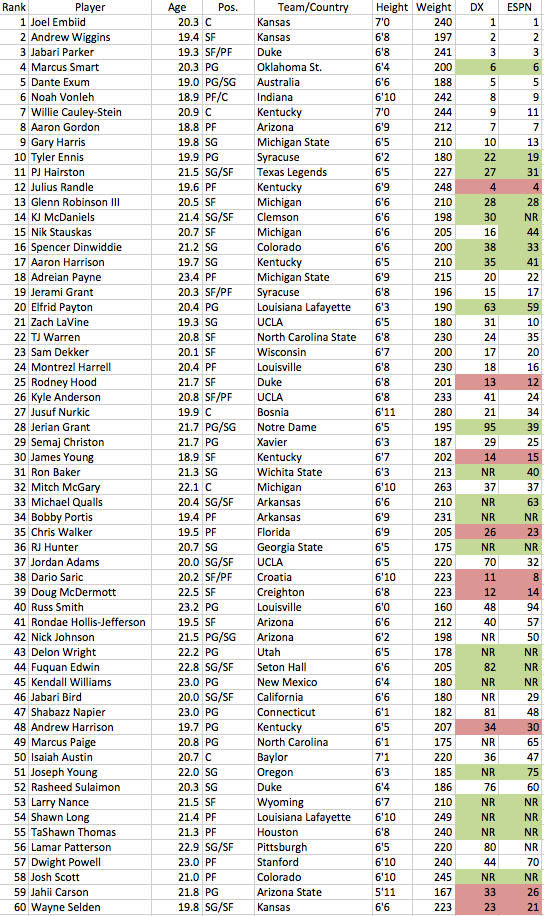
It’s time for my first big board of top 60 prospects.  Note that because internationals are less accessible for analysis than NCAA players, some highly rated ones are missing.  As the draft nears, more internationals will start appearing on the  board.

Note that age is as of draft night (6/26/14):

Of course these rankings are extremely fluid.  Notable variations from consensus:

-Marcus Smart belongs ahead of Exum as they are similar players, except Exum has significantly more downside risk since he is unproven against decent competition.  Exum may have slightly more upside, but to me it is clearly outweighed by Smart’s floor.

-Julius Randle is full of warts that will likely cause his stock to drop, which I will be sure to highlight in the near future.  Chad Ford mentioned earlier today that some NBA teams rate Vonleh as higher, and he has nowhere to go but down from #4.

-Tyler Ennis is having a fantastic start to his freshman season, and has been at his best against good competition.  He may not ooze appeal with tools and upside, but his production thus far points to him being lottery worthy.

-PJ Hairston had an excellent sophomore season and likely will climb boards as focus shifts away from his offseason woes and toward his impending D-League dominance.

-Spencer Dinwiddie drops due to his recent ACL tear, but he remains underrated.  He is a prototypical complementary SG and his intelligence will likely be attractive to analytics driven teams.

-I find it amusing that nobody can bring themselves to rate Aaron Harrison ahead of Andrew even though he is obviously the better player at this point.  They were rated similarly as high school recruits and Aaron’s skill set is an easier fit in NBA lineups, so I am comfortable with a massive rift between the two in my rankings.

-Elfrid Payton is a nice upside flier who needs more attention as a 1st round prospect.  He is reminiscent of a mid-major Rondo, as he is a productive PG with tools to be great defensively but is a horrible shooter.

-It is possible that I am too bearish on James Young, as he is young for his class and has not been necessarily bad as a freshman.  But his game does not have any elements that stand out as particularly strong, and he needs to develop quite a bit to become a useful pro.

-I do not understand how Chris Walker is rated so much higher than Bobby Portis.  He was rated slightly higher as a recruit (#7 RSCI vs #14), but Portis is having a solid start to his freshman year while Walker has been unable to gain eligibility.

-RJ Hunter is my favorite mid-major player that nobody is discussing.  He is a great shooter, and his steal and block rates suggest that he may have more defensive ability than his physical limitations would suggest.

-I do not understand Dario Saric’s rating as a lottery pick.  From what I have seen, he appears to be a slightly lesser version of UCLA’s Kyle Anderson.  This is a rating that will require closer analysis before I start preaching about it at a loud volume.

-Jahii Carson is having a disappointing sophomore season and given his age, size, and translation concerns, his value as a prospect is rapidly waning.