Yesterday afternoon I had the pleasure of recording a podcast with Frank Madden and Steven von Horn of Brew Hoop. They are both sharp, perceptive basketball minds and it was rather enjoyable to discuss the draft with them. The podcast will be split into 3 or 4 parts that will be released over the course of this week. Here is a direct link to their site where you can stream part 1 (which focuses on Andrew Wiggins) and read more detail.
When discussing draft prospects, it seems that people are often afraid to confidently assert that the scouts who drive the consensus are flat out wrong. This surprises me, since they have been wrong to hilarious degrees in the past, and will continue to be wrong going forward. They were able to recognize that LeBron James was a fairly awesome prospect, so that establishes that at least they have operative eyesight. But they also thought that Darko Milicic was half a notch below LeBron as a prospect, even though he never possessed any basketball playing ability of note. VJL recently made an excellent post on the irrelevance of hype, and I’d like to highlight some qualitative examples to show where high school scouts badly missed the mark.
Many scouts are woefully bad at assessing prospect skill level, especially in watching them go against high school competition. A recent example is UCLA’s Zach LaVine, when Chad Ford noted that a few scouts called him “Russell Westbrook with a jump shot.” Of course the only things LaVine has in common with Russell are his leaping ability and his decision to attend UCLA. Granted, he doesn’t get to show off much of his PG skill with Kyle Anderson and his virtuoso passing ability running the offense. But he also isn’t trusted enough as the backup PG, as those duties fall to Bryce Alford. And his assist rate (13.8%) doesn’t stand out from UCLA’s other wings as Jordan Adams (14.0%) and Norman Powell (12.7%) who are definitely not PG’s have similar assist rates. Ford notes that LaVine has a propensity to look for his shot instead of passing, but the fact of the matter is that he hardly has any dribble penetration skills whatsoever. On the season he is 11/28 on rim FG’s in the half-court offense, only 6’3 non-leaper Bryce Alford has fewer attempts at 10/25. Adams (44/67) Anderson (24/44) and Powell (44/73) all show vastly superior penetration ability. It is possible that his low attempts are due to lack of confidence in finishing in traffic given his thin build, but his handles look awfully pedestrian to me. He appears to be a SG through and through.
To bring back the Westbrook comparison, he led his UCLA team in assists as a sophomore in spite of playing a fair amount of SG with Darren Collison running the show. Like LaVine he didn’t get the chance to fully flaunt his PG skills, but at least he flaunted something, as the Thunder drafted him in large part to his strong performance as primary ball handler when Collison was out. LaVine has not begun to display flashes of PG skill, yet Chad Ford writes:
While he isn’t really running the point for UCLA, most scouts who have seen him in high school think he has all the tools to be a NBA point guard down the road
Why do they believe this? I don’t know, maybe they saw him dribble down the open court and finish spectacularly in transition and wrote down “POINT GOD” in their scrapbooks. If he develops his handles and passing at an inordinate rate then maybe he could be a PG, but to weigh that as a significant possibility at this stage is wishful thinking. Comparing him to Westbrook is silly so long as they have such an inordinate gap in PG skills, but many scouts are bad at deducing these sort of gaping differences so they wouldn’t know any better.
Now you may be thinking that while scouts may not be experts on deducing basketball playing ability, you gotta give credit to their ability to eye test tools. This is also wrong. Let’s take Noah Vonleh, in November of 2011 DraftExpress writes:
Standing a legit 6-8, with a 7-3 wingspan, huge hands, a terrific frame and excellent athleticism, Vonleh does not look like your typical 16-year old.
I imagine that the “excellent athleticism” was simply a commonly held belief in HS scoutings circles, as his ESPN recruiting profile notes that his “physical intangibles” include “extraordinarily long arms and bounce.” While he has done well as a freshman for Indiana, it is not due to leaping ability, as Vonleh has struggled to finish at the rim in spite of his size and length due to lackluster athleticism. To DX’s credit, they noticed that the initial assertion was incorrect and in their recent scouting video note that Vonleh is “not a leaper” and list lack of explosiveness as a weakness. But the bottom line is that HS scouts are not specially trained to deduce physical tools, and when they see a super long player like Vonleh dunking or blocking a shot, they conflate his impressive use of length with athleticism. Consequently, it is not safe to take their tool assessments entirely at face value.
Now let’s see what ESPN’s recruiting service said about Julius Randle’s future:
His reputation as a good person and hard worker will aid him as he hopes to improve and stave off competitian for his slot
This is part of a short writeup on the #2 prospect in America, and they couldn’t even spell “competition” correctly. I know this strays from basketball analysis, but most of their writeups do appear to have been translated from English to Estonian and back to English using Google translation. Here’s their bottom line on Andrew Harrison:
Bottom Line:
He raises the level of play on his team because he leads by example with a competitive nature, focus and battle tested toughness. At his size he has blossoming lead guard skills and is terrific at making plays. What separates him from the rest is in his pace of play. His game is like a stop light he can go from green to yellow to red all in a moments notice.
Maybe I’m being harsh, but when a scout’s writing is barely literate, it makes it that much harder to trust their “expertise.” That isn’t valid basketball analysis– it more closely resembles a child’s attempt at writing poetry.
For all intents and purposes, high school scouts are casual fans who try their best to offer their best NBA projections of high school prospects. Aside from the fact that extrapolating a player from high school to the pros is exceptionally difficult, it’s not a particularly prestigious position and does not attract the sharpest basketball minds. They are smart enough to know that LeBron James is great when they see him play, but they also have a number of baffling false positives. If any of us actually met a collection of high school scouts and had the opportunity to pick their brains, I doubt we would come away with the sensation that they possess any sort of expert wisdom that we lack.
In order to maximize efficiency in prospect analysis, stuff like pedigree and hype should be almost entirely disregarded. There may be exceptions for a player like Bradley Beal who was reputed as an elite shooter but ran cold from outside as a college freshman. But when top prospects such as Andrew Wiggins or Julius Randle show troubling signs for their future, people seem slow to accept the relevance of these signs, as they feel that obvious warning signs are superseded by high school hype. The bottom line is scouts don’t have any advantage over an intelligent basketball fan in information (at least not once we get a sizable college sample), analytical ability, or even expertise in assessing tools. Personally I try to glean why they felt the way they did, take the perceived strengths for what they are worth, and then discard all bottom line conclusions as it is only noise that will dilute my own analysis. Giving any more credence than that only leads to skewed perceptions and wrong conclusions.
This weekend I tweeted that Joel Embiid is the 6th best prospect of the past 20 years (behind LeBron, Duncan, Durant, A Davis, Oden), and a number of reasonable minds disagreed with me. There is an argument to be made that Yao and Dwight were superior, although the problem with prospects lacking info is that sometimes you get Darko. Other suggestions included Blake Griffin, Allen Iverson, Elton Brand, Andrew Bogut, and Michael Beasley. Many of these suggestions came from Layne Vashro (@VJL_bball on twitter) who does an excellent job statistically modeling the draft, and were echoed by others. This suggests that it is time to explore the facets of Embiid’s game that make him so much more enticing than the raw numbers would suggest.
Embiid has excellent statistics for a soon to be 20 year old freshman, but not historically great numbers. He has strong shooting percentages as he is both efficient from the floor with a 62.9% eFG and has a strong FT% for a young 7 footer at 68.5%. His rebounding and block totals are excellent, and his steal and assist totals are strong. This is all somewhat mitigated by his exorbitant turnover rate, and he also does not score with exceptionally high volume (his usage rate is 24.4 but that’s largely padded by his turnover rate). Further, while his defensive stats are excellent, he is not a pristine defensive player, as he is still mastering fundamentals such as defending the pick and roll (covered in my post on his defense vs Ok St.)
This leaves two conflicting schools of thought to assess the merit of Embiid’s performance. One is that he stuffs the stat sheet far better than expected for a player lacking experience, and he will grow at a faster rate than normal going forward as he catches up to speed with his peers. The other is that lack of experience is not necessarily an advantage, since he missed key developmental years that have caused warts not seen in the statistics (i.e. pick and roll defense).
The latter case does have merit. Based on the numbers alone he appears to be a Greg Oden level defensive prospect, but it simply cannot be taken for granted that he develops a masterful basketball IQ and eliminates a large portion of his mistakes on that end. This also can be applied to his offensive game, as it is much easier to make an impact on sheer size as a 7 footer in college than it is in the NBA. An example of this would be Hasheem Thabeet, whose stats as a college junior don’t look woefully different from those of Embiid. He shares good FG% on only slightly lower volume, as well as an excellent block and rebound rate. Embiid does have a much better assist rate, but Thabeet’s turnover rate is lower as well. All of Thabeet’s stats came after two years of college experience to merely become comparable to Embiid, but that’s not particularly re-assuring when he has completely flopped as a pro.
So before lack of experience can be construed as a positive, it is worth addressing what makes Embiid more than a slightly more advanced Thabeet. First, Thabeet was almost exclusively a finisher. Before the 2009 draft, DraftExpress had an excellent writeup about Thabeet’s lack of offensive creation based on situational stats. Further, he grew leaps and bounds from his freshman season where he had a 14.9% usage rate and 96.1 O-Rtg to a 19.5% usage rate and 118.0 O-Rtg. For reference, Embiid has a 24.4% usage and 112.2 O-Rtg thus far this year. Even the average giant needs a bit of time before discovering how to dominate a bunch of comparative midgets, which is why limited production was expected from Embiid this year as he started the season as a bench player. If he were to stay in school for 3 years and progress at Thabeet’s rate, he would likely post mindblowing statistics that insist that he is a historically elite prospect.
The fact of the matter is that Embiid is an outlier by virtue of going from inexperienced player to college star instantaneously. The only other player to be this good this early is Hakeem Olajuwon. As a freshman, Hakeem was 10 months younger, but he had the advantage of practicing with the team in his prior redshirt season. Also Hakeem played fewer minutes per game. (18.2 vs 23.1). These stats are pace adjusted per 40, as Hakeem’s Phi Slamma Jamma Cougars played at a faster pace than Kansas (~75 possessions/game vs 68).
Player
PTS
FGA
eFG%
FTA
FT%
Hakeem
16.4
10.2
0.607
7.1
0.563
Embiid
19.4
10.6
0.629
8.8
0.685
Player
TRB
AST
STL
BLK
TOV
PF
Hakeem
12.2
0.7
1.8
4.9
2.8
5.8
Embiid
14
2.3
1.5
4.5
4.1
5.8
Embiid stacks up fairly well, and this is with Kansas playing the toughest schedule in the nation (according to cbb-ref, Kansas’s average opponent is 11.9 pts above average, Houston’s was 7.5). Hakeem’s steal advantage is for all intents and purposes negligible, given the SOS difference, the fact that steals are down this year due to handcheck rules, and the fact that Bill Self preaches an anti-gambling style defensively. Hakeem does also have a small advantage in blocks, but Embiid has been better on the boards. Also for those concerned about Embiid’s foul rate, it is identical to that of Hakeem. I have no idea how Hakeem’s defensive fundamentals were as a freshman, but if nothing else the numbers portray the two as extremely close on that end.
Offensively is where the two begin to differ. Embiid gets more points and assists with better shooting percentages, but also turns it over much more. This seems to suggest that Hakeem was used as more of a finisher whereas Kansas frequently runs their offense through Embiid. Embiid scores the vast majority of his points in the half-court (he is just 9/12 on transition FG’s), where he is double teamed nearly every time he touches the ball. Unlike Julius Randle, he rarely turns it over attacking double teams, as he is quick to dribble away and kick it back out to the perimeter. Other times he waits for the double to go away before attacking. Suffice it to say that defenses invest quite a bit of effort in preventing Embiid from getting in a position to finish easily, which explains why his shooting volume isn’t higher. But in spite of being often used in difficult circumstances, he is surprisingly effective as he uses he elite skill level to create and finish. He has excellent coordination, footwork, touch around the rim, and instincts that cumulatively creates a highly intriguing upside.
Embiid’s turnovers are a bit worrisome, but many of them can be easily cut down. 3 of his 68 turnovers have come from technical fouls, and a healthy portion have come from offensive fouls. Some of these are not especially concerning since it is only a matter of time before he learns how to establish position in the paint without fouling, for instance. He also turns it over on his passing attempts, as sometimes when he is doubled he makes risky cross court passes to the perimeter that go awry. Other times he may throw away simple entry passes from the top of the key. Without having charted anything, he seems to turn it over on bad passes more often than he does in trying to create his own shot.
While the turnover gap between Embiid and Hakeem may appear to be slightly unsettling, I do not believe it necessarily means that Embiid was worse offensively as a freshman. The fast pace of Houston implies that Hakeem likely had more easy buckets in transition than Embiid, and he would likely have quite a few more turnovers if he was used as a passer/creator more. While Hakeem was the more explosive athlete, it is a reasonable hypothesis that Embiid had a higher skill level as a freshman, as crazy as that sounds. At least he has played a slightly more demanding role in Kansas’s offense than Hakeem did for Houston.
Does this mean that Embiid is as good of a prospect as Hakeem? Absolutely not. Hakeem improved quite a bit over the next 2 years and then continued to develop exceptionally well as a pro. But when the only frame of reference to start playing at a young age and post similar numbers as a freshman became an all time great player, it is a strong check mark in favor of lack of experience being a positive for Joel Embiid specifically. On a scale of Hasheem to Hakeem, Embiid’s start closely aligns with the latter while the former is completely left in the dust. Perhaps on average starting late is not advantageous for future growth rate of 7 footers, but Embiid is clearly not an average prospect. I do not believe that prospects such as Hasheem Thabeet or Fab Melo are valid frames of reference when they have nowhere near the skill level of Embiid, and could never come close to doing this:
The problem for unskilled bigs is that when they face competition that can physically match up, they lose a ton of their production. When Embiid moves on to facing NBA bigs, he will maintain the advantage of his unique skill level which bodes well for his ability to translate. And not only do we need to bear in mind that he is starting at a much higher skill level than the average African giant, but if he is able to figure out how to perform so well so early it is worth wondering whether he is also a uniquely fast learner. While there is plenty of easy improvements to his game in cutting turnover fat and mastering defensive fundamentals, it cannot be taken for granted that he will do so as well as one would hope. But when he has smashed expectations as a freshman, there is reason for at least slight optimism regarding his future growth ability. This is especially true when he has also displayed a basic competence in learning on the court.
Overall my intuition is that Joel Embiid’s freshman stats comfortably underrate his NBA upside when taken in a vacuum. They are all accrued in the half-court receiving a ton of defensive attention, when he was expected to be nowhere near ready to perform at this level. Further, a well built NBA team will be able to offer him better spacing. If he can master defense enough to become a solid rim protector and develop into a more reliable passer, he can be an overwhelmingly powerful piece to build around. Surround him with four shooters and teams are forced to either double him and likely cede an open 3, or single cover him and let him cause damage in the post. This is why he stands out over other past #1/2 picks. Andrew Bogut had solid offensive numbers in college, but didn’t have the skill level to project as a great scorer in the pros. Blake Griffin projected to be a poor defensive PF with a somewhat limited half-court offensive repertoire. Allen Iverson is a 5’11 guard that neither excels as a shooter nor distributor. Michael Beasley was able to get some steals and blocks in college, but was never anywhere close to competent defensively. None of these players ever had much of a prayer of becoming top 10 players of all time. Embiid certainly has a long way to go and is a clear longshot to get there, but there is also nothing obviously holding him back. Questions about his defense linger, but if Hakeem was able to become an all-time great defensive player then why is it impossible for Embiid to do likewise? Embiid is less of an explosive athlete, but he has good tools overall, and his ability to master the mental aspect of defense is what will make or break him on that end.
The draft is sort of like video poker, in that a huge portion of upside value lies in the upside tail. In video poker a large percentage of expected value comes from the outside shot of binking a straight flush, and NBA prospects are not all that different. If we assign Embiid just a 2% shot of becoming the next Hakeem or better, that carries massive value as a player of that magnitude completely changes the value of a franchise. And the good news is that he can peak well short of Hakeem and still provide an excellent return on a #1 overall pick. So if we are willing to buy that he has an inkling of hidden super upside that the average #1 pick such as Blake Griffin, Allen Iverson, or Andrew Bogut lacks, it is worth enough value to set him apart from the pack.
Some may be inclined to devalue Embiid for his proneness to minor injuries, as he already had to sit out a game vs TCU with some minor knee and back issues. And in a recent game against Oklahoma State he appeared to aggravate his back injury, which bears monitoring going forward. It is reasonable to devalue his draft stock slightly, but even if we price in a 10%-20% chance that his career gets completely derailed by injuries (I would say the latter is an aggressive projection given such minor injuries), that is significantly less impactful than the aforementioned 2% super upside. Simply put, Embiid is a unique prospect with no obvious cap on his upside, and even treating the experience factor as neutral he has a higher floor than most. He is a rare prospect that is drawing live for the metaphorical royal flush, and GM’s are justified in losing on purpose for a shot of playing his hand.
After Marcus Smart shoved a fan and received his 3rd technical foul of the season, I wrote about the correlation between technical fouls and defense in the NBA. As tempting as it was to anoint him as a future defensive star on this alone, playing good defense in games is still important, too. I compiled a video of his performance vs. DeAndre Kane and Iowa State, which will surely be the toughest matchup he faces all year. Kane is a 6’4 200 PG who turns 25 in June and is having a great season under Fred Hoiberg, as he is vying with Smart and Andrew Wiggins for Big 12 Player Of The Year. Also this should shed some light on why Oklahoma State has struggled so much with Mike Cobbins’s injury, as Smart has been forced to play minutes as an undersized PF instead of permanently wreaking havoc as a great perimeter defender.
I believe this game exemplifies what Smart brings to the table on defense. It seems that nobody wants to discuss him as a defensive superstar because he doesn’t have the super quicks and athleticism of a prospect like John Wall, but everything else about him is so elite that he may be great anyway. He is listed as 6’4 220 with a 6’8 wingspan, and it may not be long before he is the physically strongest PG in the league. Each of Iowa State’s bigs tried backing him down, and none of them could push him too deep. DeAndre Kane is strong for a college PG and was hopeless trying to post up Smart. Smart’s strength will aid him in fighting through screens in the NBA, and he has the size to match up with PG’s, SG’s, or even the occasional SF. While he is considered a bit of a tweener, his defensive versatility and ability to cross match automatically makes him one of the good variety. He makes an excellent pairing with guards such as George Hill or Avery Bradley, as either would create a dynamic defensive duo with awesome matchup flexibility.
Even though he only had one steal this game, it may be the most impressive steal I have witnessed this season. I do not believe anybody else in the 2014 draft class can both make the lightning quick mental reaction and have the tools to close out and intercept the pass. Smart is a steal generating machine, and there is no gimmicky press or zone defense involved, just honest to goodness defensive domination. Oklahoma State plays mostly man to man defense, and prior to Smart’s arrival Travis Ford has never coached a defense that forced many turnovers. His best rank in defensive TOV% prior to Smart’s arrival is 160th in 2008-09, and they have ranked 77th and 87th in each of the past 2 years respectively. This is entirely due to Smart, as he has 31% of his team’s steals in 14% of their minutes played, and as a freshman he had 40% (!!!) of his teams steals in 16.4% of their total minutes. Among regular rotation players this year, Smart has a 4.6% steal rate and the second highest is Brian Williams at 2.3%. Fringe prospects Markel Brown (1.4%) and Le’Bryan Nash (1.1%) create a small fraction of the steals that Smart does. As a freshman he boasted a 5.3% steal rate which was more than double any of the Cowboys’ regular rotation players.
Further, Oklahoma State’s opposing eFG% has flourished since Smart’s arrival. Ford had some defenses that forced difficult shots at UMass, but in his first 4 seasons at Oklahoma State they ranked 219th, 136th, 71st, and 122nd respectively in eFG% defense. In Smart’s two seasons they have ranked 27th and 49th. This is less directly attributable to Smart, but there is a good case to be made that he deserves more credit than any other Oklahoma State player for this recent leap.
Of course the counterpoint to all of this is that he cannot shoot. Even if he is the next Tony Allen defensively, he needs to set himself apart from Tony Allen offensively to justify a top 5 pick. His overall offensive stats are comparable to those of senior Tony Allen, except he is posting them at 2+ years younger. His poor shooting is mitigated by his handling, passing, and finishing ability, and he also excels at getting to the line and making his free throws at a decent clip. Also his shooting woes are mitigated by the fact that he understands that 3 > 2. He is shooting 29.3% from 3 and 30.2% on non-rim 2’s, which unfortunately compares to Aaron Gordon who is shooting 32.3% from 3 and 27% on long 2’s. But his overall eFG on non-rim shots is 39.5% vs Gordon’s 31.2%, simply because he knows not to relentlessly launch long 2’s and Gordon doesn’t. His free throw percentage offers an inkling of hope that he can develop into a respectable 3 point shooter in the pros, after all he shoots an awful lot off the dribble with just 56% of his 3 point makes coming assisted this season.
A common comparison for Smart is Tyreke Evans, and I do not believe it is an unflattering one. Evans was worse from both 3 (27.4% vs 29.2%) and FT (71.1% vs 76.0%) in college, his shot has developed poorly in the pros, yet he is still a capable scorer. He had similar efficiency on higher usage (33 vs 28) to Smart as a freshman, but as a sophomore Smart has cut down on his turnovers to improve his efficiency and surpass Evans’ overall freshman stats by a slim margin. Being behind Evans as a collegiate scorer is not the worst thing in the world, as Evans appeared to be on the path to stardom as a rookie before regressing. Between Smart’s work ethic, competitiveness, confidence, and the fact that he probably will not be drafted by the Kings, he has a strong shot of developing much better than Evans as a pro.
A common critique of Smart’s game is that he bullies smaller competition and this will not translate. This critique is poorly founded. Opposing teams are aware of Marcus Smart and what he does on the basketball court. They don’t simply let him post up 6’0 point guards ad nauseum. Believe it or not, they will often use their bigger wing players to match up with him because they noticed that he is 6’4 and built like a linebacker and good at basketball. It’s not costly for them to do this either, as he is never the smallest player on the floor for Oklahoma State in spite of being the PG. He may not be able to fully translate his FT rate, but he should prove adept at getting to the line in the pros as he will continue to have a significant advantage in strength over opposing guards.
The important questions regarding Smart are his shooting ability and his ability to run an offense. If either of these were stronger, he would be in the conversation for a top 3 pick. But between his array of skills and his elite intangibles, he has a decent shot of nevertheless becoming a valuable offensive player who is a force defensively. And even if he never quite pans out offensively, he can still be better than Tony Allen on that end with similar or slightly worse defense. In short, he should be at least as useful as Tony Allen a significant % of the time and he has clear star upside as well. That may not be enough to merit top 3 consideration, but after Embiid, Exum, and Parker there is no clear #4 and I believe Smart makes as compelling of a pick as any other prospect in that slot.
The word “tweener” has become a common draft lexicon to describe players who are stuck between positions. It normally carries a negative connotation, but is not always fleshed out. And not all tweeners are created equally, in some cases it can be a strength. It largely depends on how each player’s offensive fit meshes with his defensive fit. I’ll run through some examples from this draft to demonstrate my interpretation of a few players’ tweener relevance:
Good Tweener: Jabari Parker
Parker’s concern is that he is too small to play PF and too slow to play SF. This is valid to an extent, but nobody is projecting him to be a positive defensively. He only needs to not be a sieve so teams can get his offense in the lineup, and I believe he certainly has the tools for that. I quite like him as a PF, he’s 6’8 235 lbs with a 7’0 wingspan. He plays like he weighs 300 lbs, as he doesn’t mind getting physical in the post and rebounds well for his size. Further, his length enables him to average 1.7 blocks per 40 minutes. Playing at PF mitigates the impact of his lack of quickness, as he will spend less time defending wings on the perimeter. He is listed as having an 8’8 standing reach at DraftExpress, which is lower than you’d expect for a player with his height + length and is a mild concern. But I’d like to see how he measures at the combine before harping on this too loudly, as reach measurements are not always done with precision. For reference Carmelo Anthony is half an inch shorter with the same wingspan and measured with a 8’9.5 reach, and he has performed extremely well as a small PF paired with Tyson Chandler at C. Parker shows similar potential to be an elite stretch 4, as if you surround him with a strong defensive center and three shooters, you have a synergistic NBA lineup.
While I would err on the side of giving Jabari PF minutes, he also does have the capacity to play SF. He has the perimeter skills to play on the wing offensively, and his size and length may atone to prevent his quickness issues from holding him back too much. Further, it is possible that he proves to be more adept at defending the perimeter than the post, so this gives an alternative means of success if his lack of reach causes him to struggle to defend bigger PF’s.
Although he’s not a perfect fit at either position, the fact that Parker can fit in well enough at either position to get his offense into the lineup is a bit of a bonus. And even if he doesn’t find a niche where he can play solid defense, his offense still may outweigh his defensive shortcomings as is the case for his upside comparison Carmelo Anthony.
Bad Tweener: Aaron Gordon.
Earlier I wrote about Aaron Gordon’s shooting woes. He almost certainly will not be able to play the wing offensively in the pros, and needs to focus on adding strength and developing a post game. PF is clearly going to be his niche offensively, but his main appeal is the defensive upside that his tools offer. And as far as I can tell, he has much better tools to be a perimeter stopper than a post presence. He is listed at 6’9 with a 6’11.5 wingspan and an 8’10.5 reach, which is adequate to play PF, especially with his athleticism. But he only weighs 212 pounds, and being below average in all of length, reach, or strength it makes it a bit more daunting of a proposition. Further, using him at SF does not capitalize on his lateral quickness that offer promise for his potential as a perimeter defender. His ideal situation would be to pair him with a perimeter shooting PF such as Ryan Anderson, and play him in the post offensively and on the perimeter defensively. But that makes it a pain to build around him as an integral part of your core, as it disqualifies the majority of starting PF’s as plausible pairings and precludes an offense from ever being perfectly spaced with 4 shooters. His synergy between his offensive and defensive skill sets are quite messy, and frankly he doesn’t offer enough upside promise to be worth the hassle as a top 20 pick.
Tweener comparison: Kyle Anderson vs Dario Saric
I have mentioned that these players strike me as similar, as they are both tall ball handlers who lack burst. They also both have questionable outside shots, and offer much more appeal playing as primary ball handlers than complementary pieces on offense. They are both best served to play PF, since it is easier to pair them with a SF who can shoot than it is to find a floor spacing PF. It also is ideal to mitigate the defensive issues caused by their lack of quickness. There is quite a bit of value to these two players fitting into NBA lineups at PF. Saric is 1.5 inches taller (6’10 vs 6’8.5) and DX lists him as a possible SF/PF whereas Anderson is listed as a possible SF, so one may initially be inclined to give the edge to Saric. But Anderson has a much longer wingspan at 7’2.25 vs 6’10, and his 9’0 standing reach is likely greater than that of Saric as well. Further he is listed at 233 vs 223 and is possibly slightly stronger. It’s not by an enormous margin, but if Anderson does indeed have the edge in all of length, strength, and reach it is a significant advantage over Saric. Ability to defend bigger positions is always a bonus, but it is especially helpful for players in their offensive mold.
Bad Tweener That Isn’t Too Bad: Nick Johnson
Johnson is the classic SG in a PG’s body. He has good tools and defensive acumen defending the perimeter for the best defense in the nation, but he is just a bit small to regularly defend SG’s. DraftExpress lists his height at 6’2.5″ with a 6.5.5″ wingspan, which makes him big enough to only situationally defend SG’s. But since he doesn’t have the PG skills to run an offense, he will likely be available in the 2nd round. But that doesn’t make him necessarily difficult to fit into NBA lineups. If his outside shot develops well he can be a 3 + D PG in a lineup where a taller player runs the offense. A team with a big PG such as John Wall, Deron Williams, Michael Carter-Williams, Marcus Smart, or Dante Exum could pair him with their bigger point guard and cross match accordingly. He also fits well alongside ball dominant stars such as Dwyane Wade and LeBron James, as he could fill the Mario Chalmers role in Miami. There is a common perception that the smaller player on the court should necessarily run the offense, and this isn’t true. He’d be a significantly more appealing prospect if he was 2-3 inches taller + longer, but he remains an appealing 2nd round flier for a team that has a bigger ball-handler to pair him with.
What happens when an unstoppable force meets Adriatic League big men? You get Jusuf Nurkic (25th DX, 33rd ESPN), a 19 year old big man prospect who is currently terrorizing European basketball. He is still raw as he has only been playing basketball since 2009, but his stats per 40 minutes closely parallel those of DeMarcus Cousins as a college freshman:
Player
PTS
FGA
eFG%
FTA
FT%
Cousins
25.8
16.5
0.56
12
0.604
Nurkic
28.4
17.6
0.559
11.7
0.705
Player
TRB
AST
STL
BLK
TOV
PF
Cousins
16.8
1.7
1.7
3
3.5
5.5
Nurkic
12.8
1.6
2.5
2.2
3.7
8
Nurkic is a better FT shooter and gets more steals, Cousins is a better rebounder and gets more blocks, and other than that they are statistically dead ringers for one another. Nurkic also fouls more as he only plays 16.1 mpg vs Cousins’s 23.5.
Physically they are both massive human beings as Cousins weighed in at 292 at the draft and Nurkic is listed at 280. They are both 6’11, but Cousins has longer arms with a 7’5.5″ wingspan vs 7’2″, 9.5″ reach vs 9’1.5″. Nurkic atones for this with a significant advantage in quickness, and neither of them are explosive athletes. It’s arguable that Cousins has superior tools overall, but if so it’s likely by a slim margin. And they are going to share the same draft night age if Nurkic declares, as their birthdays are 10 days apart.
You may be wondering how the Adriatic League compares to the SEC, and whether we can trust such a small sample from Nurkic (the stats were posted in 322 minutes). First to address the latter, these stats are somewhat cherry picked. Nurkic’s Eurocup stats are far worse, as his PER falls off from a mammoth 35.0 down to a humane 22.2 in 210 minutes. His turnovers rise, his rebounds plummet, and he scores less. He also gets fewer steals, but on the bright side he gets more blocks at 3.5 per 40, which is a sign that his lack of athleticism doesn’t cripple him. The split is likely due to both sample size variance and Nurkic facing (literally) stronger competition in Eurocup. It could be argued that his translation to matching up against stronger post players bodes ill for his NBA future, but then again his numbers still aren’t bad for an inexperienced 19 year old going against adult men.
This good news is that the leagues Nurkic is playing in offer a much higher level of competition than the NCAA. He currently plays on a team with 3 former major conference NCAA stars who are now in the prime of their careers. I took their Adriatic League PER, Eurocup PER, a minute weighted average of the two, and compared it to their senior year PER:
Age
Adriatic
Eurocup
Average
NCAA Senior
Nolan Smith
25
16.5
18.8
17.5
26
Allan Ray
29
10.1
12.4
11.2
21.7
Goran Suton
28
11.5
17.9
14.1
23.3
Granted, this quick and simple analysis may overstate the gap between NCAA and the European competition that Nurkic is facing, as Ray had a PER in the low 20’s in 12-13 as did Suton in 11-12. But the fact remains that players who starred for college programs during their developmental years generally fail to exceed their college production at this level of competition in the prime of their careers. For inquiring minds: Nurkic’s weighted PER is 29.8 and leads the team. Second is Miro Bilan at 21.8 and Nolan Smith is 3rd. Their team is fairly successful as they have a 15-5 Adriatic Record and a +3.6 point differential, and are 8-7 in Eurocup with a +2.7 PD.
For a quick and dirty comparison: consensus lottery prospect Dario Saric (11th DX, 9th ESPN) plays in the same leagues, and he has posted a 24.1 Adriatic PER and a 16.5 Eurocup PER while being several months older. As usual PER doesn’t tell the full story, as Saric is in a different mold. Saric accrues an Evan Turner-esque combination of points, rebounds, assists, and turnovers as the primary ballhandler, with a questionable shot and tools that cause translation concerns. We have already seen Evan Turner erroneously get selected before DeMarcus Cousins before, so the fact that history may be repeating itself with Saric and Nurkic is delightfully juicy to me.
The most similar NBA prospect to Nurkic who has come from the Adriatic League is Nikola Pekovic. Pekovic was the 1st pick in the 2nd round in 2008, but in reality his draft stock was higher. Teams refrained from selecting him in round 1 due to the belief that he was unwilling to come to the NBA for a mid-1st round salary, and by selecting him in round 2 the Timberwolves were able to offer him a 3 year $13.3 million contract to entice him across the ocean. Later Pekovic returned to the Adriatic League for 10 games during the 2011 NBA lockout at age 25 before returning to the NBA to have his breakout season. Let’s compare each sample as well as Pek’s 19 year old season (where he was really 8.5 months older than Nurkic is currently) to that of Nurkic (all statistics per 40 mins):
Player
PTS
FGA
eFG%
FTA
FT%
Nurkic
28.4
17.6
0.559
11.7
0.705
19 y/o Pek
17.6
9.8
0.615
7.3
0.765
21 y/o Pek
24.6
13
0.684
8.6
0.797
25 y/o Pek
27.1
12.9
0.692
12.9
0.723
Player
TRB
AST
STL
BLK
TOV
PF
Nurkic
12.8
1.6
2.5
2.2
3.7
8
19 y/o Pek
8.6
0.4
1.6
1.5
3
7.9
21 y/o Pek
8.9
1.2
1.4
1.4
2.4
5
25 y/o Pek
10.9
1.2
1.2
1.6
3.4
3.4
First note how incredibly distant from Nurkic’s production Pek was at a similar age. He also shared Nurkic’s exorbitant foul rate, which is a sign that we should likely not fret too much over this. By the time he declared for the draft, Pek was a much more polished prospect as reflected in his shooting percentages and foul rate, but Nurkic clearly has much more upside. He accrues points, rebounds, assists, steals, and blocks at a faster rate in spite of being far younger. The blocks and steals are especially encouraging since Pek’s defense strongly inhibits his value as an NBA player. It doesn’t mean that Nurkic will necessarily be better on defense as his defensive fundamentals need work, but his potential is clear.
Again, this is somewhat of a cherry pick since we aren’t including Nurkic’s Eurocup stats. But Pek’s stats also fell off in Eurocup play. He has a career 25.2 Adriatic PER and in those seasons in which he played in the Adriatic he averaged a 20.9 Eurocup PER. It’s not as pronounced as Nurkic’s dropoff, but even if you combine the two leagues Nurkic stands out as the more exciting prospect. Pekovic’s weighted PER between the two leagues pre-lockout was 27.9 (Nurkic’s is 29.8), and then he went on to drop a 21.4 NBA PER.
The undeniable conclusion from this analysis is that Nurkic is posting outliery good statistics for a 19 year old European prospect. I am still acquainting myself with the world of European basketball to glean the meaning of this, but at a glance I cannot find many busts who statistically dominated similar competition. Really I am struggling to find any international prospects at all who posted Nurkic level statistics. Jonas Valanciunas seems to be on par, as he posted a 25.2 Eurocup PER at age 18 and 27.0 at age 19. Valanciunas also has better tools, so it makes sense to qualify Nurkic as an inferior prospect. But that also sets the bar awfully high, as Valanciunas posted a strong 20 year old rookie season and has plenty of room to grow; he was clearly the best prospect other than Kyrie in the 2011 draft and I believe he would merit top 3 consideration in this draft.
So why does Nurkic not merit top 5 consideration? On one hand he is raw and needs to cut his fouls and turnovers as well as improve his basketball IQ. But that description also applies to Joel Embiid, and it has not prevented scouts, GM’s, and myself from drooling all over him. Nurkic may have more translation concerns than Embiid since he’s so reliant on his strength, and that’s a topic that I will explore before anointing him as a future stud at a loud volume. But he’s playing at an inordinately high level for such a young and inexperienced player, and it does seem that his tools will enable him to translate enough of his production to become a good NBA player. If he proves to excel at learning and developing, he might provide a monstrous return for whatever team gambles on him.
If nothing else, Nurkic is one of the more unique and intriguing prospects in this class. I ranked him 11th on my recent big board, which was a semi-conservative ranking pending further investigation. I still have plenty of analysis to do before arriving at a confident assessment, since the Adriatic League is much less familiar territory for me than the NCAA. But the more digging I have done, the more captivated I have become with Nurkic, and at this point I cannot fathom how he is not worth a lottery selection.
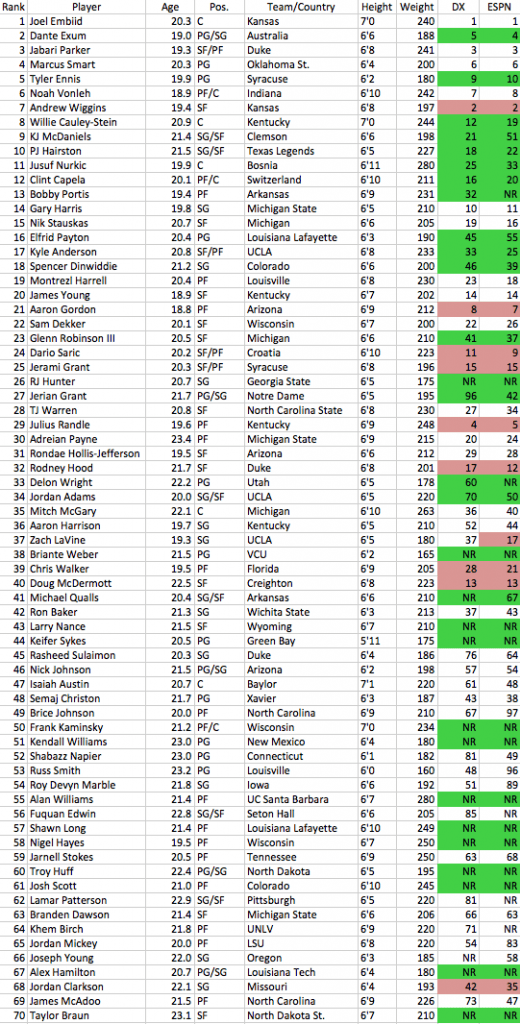
Age is as of draft night (6/26/2014). I still need to catch up on a few internationals, but it’s looking like we are going to have 4 important ones in this year’s crop, and I have included all of them in this iteration:
Notable Exclusions:
Wayne Selden (26th DX, 27th ESPN)
CJ Wilcox (35th DX, 28th ESPN)
Jahii Carson (38th DX, 31st ESPN)
This draft is shaping up to have 3 clear prizes: Embiid, Exum, and Parker. Marcus Smart would have been able to challenge Parker for #3 if not for his shooting woes. Tyler Ennis’s stock is inhibited by his lack of tools and current NBA PG depth. Noah Vonleh’s warts keep me from getting too high on him, but he still has quite a bit of upside intrigue.
People may think I’m being too harsh with my ranking on Andrew Wiggins, Aaron Gordon, and Julius Randle, but I think I am giving them all quite a bit of leeway to prove me wrong. I have them all as 1st rounders and Wiggins as early lotto, after all.
Willie Cauley-Stein is dropping too far. There are reasons to be skeptical of his odds of success, but there’s a limit to how far you can drop a player with his tools and possible defensive impact. DX’s rank of 12th is reasonable, ESPN’s rank of 19th is not.
DX is starting to catch up on McDaniels, Hairston, and Portis all being underrated. ESPN is much slower to pick up on sleepers.
For my money, KJ McDaniels is the best NCAA player in the country. He has been posting some ridiculouslyinsaneFebruarybox scores. Casuals can have their Ougie, I’ll take 2 way superstar KJ. Shame that he goes to waste on that woeful Clemson team.
I have been doing some digging on Jusuf Nurkic and Clint Capela, and they both carry a good deal of intrigue as upside picks. If I am gambling on a mystery box, I feel much better than them than college freshman such as Aaron Gordon or James Young.
I am warming up to UCLA’s Kyle Anderson. His lack of quicks and athleticism are problematic, but he is so big, smart, and skilled that he can’t be sold too short.
Spencer Dinwiddie and Jerian Grant are underrated due to their seasons being over prematurely, and there’s a strong chance that neither of them is in this draft class. But that does not diminish their appeal to me. I have a suspicion that the wrong Grant brother may be getting the hype, as Jerian is a much easier fit into an NBA lineup.
Things become incredibly fluid from 19 down. I am softening my anti-Saric stance until I am able to attain a thicker slice, but I still do not see what he offers that Kyle Anderson does not.
Briante Weber is an interesting new addition to my board. His steal rate is off the charts, and anybody who is an outlier on defense is going to catch my eye. He will likely become a prospect of note at some point as he breaks prediction models that heavily price in steals.
It’s time to put the Zach LaVine hype train on hold. He can jump, he can shoot, and as far as I can tell that’s pretty much it. I have a hard time getting excited for him until he shows some discernible basketball skill beyond shooting. I like that DX is right there with me. They are clearly sharper than ESPN on average.
Jordan Clarkson has an impact on others that completely and utterly mystifies me. He is good but not great upperclassmen with OKish tools playing on a fringe tourney team, yet everybody wants to discuss him as a 1st rounder. DX and ESPN are the least guilty, as I often see random mocks that have him in the 1st round and nbadraft.net has him as the #14 overall pick. Can somebody fill me in on what joke I’m missing here?
A common critique of Andrew Wiggins’ game is that he plays passively, but passive is a slippery word that is often misconstrued. Wiggins’ passiveness comes in a different flavor than the traditional narrative of not looking for his shot. He seems to be carrying the correct level of usage based on his offensive skill set, so it would not be advantageous for him to shoot more frequently. The problem is rather that he has been unable to convert his spectacular tools into dominant play. In spite of his tremendous first step, he hasn’t regularly blown by his opponents in the half-court. In spite of his explosive athleticism, he hasn’t finished strong at the rim in traffic. In spite of his quick feet, he has often gone under screens when he has the tools to go over and still keep pace with his matchup. In spite of all of his explosiveness, mobility, and length he hasn’t generated a particularly impressive steal rate (although his steal rate isn’t bad). I recently wrote about the importance of synergy between tools and skills, and Wiggins seems to lack the skills to capitalize on his tools and produce at a superstar level as advertised.
He has managed to be a good college player nevertheless, as he has been an effective transition scorer and wing defender. But I have not seen signs of him using his tools in a way that screams future NBA superstar, so I checked the stats to see how he compares to past toolsy wing prospects. I used Paul George’s sophomore season, everybody else’s freshman year. Note that Opp D-Rtg is as per kenpom.com, and adjusted O-Rtg adjusts each player’s usage (1.25 pts of O-Rtg = 1 pt of usage) and strength of schedule to match that of Wiggins:
Usage
O-Rtg
Opp D-Rtg
Adj O-Rtg
Steal%
Kevin Durant
31.5
116.9
99.8
125.4
3.0
Carmelo Anthony
27.8
113.6
96.4
121.6
2.3
Jabari Parker
31.5
113.5
100.5
121.2
2.1
Marvin Williams
20.4
119.9
96.6
118.3
2.5
Luol Deng
23.7
110.6
95.9
113.8
2.4
Thaddeus Young
23.2
112.9
99.5
111.4
2.4
Andrew Wiggins
24.5
110.6
99.6
110.6
1.8
Harrison Barnes
24.9
106.5
98.2
108.5
1.3
Quincy Miller
23.0
107.5
98.1
107.2
1.6
Paul George
27.6
105.1
101.8
106.6
3.9
Rudy Gay
19.7
107.4
99.2
101.8
1.5
Kevin Durant is miles ahead of everybody. Not only was he an elite freshman player, but he has improved by leaps and bounds every season in the league. At this point it is safe to say that Wiggins is completely drawing dead to be Durant level good. Melo and Jabari are also well ahead of him statistically, as Jabari continues to look Melo-esque.
It seems that many people have yet to open their minds to the possibility that Wiggins will be as underwhelming as Marvin Williams, which is silly. Williams was straight up better as a freshman, and sometimes good toolsy players just don’t develop the way people would hope. Wiggins finds himself sandwiched between fellow 5 star freshmen Luol Deng, Thaddeus Young, Harrison Barnes, and Quincy Miller. While his tools are superior to those players, it is a solid group to estimate his baseline value. I especially like the Thaddeus Young comparison since he shares Wiggins’ 3 + D + transition skill set. (Rudy Gay is also there, to provide a baseline.)
Sophomore Paul George is behind all of the freshmen, and it is stunning that he was able to become a top 5 player in the league in just his 4th NBA season. But George’s accelerated development is incredibly rare, and if there was any statistical signal that this was forthcoming it was his steal rate. Perhaps his steal rate not only is indicative of the synergy between his tools and his defensive acumen, but also the aggressive mentality that has enabled him to become a star on both ends of the court. Even if not, George is an outlier in every regard, exemplified by the fact that he grew 2 inches at age 21. Wiggins will also become a franchise changing star if he grows an additional 2 inches and improves his game at an extraordinary rate, but it is not wise to base his draft stock on this as a likely occurrence.
More important than the stats is how they are accrued. Wiggins receives acclaim for excelling in transition, but half-court scoring is far more important to NBA translation. This intuitively makes sense, as teams that are overly reliant on transition scoring often underperform in end game situations (see: 2013-14 Timberwolves) or in the playoffs (see: George Karl’s Nuggets). So let’s see the individual stats on Kansas players when the defense has time to set itself. Note that eFG/40 is FG’s made per 40 minutes with 3 pointers counting as 1.5 FGM:
eFG
eFG/40
Joel Embiid
60.8%
6.3
Perry Ellis
51.0%
5.7
Brannen Greene
58.1%
5.5
Tarik Black
59.2%
4.7
Andrew Wiggins
43.5%
4.5
Wayne Selden
52.8%
4.3
Naadir Tharpe
59.6%
3.9
Jamari Traylor
67.5%
3.2
Frank Mason
43.2%
3.0
Not only does Wiggins have middling volume, but he is horribly inefficient as a half-court scorer. Only Frank Mason has an eFG as poor as Wiggins, everybody else on the roster is miles more efficient. Some people blame Bill Self for Wiggins’ underachieving, but his less talented teammates do not seem to be plagued with his half-court woes. Even Wayne Selden and his 12.3 PER scores with similar volume + significantly better eFG. This also illuminates one reason why I am so infatuated with Joel Embiid, as he has shown potential to be a monster half-court scorer. Sure he’ll have a tougher time against bigger and stronger NBA competition, but he has the tools and skills to translate and has plenty of room to develop.
The biggest wart preventing Wiggins from being a useful half-court scorer is his poor finishing ability. I compiled all of his rim attempts and a few short jumpers from 6 conference games (Iowa St x2, Baylor x2, @Texas, vs Oklahoma State). In sum he shot 41.4% from 2 in these games and averaged 14.5 pts, and he is averaging 42.4% from 2 and 16.4 ppg in conference play, so I think it’s a fair selection even if not the most flattering:
There’s no way around it: Andrew Wiggins has horrific touch around the rim and is completely inept at finishing in traffic. In 10 games against teams that are top 130 in both defense and block %, Wiggins is shooting just 22/72 (30.6%) from inside the arc. There’s likely bad variance on long 2’s in that sample, but the fact remains that it’s hard to find footage of him finishing over trees.
These are not pace adjusted, but seeing that Kansas plays at an above average tempo, adjusting for pace would only paint Wiggins in a less flattering light:
Yr.
HC FG/40
HC eFG%
Trans FG/40
Trans eFG%
Jabari Parker
Fresh
8.1
52.0%
1.9
53.9%
PJ Hairston
Soph
7.7
55.1%
2.4
55.2%
Harrison Barnes
Soph
6.1
45.9%
3.0
55.0%
KJ McDaniels
Junior
5.9
47.4%
1.6
66.7%
Austin Rivers
Fresh
5.7
50.8%
1.5
50.0%
Marcus Smart
Soph
5.5
46.5%
2.0
53.8%
Gary Harris
Soph
5.4
45.1%
3.2
59.5%
James Young
Fresh
5.3
52.3%
1.7
46.4%
Quincy Miller
Fresh
5.3
47.4%
1.4
53.5%
Aaron Gordon
Fresh
5.0
47.4%
1.4
54.5%
Glenn Robinson
Soph
4.9
51.4%
1.8
61.5%
Nik Stauskas
Soph
4.6
54.3%
2.0
83.3%
Andrew Wiggins
Fresh
4.5
43.5%
2.4
62.7%
Again his half-court scoring splits look poor in comparison to those of his peers. This highlights why PJ Hairston is absolutely a lottery talent, as he is an elite weapon in the half-court with his endless barrage of high % 3’s. Again Jabari completely outclasses Wiggins on both volume and efficiency. Even Aaron Gordon scores with greater volume and efficiency in the half-court in spite of having a completely broken shot. Gary Harris is nearly as inefficient at 45.1%, but that seems in part due to fluke as he had a 53% half-court eFG as a freshman.
I also included transition stats to show that while I am weeding out a strength of Wiggins’ game, he isn’t a uniquely good transition scorer. He is among the best in this sample, but he doesn’t blow everybody away because he still struggles to finish when he doesn’t beat the entire defense down the court.
It is hard to say whether there have been any past examples of such poor half-court scorers who developed into stars, because nobody tracks these splits prior to 2011-2012. But this all stems from Wiggins’ inability to get to the rim and finish. He has converted a grand total of 30/58 (51.8%) half-court rim FG’s in 24 games. He has done a solid job of drawing free throws, but until he adds weight and becomes a respectable finisher, he will likely have a tough time fully translating this to the NBA.
Currently he has several problems, and none of them can be addressed independently of the others:
1) He does not have advanced ball handling skills to get to the hoop at will
2) He does not have the touch to finish contested shots in traffic
3) He doesn’t atone for his lack of touch by using his athleticism to dunk over everybody
He has issues with both creating and finishing, and he will need to address them simultaneously. If does make a stellar improvement skill-wise and add bulk to his frame, his tools will enable him to be a weapon in the half-court. Skills can be learned, tools cannot. But when he is starting so incredibly far behind his peers, is it realistic to project such drastic growth such that he is able to become a good attacker in the half-court against NBA defenses? It would be swell if it did happen, but it seems like a long shot to me. The best argument for his upside is that a sharp coach finds a way to unlock some hidden upside unseen by this analysis, but again this is not safe to bank on.
Realistically, I would expect Wiggins to continue to provide value in the areas where he currently does. The Thaddeus Young mold of 3’s, defense, and transition suits him well. Also he could contribute in other ways playing off the ball, such as finishing lobs and scoring on cuts and putbacks. A slightly toolsier Thad Young is a happy return on a pick in the middle of the lottery. But in the top 3, it is insane to take him on the outside shot that he mimics Paul George’s otherworldly development curve and becomes a two way superstar. It’s more likely that he becomes Marvin Williams (or worse) than Paul George (or better). Wiggins still has time to improve his stock, but at this stage I believe he belongs in the 4-9 range and I suspect that he will not be in the top 5 of my final big board. It is time to update the narrative that he is a rare prospect. Andrew Wiggins has rare tools but his skill level and employment of his tools are alarmingly worse than advertised.
After Tyler Ennis’s amazing shot to preserve Syracuse’s perfect record, there seems to be quite a bit chatter about him being clutch:
It was a swell play, but there was obviously a bit of luck involved. So I decided to look at a variety splits to explore the Ennis clutch narrative.
First, I’d like to clarify what I mean by “clutch,” which is better in high leverage situations (i.e. late and close, vs. quality competition, or both). Regardless of your feelings regarding the impact of pressure on the performance of athletes, there is a clutch skill set in basketball as some players translate better to late game scenarios than others. For instance, Dirk Nowitzki’s Mavericks often overperform their expected record based on margin of victory. During his prime from 2004-2005 to 2010-2011, Dallas won 19 more games than their point differential would suggest. Also Dirk has a higher playoff PER (24.7) than regular season (23.5) in spite of the increased quality of defense. It makes sense, as he is so tall and so elite at shooting and once he catches the ball there’s little that the defense can do to stop him. They just have to hope he misses. Dirk is living proof that clutch exists in basketball.
The fact that Syracuse is undefeated is a good start for Ennis. ESPN posted that his stats in the last 5 minutes of 1 possession games are 8/9 FG 6/6 FT 6 assist 0 turnovers, and last night he committed his first turnover in the final 5 minutes of any game this season. Those are both awfully impressive, and it is easy to buy the narrative that he has an awesome half-court skill set with his combination of handling, shooting, and basketball IQ. And a half-court skill set equates to a clutch skill set, since high leverage situations are normally against a set defense when transition opportunities wane. This is supported by his splits, as he has a 42.3% eFG in transition and a 48.2% eFG in the half-court as per hoop-math.com.
Earlier I posted about how Julius Randle posts much better statistics against doormat teams than actual competition, so let’s see how Tyler Ennis fares with this test. I split out the 10 worst defenses Syracuse faced and the 14 best, which were all top 90 as per kenpom.com:
Pts
eFG%
TS
2P%
3P%
Ast
TOV
top 90 D
14.9
50.4%
57.8%
50.0%
34.8%
6.5
1.7
not top
12.2
42.8%
47.7%
34.9%
40.7%
6.5
1.6
That is an incredible split, as he actually performs better vs. good defense. And it’s not like this is hugely altered with the line drawn elsewhere- he fared decently against #97 and #98 defenses Minnesota and Wake Forest. His worst games were at home vs Cornell (#349), Binghamton (#260), and St. Francis (#122). Among the good defenses, his worst performance was against #23 defense Eastern Michigan who has the #263 offense and lost to Syracuse by 23. Perhaps the narrative is that he coasts against weaker teams, so let’s check out his splits sorted into games in which they were 10+ point Vegas faves vs expected close matchups:
spread
Pts
eFG%
TS%
2P%
3P%
Ast
TOV
< 10 pts
16.4
50.6%
58.8%
48.7%
37.9%
5.9
1.6
10+ pts
9.2
45.0%
42.1%
34.0%
38.1%
7.5
1.9
OK, now we’re just getting ridiculous. In fairness, the close games are boosted by a much better FTA:FGA ratio (.81 vs .26 hitting 83% vs 48%) that likely is in part due to end game fouling, but that does not change the fact that his splits are amazing. This bodes incredibly well for his odds of translating to the NBA, and emphatically confirms the narrative that he is clutch. Ennis may not have the size, speed, or athleticism to overwhelm weaker competition with sheer physicality, but he does have the skills and intelligence to dominate whoever he chooses with sheer basketball playing ability.
The only downside with Ennis is that he has questionable tools and projects to be a defensive liability. Although he has a good steal rate, it cannot be trusted as it has come in Syracuse’s zone, and he only got 10 steals in 9 FIBA games playing for Canada. But with his half-court skill set and elevated performance in high leverage situations, who cares? Ennis’s upside knows little bounds offenisvely, he should be assigned a small but non-trivial probability of becoming the next Steve Nash or John Stockton. At this point he has cemented himself as a top 10 draft value, and should merit serious consideration in the top 5 if he continues to dominate high leverage situations.
An aspect often overlooked by traditional scouting is the way in which a player’s physical tools and skills can feed off of one another to create a multiplier effect on production. Today I will explore this concept using an unheralded prospect as an example.
Utah guard and younger brother of NBA player Dorell, Delon Wright is slowly creeping onto the draft radar with a surprising junior season after transferring from junior college. He’s currently ranked 59th on DX’s top 100, and not yet on ESPN’s big board. His rise is particularly surprising, because JUCO transfers simply are not a healthy source of NBA prospects. Of the 2011 and 2012 top 100, only Pierre Jackson (#1 in 2011) became an NBA prospect as he was drafted 42nd overall in 2013 and is now leading the D-League in scoring after two good seasons at Baylor. Some successful examples of NBA players who started off at the JUCO level are Jimmy Butler, Carl Landry, and Jae Crowder. It is possible to become a useful pro while starting with the JUCO route, but it’s not a common occurrence. The most surprising aspect of Wright’s ascent to prospect is that he wasn’t even considered the prize of his JUCO class, as he was ranked 17th in the 2013 class, behind 16 players who are not recognizable to most basketball fans.
It is fair to wonder why he was so unheralded as both a high school recruit and JUCO transfer. He is a 6’5 PG with lengthy wingspan and an NBA brother, so it seems that should translate to some positive attention. Delon’s warts likely turned scouts off, as outside of his height and length his tools are not good. He is rail thin and is not particularly quick, fast, or explosive. I estimate that he is below average for an NBA point guard in all of those categories, although lack of strength is his only glaring wart. And while he is a good mid-range and FT shooter, his shot does not extend to 3 point range. If you want to not be noticed by scouts, being a guard without 3 point range and questionable tools is the perfect foundation to be entirely glazed over.
Now it is fair to wonder how he can be an NBA prospect with all of those warts. The answer lies in his arms- they are his everything and he uses them to accomplish far more than most would expect. While I cannot find an official listing of his wingspan, it would not surprise me to see him measure out around 6’10. Regardless of the precise measurement, he plays as if he has a wingspan greater than 7′. He uses his length to create steals, block shots, pass in traffic, and finish over bigs at the rim, and consequently he stuffs the statsheet. After discarding Utah’s 2 games vs Division II teams, he is averaging 16.5 points, 6.1 rebounds, 5.3 assists, 2.8 steals, and 1.1 blocks on 65.5% TS, largely driven by his amazing 65.9% 2P%. This has come against a middling schedule as Utah played a number of non-conference doormat teams, but it has translated to team level overachievement. Utah started off ranked as the #150 team in kenpom.com’s pre-season rankings and has risen all the way up to #44 behind Wright’s strong play.
There are not many frames of reference for Wright’s mold of play, as he is so unique it is difficult to find an apt comparison for him based on past prospects. Perhaps the closest statistical comparison is fellow non-toolsy Utah point guard in Andre Miller. Miller accrued his stats playing vs. a similarly middling schedule, and did so while being 13 months older than Delon:
Usage
O-Rtg
eFG
FTA/FGA
FT%
AST%
TOV%
Delon
23.3
123.4
61.1
0.567
78%
29.3
17.0
Andre
29
113.4
51.9
0.441
69%
35.6
19.0
Andre Miller took on a higher volume of scoring, and Delon has had greater efficiency. They shared similarly poor 3 point shooting (Delon 26.3% on 38 3PA, Miller 26.5% on 83 3PA), although Wright showed better touch at the FT line. Miller has a clear edge in his assist stats, which is his most significant advantage over Wright. Wright is a solid passer and occasionally makes an impressive pass in transition, but many of his assists stem from simple passes that find open teammates for 3. His point guard skills are not on par with those of Miller.
ORB%
DRB%
STL%
BLK%
Delon
3.9
15.9
4.5
3.3
Andre
6
14.3
4.9
1.5
Defensively, both players stand out with their exceptional steal and rebound totals. Most impressive for Delon is that Utah does not play a gimmicky gambling defense. They play man to man with a better rank in opponent eFG% than TOV% in spite of Delon’s playmaking, and none of his teammates accrue steals at even half the rate that he does. Further, he uses his length to block more shots than Miller. Miller does have the advantage of being significantly stronger to aid him in fighting through screens on the perimeter, but Delon is 3 inches taller and has a clear advantage in wingspan.
In spite of the similarities statistically and athletically, there are reasons to be skeptical of Delon’s ability to translate to the NBA as well as Miller did. Miller had an incredibly rare combination of handles, passing, and basketball IQ to become a successful pro in spite of his lack of quicks and explosiveness. Also it’s not clear that Wright could simply take on an offensive role the size of Miller’s without a drastic hit to his efficiency. Wright’s efficiency stems largely from his transition play, which does not translate to NBA play as effectively as half court offense. 43.8% of his points scored from the floor (i.e. not free throws) have come in transition where he sports a stunning 81.1% eFG as per hoop-math.com. In the halfcourt, he sports just a 52.4% eFG which is rather pedestrian given his lack of volume. This does not mean that his transition scoring should be ignored altogether- he created many of those opportunities with steals and the ability to score with such efficiency in transition isn’t worthless. But it is a major damper on the goodness of his statistics, and a good reason to not get too carried away with the Andre Miller comparison.
Being a clearly inferior prospect to Andre Miller is not a gross condemnation. Andre Miller was drafted 8th overall and has the 4th most career win shares for his draft slot, as he has had a fantastic NBA career. Delon can be inferior by a considerable margin and still merit a first round selection. While he does not have Miller’s floor general skills, he isn’t lacking in this regard and he is a good decision maker as he rarely forces up bad shots and protects the ball fairly well. And between his FT% and solid 41.3% FG’s on non-rim 2’s, there is an inkling of hope that he may eventually extend his range to the NBA corner 3. It’s difficult to project him defensively with such a unique collection of tools, but he has the potential to be solid on this end. One feature is that he can situationally cross match onto SG’s, although this is somewhat inhibited by his lack of strength. It is difficult to predict Delon’s future with confidence, he may never cut it as a useful NBAer, or he might become a sneaky solid player. I currently believe that he is a worthwhile gamble somewhere in the late 1st or early 2nd, and he still has some tough games on the schedule to alter his perception.
If nothing else, Delon Wright is the perfect example of the leak in the mental approach commonly taken by NBA scouts. It seems that they create a checklist of tools and skills, and then rate a prospect based on how many boxes are checked. Consequently a prospect like CJ Wilcox, who likely does not have upside to be better than a dime a dozen SG such as Willie Green, receives more attention than Wright. Scouts are generally more attracted to significantly watered down protoypes of NBA players such as Wilcox than more productive offbeat molds such as Wright. Wright exemplifies an underrated concept, which is the importance of synergy between tools and skills. For instance, Julius Randle has excellent touch around the rim but this skill is diminished by his short arms, and the poor synergy reduces his value as a prospect even though his tools are not bad overall. Wright is the opposite in that his primary skills are quick hands, excellent anticipation instincts on defense, and touch around the rim, all of which mesh perfectly with his length to create an awesome blend of production, at least at the NCAA level. Instead of perceiving tools as a checklist of physical traits, we should focus on how a player is able to employ them on the basketball court. Steal rate is an indicator of NBA success, as it often tells a story which may be overlooked by scouts. Delon’s story is that while his overall tools may be suboptimal, we shouldn’t write them off as inadequate because he can do more damage with his length than even expert observers would expect.

 Dean On Draft