Parsing through the NCAA Prospects: Part 1

Tags

, , , ,

I spent the weekend combing through the international draft class.  Now I may as well get my final thoughts on the NCAA prospects in the draft.  I believe I have said all I need to regarding Marcus Smart, Aaron Gordon, Andrew Wiggins, and Julius Randle.  But there are other players I have written about who I would like to make follow up commentary, and other prospects who have been nothing more than a blip on my big board.

Joel Embiid
I am a huge fan of Embiid’s talent and upside, so I was disappointed to hear that he injured his foot.  Further, this makes pinpointing his draft value a painful experience, as I have no medical expertise and do not believe I have any edge whatsoever when it comes to predicting health.  But I will share my thoughts nevertheless.

From the sound of it, this particular injury is a worse than his back injury but not condemning on its own.  Zydrunas Ilgauskas made a strong recovery from the condition early in his career in spite of being 2 inches taller than Embiid.  Yao Ming didn’t recover, but the Rockets’ doctor came out and noted that Yao was a 7’6 monster with uniquely high arches on his foot, and the injury is unlikely to affect Embiid as badly as it did Yao.  Further, it seems that the early prognosis is a favorable point for Embiid as past cases have been exacerbating by going undiagnosed in their early stages.  While the injury on its own seems like it could derail Embiid, it sounds like he has a good enough chance of full recovery to not have his draft stock torpedoed by it.

What sits less well than me is that in 647 minutes, Embiid managed to hurt his knee and back and then he somehow managed to injure his foot in the offseason.  As much as I’d like to believe that he simply has the worst injury luck ever, it’s hard to shake the notion that he’s simply bad at staying healthy.  I have no idea how predictive a myriad of injuries at a young age are regarding future ability to stay healthy, but it feels a bit scary.

Embiid now has to fade his foot injury, general durability issues, and the fact that he’s going to miss out on sorely needed competitive reps to make up for lost time with respect to playing experience.  This definitely deflates his draft stock, but I have no idea how much.  For all I know he’s doomed and we should be slashing his draft stock by like 75%.  Or maybe we are all over-reactive to injuries and this only depresses his stock by 15%.

What I do know is this: once health is assumed, Embiid is miles more valuable than any other prospect in the draft.  He was in a tier of his own before the injury concerns popped up, and super upside should be valued on an exponential curve.  If I was given the choice of healthy Embiid at #1 or the #2 and #3 picks, I would have chosen healthy Embiid rather confidently.  It’s fair to say that healthy Embiid has approximately twice the draft value of healthy Exum (my #2 prospect), so instantly dropping him below #1 is not necessarily correct.  It is well within the realm of possibility that his stock should not be slashed by 50%+, in which case he is still worth the #1 pick injury risk and all.  There’s also a chance that it should be slashed by more than 50%, which would slide him down multiple slots.

So the short answer is I have no idea what to think about his injury, but I can say that his talent is so awesome he is going to remain at or at least near the top of my big board.

Jabari Parker
I covered most of the reasons why I believe he is comfortably inferior to Melo as a prospect, and now I can’t stop feeling sour toward him.  It keeps nagging at me that he was a world beater vs. bad defenses and cancerous vs good defenses, and Layne Vashro pointing out that he had less than half the assist:TOV ratio of Melo is a smoking gun to me.

Given that his tools are at best average and he projects to be a liability defensively, this is a sign that he may not be nearly what he’s cracked up to be.  The problem is that bulk scoring is vastly overrated and ball movement is vastly underrated.  Jabari might me the least Spurs-like prospect in the draft, which can’t bode well for his future.

Jabari’s glimmer of hope is that he did display good feel for the game in non-conference blowouts, when he was a willing and competent passer.  I imagine his issue is that he lives in a world where he is expected to score every high leverage bucket, and this caused him to play sub-optimally once the conference schedule began.  He still has hope to become a good player if he can be re-wired to always play as if it’s a blowout and he needs to get his teammates involved.  But his conference and tournament performance is still possibly indicative of some fundamental flaw (i.e. he doesn’t strike me as particularly perceptive), and at his current rate he has some risk of becoming the next Derrick Williams.  Frankly I wouldn’t use a top 5 pick on somebody with an upper bound of the next Carmelo anyway since he’s such a ball stopper and defensive liability.  Jabari’s ticket to success is definitely going to be developing in the Paul Pierce direction of a more balanced player who doesn’t stop the ball and chuck away.

I have dropped Jabari out of my top 5, but I still have him ahead of Wiggins on my big board.  He has enough red flags for me to disagree with the narrative that he’s a top 2 pick, but none of his flaws are necessarily fatal and he still has enough skill to be molded into something nifty.  And I have to admit I’m a bit frightened to fade him too aggressively him since he’s such an intense competitor.  He has a wide range of possible outcomes and I am fascinated to see how he develops as a pro.

Noah Vonleh
I don’t think I have written anything about Vonleh yet in spite of him perpetually being on the top 10 of my big board.  He has good stats, solid tools, enough skills, and is super young so this earns him a top 10 slot.  But he’s overall a fairly bland prospect.  He’s not a rim protector, he’s a weak finisher, he has bad hands, and he has a horrible assist to turnover ratio.  His main appeal lies in his small sample 3 point shooting where he made 16/33 attempts.  It’s nice to get a stretch 4 who can rebound and possibly play solid defense, but I struggle to see how he becomes a top 15 player and he has plenty of bust risk.  In my eyes his upside is David West with 3 point range.  That’s not a bad upside, and I like Vonleh considerably more than Julius Randle. But I think it would be a big mistake to take Vonleh over Marcus Smart or Aaron Gordon, and I also favor international bigs Jusuf Nurkic and Clint Capela.

Tyler Ennis
Earlier in the season, I wrote about Ennis’s amazing statistical splits where he is at his best against good defenses, in the halfcourt, and in close and late situations.  These are situations that provide the best tests for NBA translation, and he aced all of them.  This along with his fantastic assist:TOV rate define Ennis to me– the man simply knows how to navigate through a set defense.  It is especially impressive coming from a freshman, as I believe PG’s have the toughest transition from high school to college.  They are constantly navigating through bigger and more athletic opposing players than they are accustomed to as the smallest player on the floor, and it is common for players to struggle at first.  I am attracted to prospects who display some level of outlier positive quality, and Ennis seems to possibly have unique feel for the game.

The downside of Ennis is that his great steal rate is completely fraudulent playing in Syracuse’s zone.  He posted a mediocre steal rate in the FIBA u19 games playing for team Canada, and given his mediocre athletic package he projects to be a liability as a man to man defender in the NBA.  He is not certain to be below average defensively, but it is the most likely outcome.

Overall I rather like Ennis, as his unique feel for the game merits a sliver of John Stockton or Steve Nash equity.  His value is somewhat depressed by the current PG depth in the NBA, so my final ranking may not reflect exactly the extent to which I like him.  But after typing this up I feel inclined to at least move him ahead of Noah Vonleh.

Elfrid Payton
I have had Payton as a mid-1st round pick all season long and now everybody is finally catching up ranking him as a fringe lotto pick.  Chad Ford even has him ahead of Ennis, and I think the two players are in a close race for 3rd best point guard in the draft.

Payton’s big advantage over Ennis is his defense.  The two have similar steal rates, except Payton’s was accrued by being a genuinely good ball hawk as opposed to playing in a gimmicky zone and is far more meaningful.  He has good height (6’3.75″) and length (6’8″) for a PG and moves well laterally.  I believe he’s a clear favorite to be an above average defensive PG which is his big selling point over Ennis.  That said it is excessive to try to compare him to Marcus Smart, as he does not have the outlier level of defensive performance that Smart does.  Smart has a higher steal rate against tougher competition, an obviously huge impact on his team’s defense, and has better tools as he is much stronger than Payton.  Payton is a good defensive prospect but he is not on Smart’s level of elite.

Offensively is where Payton is a bit of a mystery.  Layne Vashro’s EWP model ranks him as the 9th best NCAA prospect with John Wall and Derrick Rose included among his top comparisons.  But Kevin Pelton’s WARP model ranks him as just an early 2nd rounder, as he has less faith in his ability to translate offensively.  Suffice it to say that his future on the offensive end is polarizing.

I do not believe the Wall or Rose comparisons are entirely fair.  Those guys all had some level of freakish speed and/or athleticism to accentuate their offensive upside.  Payton is a solid athlete but his physical tools are not enough to carry a guard who cannot shoot to offensive stardom.  They are good enough to dominate Sun Belt defenses in transition, but much of that production will be lost in translation as he moves on to the NBA.  So his 54.1% 2p% on high volume likely overstates his upside, as he was horrible from mid-range and there are questions about his ability to finish against NBA help defense given his sub-par strength and non-elite athleticism.

That said, I’m not completely sour on his offensive package.  In my sample of watching him, his ball handling ability stood out as particularly impressive.  He got to the rim unassisted in the half-court more than any other PG prospect. Even if it was in a weak conference, his combination of handling and quicks give him solid upside as an NBA slasher.  He also fared well as a dependent scorer, tallying 31 assisted half-court FG’s made at the rim as per hoop-math.com.  Among point guards in the class he only trailed Semaj Christon (with 35) who only played PG part-time as he shared duties with Dee Davis.  This offers a bit of hope for his ability to play off the ball in case he doesn’t develop his shot. He also has solid potential as a playmaker and is a good offensive rebounder for a point guard.  And who knows, maybe he improves his shot to an outlier extent and becomes a better than break even 3 point shooter.

Overall he may struggle to translate offensively, but he does have enough positives to have hope of becoming solid on that end.  Ultimately I favor Ennis because he brings more outlier appeal to the table that may result in stardom, as Payton doesn’t have a clear calling card to become great offensively.  But there’s nothing wrong with a point guard who is decent on offense and good on defense, and like other prospects he can always surprise with an outlier rate of development.

I like Payton and have him as a late lottery value right behind Vonleh and Ennis.  Since so few teams need PG’s, one of him or Ennis will inevitably slide and provide fantastic value to the team that pulls the trigger.

Anyway, those are lots of words on Elfrid so now is a good time to cut off part 1.  I’m going to try to squeeze in as much last minute analysis as I can get pre-draft and then I’ll post my updated big board.
How Good Is This International Class? Part 2

Tags

, , , , , , , ,

Yesterday I wrote about Dante Exum, Jusuf Nurkic, and Clint Capela in part one of my international analysis. Now onto the next tier of international players in part 2:

Damien Inglis
Inglis checks in at the 6th highest international WARP and 23rd overall, and he offers reasons to be liked beyond the box score.  At the Nike Hoop Summit, he measured 6’8.5″ with a 7’3″ wingspan and 240 pounds.  For comparison, LeBron James measured 6’8″ 7’0.25″ wingspan 245 pounds pre-draft.  For a 19 year old SF prospect, Inglis has an absolutely stellar body.  Weight is not precisely descriptive of strength, but based on his defense of Jahlil Okafor who is 6’10.75″ 272 pounds, it appears that his strength is good.  His combination of strength, height, and length advantage give him the flexibility to comfortably defend PFs.

The area where he trails LeBron physically is his athleticism, which is only average as opposed to freakish. But if your tools all range from average to great, you net have good tools.  Further, DraftExpress believes that he moves well laterally and has good defensive fundamentals.  I wouldn’t take this as an absolute truth, but DX is accurate more often than not.  Leaving some margin for error on his lateral movement and defensive acumen, Inglis still has quite a bit of intrigue.  Size, length, quicks, and defensive instincts collectively offer a ton of upside and versatility defensively. He has the tools to guard either forward position and seems custom built to match up 1 on 1 with star wings such as LeBron.  Before getting too excited it’s worth noting that his steal rate was solid but not great (1.6 per 40 pace adjusted) and his block rate was surprisingly low (0.4 per 40 pace adjusted), so he’s far from a guarantee to be a stud defensively.  But based on his physical tools and scouting, there is quite a bit more to like about his D than stats suggest, and WARP already likes him as a 1st round pick.

Offensively Inglis shows why he is not receiving 1st round consideration, as he only averaged 4.6 pts per game in 15.3 minutes and is turnover prone.  But he doesn’t appear to be a complete zero offensively.  He shot well in a small sample making 12/31 3P (38.7%) and 21/29 FT (72.4%).  The small samples likely overstate his shooting ability as he is reportedly streaky and his form needs work, but he appears competent enough for his age to be a solid bet to develop into a capable NBA floor spacer.  He also has a good assist rate, posting 2.7 assists per 40 pace adjusted.

Layne Vashro has hypothesized that assist:turnover ratio is especially important for projecting 3/4 tweeners to translate to the NBA, and I find that hypothesis to be compelling.  Undersized PF’s such as Michael Beasley and Derrick Williams have dominated undersized NCAA competition, and then lacked the basketball IQ to thrive vs. NBA competition that can physically match up versus them. Here are some examples of assist:turnover rate from that mold, and Inglis checks in at a solid 0.84.  Note that not all of the players listed were freshmen, and Inglis is the age of an NCAA freshman playing in a tougher league.

Inglis is a bit of mystery box because of his age and limited sample, but add everything up and you have a toolsy 3/4 who offers plenty of defensive upside and versatility as well as the ability to likely space the floor and move the ball.  Even though he likely won’t be a big time scorer, his pace adjusted scoring is only a shade under Nic Batum’s first season in France (12.1 vs 12.3).  It seems his handles are a work in progress but he has some handling ability to work with nevertheless.  If he develops well, he could become an awesome 3 + D role player who fits into almost any lineup.  His physical profile and skill set are similar to those of Kawhi Leonard.  Even though he is a clear underdog to become as good as Kawhi, he is not drawing dead and is a painfully obvious 1st round value to me.

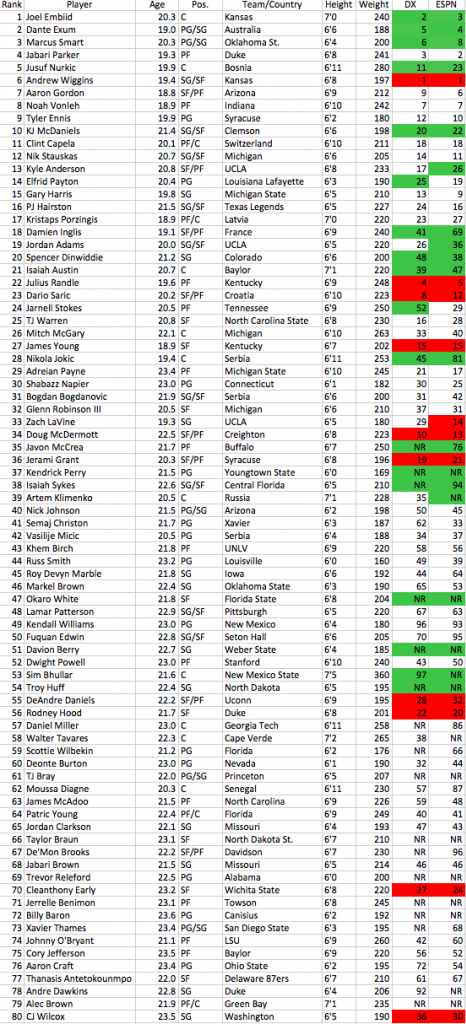
So why is he rated as a 2nd round pick (36th DX, 37th ESPN)?  As far as I can tell it’s because bulk scoring is overrated and French prospects are underrated.  If the San Antonio Spurs showed us anything in their demolition of the Heat, it’s that off the dribble scoring isn’t all that important when you move the ball, space the floor, and play intelligent team basketball.  Incidentally, the Spurs have drafted three French players in round 1 since 2000 (Tony Parker, Ian Mahinmi, Livio Jean-Charles) as well as Nando de Colo in round 2. They also signed Boris Diaw as a FA after he was released by the Bobcats. Damien Inglis appears to be completely in their wheelhouse. With the Spurs picking last in round 1, I believe he is an underdog to slide past them into round 2.

Nikola Jokic
The 4th member of the super statistical international quartet, Nikola Jokic is an exceptionally skilled, but slow and unathletic big man.  His lack of mobility or explosiveness mean that his stats should be de-valued as he projects to become a defensive liability and poor athleticism casts doubt on his ability to translate offensively, but there is still plenty to like.

Jokic is 6’11” with a 7’3″ wingspan and weighs 253 pounds, which gives him acceptable size to play center.  What stands out about Jokic is his incredible assist to turnover ratio at 3.0 vs 2.3 pace adjusted per 40.  That is absolutely stellar for a 19 year old center playing in a professional league.  In Marc Gasol’s final season of European play, he turned 23 midseason and posted 3.0 pace adjusted assists vs. 2.4 turnovers in the ACB and 3.7 vs 3.4 in a smaller Eurocup sample.  ACB is a tougher league than the Adriatic, but the discrepancy between leagues is completely dwarfed by Gasol’s 4 year age advantage at the time, and Gasol is arguably the best passing big man in the NBA.  Nikola Jokic’s passing is an outlier level of good for a big prospect, and it gives him his own unique form of upside.

Beyond his passing, Jokic is a capable shooter although it didn’t show in his Adriatic sample as he only converted 15/68 3PA (22.1%).  By all accounts this is not reflective of his shooting ability and the low % should be chalked up to poor variance.  He seems to have a solid shot of becoming a competent NBA floor spacer.  His struggles from 3 were atoned for by his dominance from 2, where he converted 63.6% of his attempts.  I am not sure he necessarily projects to be a great interior scorer in the NBA since he lacks the explosiveness to finish around the rim with dunks, and it is possible that his 2p% is padded by good variance on mid-range and short jumpers.  But he also may have succeeded due to high IQ, good post moves, and touch around the rim.  I imagine his interior scoring is translatable to some extent based on his size and skill level, but his lack of athleticism also casts some doubt.

The problem for Jokic is that his poor tools outside of size will likely cause him to struggle defensively. Nate Duncan confirms this narrative with his eye test, although I am not nearly as bearish as Duncan on the implications of Jokic’s physical deficiencies.  The fact of the matter is that size is a tool, and a prospect with center height and length and guard skill level cannot be written off due to poor athleticism.  He doesn’t need to jump a mile in the air to get his shot or passes off over the defense.  When I see DX and ESPN both rate him as 42nd on their big boards, I can’t help but think of Brad Miller who was a statistical beast in college but went undrafted due to being slow, white, and unathletic.

I buy that his poor athleticism drops Jokic out of the top 10 in spite of having top 5 stats.  I do not buy that it pushes him out of round 1, as I have him as a clear top 20 value.  And frankly I can’t fathom why anybody should rather have Julius Randle than Jokic.  Randle is just as slow mentally as Jokic is physically, except instead of being center sized he’s an undersized PF.  It shows in steal + block rates, with Jokic’s per 40 rates crushing Randle’s (1.1/1.4 vs 0.6/1.0) in spite of playing in a tougher league.  Randle is a much better rebounder (13.5 vs 9.5 per 40), but that is clearly less important than Jokic’s edges in size, skill, and basketball IQ.  Randle’s outlier skill is bullying players who are too small to play in the NBA, Jokic’s is one that correlates strongly with NBA success.  A similar comparison would also demonstrate that Jokic has superior potential on both sides of the ball to Doug McDermott, yet both McDermott and Randle are projected as lotto picks and Jokic is slated to go in round 2.

Dario Saric
I don’t have much to say about Saric.  His translated stats are solid but not great as they put him 20th in the WARP rankings.  That’s roughly what I anticipated, and outside of his 6’10” height he doesn’t have a single tool that is average or better.  I simply don’t see how he has the physical package to thrive as a primary ball handler in the NBA.  The scouting narrative is that he has a virtuoso passing ability that gives him unique upside, which doesn’t strike me as quite enough to override his deficiencies.  I could see him being a Boris Diaw stretch 4 type who can move the ball and occasionally knock down 3’s or create a little of his own offense.  Or he could be an Evan Turner who cannot translate his ball dominant ways to the NBA as he faces tougher defenses.  He seems like a fine flier in the late 1st round, but I don’t see how he’s worth a gamble in the lottery.  It appears that Nate Duncan agrees with my assessment, which is enough to make me feel comfortable that I’m not missing any details of integral importance with my assessment from afar.

Even though Saric is hyped as the 2nd best international prospect in this class, I believe he’s only the 6th or 7th best in the class.

Vasilije Micic
Micic only rates as an early 2nd rounder according to WARP, but based on Duncan’s scouting report WARP may underrate him.  Duncan is especially impressed with Micic’s handling and passing ability, and those skills are not always fully captured by statistics.  That is the primary reason why I am comfortable rating Nik Stauskas higher than statistical models, so I do not see any reason why it should not apply to Micic.  Also WARP appears to value high assist rates less so than other models, as Kyle Anderson ranks as the 14th best NCAA prospect by WARP whereas he ranks 2nd according to Layne Vashro’s EWP model.

The biggest strike against Micic is that he’s not exceptionally athletic which inhibits his upside.  But he has a solid 2p% and DX notes that he finishes surprisingly well in their situational stats.  Also his jump shot is mediocre, as he shot 22/76 (28.9%) from 3 and (60/86) 69.8% on FT’s.  But shooting is also a skill where prospects are capable of making significant leaps, and that sample hardly seems condemning of Micic’s upside.

Defense is also a concern, but given his strong steal rate (2.1 per 40 pace adjusted), good size (6’5.75″ height 6’7″ wingspan 202 pounds), and the fact that he is not woefully slow or unathletic, I wouldn’t say he’s guaranteed to be a sieve.  Also he has the size to guard SG’s at least part time, which opens the door for a wide range of back-court pairings and mitigates the fact that he plays the current deepest position in the NBA.

People tend to associate athleticism with upside, but certain skill sets can buck that trend.  I doubt anybody pegged John Stockton or Steve Nash as high upside prospects when they were drafted in the mid 1st round, but they went on to become two of the best offensive players of all-time.  That level of greatness may not be within grasp for Micic, but if he’s as crafty as Duncan suggests it’s fair to say he has an outside shot of becoming great.  Even if it’s only 2% that’s worth enough to make him a 1st round value.  There are so many good PG’s in the draft and the league already that it naturally depresses the value of players at the position, but I buy Micic as somebody who should get drafted in the 20’s instead of the 30’s as consensus suggests.  I also believe there is a fair case to be made that he’s a more valuable prospect than Saric.

2nd rounders
Walter Tavares has appeal as an Omer Asik type of prospect who thrives off size, defense, and rebounding, and is a complete zero offensively.  He is already 22 and still making up for a late start, and I wouldn’t be surprised if he simply started playing too late to make a big impact.  I think he’s likely worth an early 2nd or maybe even a late 1st based on his body and mobility, but he’s going to be a drag offensively no matter what so I’ll likely rate him in the 30’s on my final big board.

Bogdan Bogdanovic rates as an early-mid 2nd rounder according to DX and ESPN, and a mid-late 2nd rounder based on most statistical models.  I don’t have a strong opinion on him one way or the other– he seems like a fairly balanced prospect without any sharp strengths or weaknesses that make me inclined to doubt models or scouting.  He’s a 2nd round flier who might become a decent role player or might not.

Artem Klimenko is a complete and utter mystery box who doesn’t have any translatable stats.  If nothing else his physical profile and the fact that he made 74% of his FT’s seems to make him worth an early-mid 2nd round flier.  Maybe he has no clue how to play basketball, or maybe he turns out to be a good defensive piece who isn’t a trainwreck offensively.  It’s difficult to assign probabilities without a baseline performance against legitimate competition, but I think it’s correct to err on the side of pessimism and gamble on him once the available known quantities are unlikely to amount to anything of substance.

Ioannis Papapetrou also seems draftable as a skilled role playing SF who will likely be a defensive liability.  Beyond that I’m not sure if anybody merits a pick– perhaps Alessandro Gentile but he sounds like more of a undrafted FA.

Conclusions
While WARP rating internationals as 4 of the top 5 players in the draft slightly overstates the goodness of this international class, I believe it is closer to correct than the scouting consensus.  In my estimation, there are 7 internationals who are worthy of a 1st round selection. 6 of those players are underrated by ESPN and DX big boards, most of them by comfortable margins. Dario Saric is the lone overrated international. There are another 3-5 players who merit a look in round 2 who all seem rated roughly appropriately by DX and ESPN. This international class is loaded, and with enough luck it may measure up to the 2008 class that included Danilo Gallinari, Serge Ibaka, Nicolas Batum, Nikola Pekovic, Omer Asik, and Goran Dragic.

The funny thing is that the draft at first was pitched to be the best NCAA class ever.  But then Wiggins, Randle, and Parker all started to look like possible busts, and the class was salvaged by the emergence of Joel Embiid as a possible superstar.  Now Embiid has a frightening injury narrative, and there may not be a single player in the class who makes for an above average #1 overall pick.  At this point, the NCAA crop has a number of solidly good prospects but overall is unspectacular, and the international class is responsible for keeping this draft afloat.  While Jabari Parker and Andrew Wiggins are currently projected as the top two picks in the draft, I would not be at all surprised if a handful of internationals end up developing into better pros than one or both of them.

I believe that colossal international busts like Darko Milicic and Nikoloz Tzkitishvili frightened scouts into taking a more conservative approach in evaluating internationals, but after the success of the 2008 class and Giannis Antetokoumpo appearing to be the steal of the 2013 draft it’s worth wondering when that trend is due to reverse.  Given the strong statistical crop this year as well as the increased emphasis on analytics across the NBA, I am fascinated to see how many of the top internationals go above their expected slot this season.

How Good Is This International Class? Part 1

Tags

, ,

The most challenging aspect of the draft for me is evaluating the international crop.  NCAA players are easy for me to work with since I’m intimately familiar with all of the players, coaches, and systems.  On the other hand, I am lacking in expertise in overseas leagues so solving the internationals involves quite a bit of thin slicing and guesswork.  But as I have tried to piece together the value of the respective internationals in this class, I have become increasingly high on the crop being especially strong.  This was reinforced when Kevin Pelton released his WARP ranking with 4 of his top 5 prospects being internationals.  Further, Dario Saric, Damien Inglis, and Walter Tavares rank as late 1st rounders and Vasilije Micic is an early 2nd according to WARP.  This not only aligns with my suspicion that the class is strong, but suggests that it is historically good.  That said his WARP formula also ranks Jordan Adams ahead of Joel Embiid, which is a friendly reminder that stats do not tell the entire story.  So let’s dive in to each player and discuss how scouting narratives may affect their value implied by statistical performances.

Dante Exum
I have already raved about Exum’s FIBA performance, where his statistics ranked him 4th according to WARP.  This seems correct to me, and WARP may even underrate his performance.  Most of the players used for translation analysis played in USA’s pressing defense, where they posted high steal rates which weighs heavily into the WARP formula.  Aaron Gordon looks significantly better according to his FIBA stats than he did playing in Arizona’s non-gambly shot prevention defense.  He had significantly better steal rate in the press (and suggests that he is underrated by his NCAA stats).  On the other hand, Tyler Ennis’s statistical performance was much weaker than his at Syracuse.  This is the most apples to apples comparison as he had to carry team Canada the same way Exum was forced to carry Australia.

On the other hand, Dario Saric was forced to carry team Croatia and performed on Exum’s level whereas he is ranked far lower according to his translated Adriatic stats.  This is a reminder that FIBA stats are only a 9 game sample, which is far too small to take at face value.  But Exum nevertheless posted a significantly better assist:turnover ratio (34:21 vs 44:43) in spite of having a bad game vs team USA, who Saric never faced.  His ability to carry the offense while protecting the ball so well at such a young age is both highly impressive and less prone to sample size variance than shooting percentages, for instance.  If nothing else, his vision and ability to protect the ball while creating loads of offense offer enough promise in tandem with his physical profile to justify the top 4 hype.

What the stats don’t show is that Exum hardly moves off the ball.  I don’t know if this is because he lacks stamina, competitiveness, or simply hasn’t been pushed to develop this aspect of his game yet.  It’s not a fatal flaw since he clearly has enough offensive upside to become an all-star even if he subscribes to the James Harden school of defense.  And with his tools and personality, it wouldn’t be shocking to see him eventually develop into a good defender anyway.  But this does give me enough pause to not instantly elevate him to #1 now that Joel Embiid’s injury concern has been heightened, and it does open the door for an argument that Marcus Smart is a superior prospect since Smart is such a safe commodity on defense.  I still have Exum locked in as a top 3 prospect and am considering him as the #1 prospect in the draft, but if there is a subtle reason to be skeptical of him this would be it.

Jusuf Nurkic
I wrote about Nurkic’s impressive Adriatic stats earlier in the season, and now that is supported by Pelton ranking him #3 in terms of WARP.  Nate Duncan (who seems to have a good eye test) recently shared a great scouting report on Nurkic, which I find encouraging for his prospect value beyond the stats for 2 reasons:

1) Duncan claims that Nurkic passes well out of double teams.  This bodes well for his ability to score efficiently against higher levels of competitions and not be a black hole of turnovers.
2) His quick feet allowed him to stop Dario Saric in their 1 on 1 matchups on multiple occasions.  The concern with Nurkic is that he doesn’t have the length or athleticism to be a traditional shot blocking rim protector.  But given his quick feet, strength, and size, it sounds like he can certainly be a defensive presence in his own rite.

Between his stats, physical profile, and scouting reports, I feel comfortable locking Nurkic in as a top 5 prospect.  There aren’t any scouting narratives that cast doubt on his potential outside of his poor leaping ability, which doesn’t seem particularly debilitating given his strengths.

Clint Capela
Capela ranks as the top international in the class according to WARP, ranking #2 behind only Marcus Smart.  Every statistical model I have seen ranks Capela exceptionally high, and he often appears ahead of Nurkic.  Further, he has good tools to translate his abilities to the NBA as he offers good length, athleticism, and quicks.  His weak tool physically is strength as he only weighs 222, but that shouldn’t preclude him from being a top end defensive center.  How his pre-draft measurements compare to those of other players who have recently served as good defensive centers:

Player Height Length Weight
Chris Bosh 6’11.5″ 7’3.5″ 225
Tyson Chandler 7’0.5″ 7’3″ 224
Joakim Noah 7’0″ 7’1.25″ 223
Clint Capela 6’11” 7’4.5″ 222
Kevin Garnett 6’11 ? 217

The fact of the matter is that once you have great height, length, athleticism, and mobility, you don’t need a world of strength to make a big impact defensively. After all, there aren’t any Shaq level bullies at center that must be stopped in order to win a title these days.  DX and ESPN list him as a PF, and I vehemently disagree: Capela is a center all the way.

Capela thrives as a shot blocker, rebounder, and finisher, as his skill set seems similar to that of Tyson Chandler.  Further, he posted 2.2 assists vs 2.6 turnovers pace adjusted per 40 this past season in French play (it was only 0.6 vs 2.9 in the smaller Eurocup sample where he had an excuse to not pass w/ his whopping 71.8% FG%), which is excellent for a center of his age and implies that he may be able to develop into a Joakim Noah level playmaker.  If nothing else he should be able to move the ball within the offense as opposed to being a Bismack Biyombo who never touches it.  Assist to turnover also correlates with feel for the game, and in tandem with his finishing ability it seems like he offers enough offensively to make it worth getting his defense and rebounding on the floor.

Based on his stats and tools Capela seems to offer a world of upside.  If scouts loved him and ESPN/DX were clamoring for him to go #1 overall, I don’t think I’d take a strong stance against that sentiment.  But in reality the sentiment is quite the opposite, DX ranks him 17th, ESPN 27th, and Nate Duncan thinks he belongs in round 2 after watching him at the Nike Hoop Summit (I like Duncan’s scouting reports but he is drastically underselling Capela’s strengths with that conclusion).

The common scouting narratives are that Capela has poor basketball IQ, poor feel for the game, and is lazy.  It is hard for me to reconcile how these narratives may be completely true in spite of the stats he posted, but they likely aren’t completely made up either.  So let’s start by examining Duncan’s critiques.  He starts by mentioning Capela’s poor jump shot (which is a viable flaw) and goes on to note:

He looks like his skill level is always going to be more center than power forward, and that is a problem given how thin he is.

I agree that his skill set mandates that he plays center. Do not agree it’s a significant problem given his weight with so many thin players succeeding as defensive centers.

Most concerning is Capela’s lack of feel overall. He was the most likely World player to make mental errors, although there may have been a bit of a language barrier involved there as well. During the game, he picked up four fouls in the first half with some silly over the backs. Throughout the week he did not prove particularly adept at finding creases for guards to give him dumpoffs, and his few postups invariably resulted in wild misses or turnovers.

I would have found this disconcerting if his lack of feel resulted in a number of defensive lapses. Let’s tackle each critique point by point:

-A few over the back fouls for a young big hardly sound indicting.
-DX noted in their situational stats that Capela finished an amazing 73.8% of his shot attempts off of cuts. Perhaps this is a minor indictment for his feel, but a larger indictment on the lack of structure of a hastily whipped together all-star team.
-He’s bad at posting up: who cares? It’s not part of his repertoire and he likely should never be used as a post-up player in the NBA.

Duncan then mentions that his strength is lacking and he struggled to even post up guards in 2 on 2 drills. It is unclear whether this is a greater indictment on his lack of strength or post up skill, but I assume it’s a bit of both.

And that’s all Duncan has to offer.  There’s nothing there that strongly pokes holes in my hypothesis that he may be Tyson Chandler 2.0.  I believe the worst than can be concluded is that Capela is a deeply dependent scorer, and he will suffer if he plays in a poorly coached offense with poor ball movement.  French teams typically have good ball movement (which is why the Spurs always draft French players) so it is likely that playing in France accentuated his offensive production.  His 2 point scoring stats are not that different from those of Joel Embiid.  But in terms of footwork, shooting touch, and offensive upside Embiid completely blows him away.  Stat models cannot fully detect the disparity in footwork and overall skill level, so this is one reason to take his stats at less than face value.

DX shares similar critiques with his feel for the game and also notes that he has questionable intangibles and defensive fundamentals.  I’d say there are enough red flag narratives from people who are competent at scouting to throw some cold water on his upside implied by tools and stats.

Overall, scouting narratives strike me as less discouraging than his positives are encouraging.  If there is one position where skill and intelligence flaws can be overcome to produce at an elite level, it’s center.  Nobody ever accused Dwight Howard of having good basketball IQ or feel for the game, but he was the 2nd most valuable player in the league when he had Stan Van Gundy coaching him. Everybody questioned Andre Drummond’s passion and basketball IQ and he slid too far and instantly smashed expectations as a rookie.  I have no idea how DeAndre Jordan slid to the 2nd round with his physical tools, but he didn’t even have good stats in college and he’s become a useful NBA player anyway.  Even Javale McGee convinced Masai Ujiri to gamble on him at 4/44, and he is responsible for some of the most inexplicably dumb plays in NBA history.  Athletic bigs are capable of such a significant defensive impact that they have quite a bit of margin for error in their skill and basketball IQ in order to still be productive.

My closing caveat is that I have compared Capela to two groups of athletic bigs: skinny and smart (KG, Bosh, Noah, Chandler) and strong and not smart/skilled (DAJ, Dwight, Drummond, Javale).  There are not many examples of skinny and not smart/skilled, so it’s possible that he simply does not become good at all.  But his French stats suggest that he has some “je ne sais quoi” that gives him his own form of unique upside (it wouldn’t be surprising if he’s smarter than scouts think he is), and I believe that’s worth gambling on in the 6-10 range.

Capela is a truly fascinating prospect given his polarizing features, and it makes me a bit sad that I’m closing by citing his “je ne sais quoi,” because that was a really long writeup to conclude with “I don’t know” in French.

That’s all for part 1.  I’m going to split this up into 2 or 3 pieces in order to address the international class in its entirety.

Which Prospects Get To The Rim The Most?

Hoop-math.com has some pretty awesome statistical splits for the past 3 years, and I decided to take advantage of that to look at a certain angle for all prospects in this draft: who can get to the rim in the half-court the most frequently?  Not that getting to the rim is everything– Austin Rivers excelled at penetrating defenses in the half-court and was bad at finishing and everything else, so he’s looking like a bust to start his career in spite of this skill.  But the reason why I feel this has value is because Otto Porter was exceptionally bad at penetrating through the defense unassisted, and this is likely correlated with him underperforming draft models, scouting reports, and his actual draft position as a rookie.  He was such a solid and well balanced player that almost every school of thought graded him as a surefire future starter, but that hypothesis now appears to be in doubt.  It’s likely that his lack of handle or burst were both underplayed warts and this was the signal that forecasting his downside risk.

So I looked at a narrow split of half-court unassisted rim FG’s that are not putbacks.  This is going to approximate creation ability, as it offers a glimpse of who can penetrate best through a set defense.  Granted, these numbers should all be taken with a grain of salt since they are scraped from play by play and they are far from precise.  They are all at the whim of assist scorers and play by play timestamps to approximate whether a basket came in transition or not. Also these are unadjusted for strength of schedule, and I measured these per minute instead of per possession since I figure up tempo teams have more transition possessions on average.  I split the sample into point guards, wings, and bigs, and also included assisted HC rim FG’s on the side.  Let’s start with wings:

Player UA FG Mins UA FG/40 Assisted
Isaiah Sykes 61 958 2.55 13
Jordan Clarkson 68 1228 2.21 7
Austin Rivers 51 1129 1.81 5
TJ Warren 54 1238 1.74 47
Doug McDermott 40 1181 1.35 81
Lamar Patterson 34 1174 1.16 17
KJ McDaniels 33 1212 1.09 14
Okaro White 27 1084 1.00 36
Markel Brown 28 1201 0.93 18
Rodney Hood 24 1150 0.83 13
Spencer Dinwiddie 32 1602 0.80 4
Deandre Daniels 22 1103 0.80 27
Andrew Wiggins 22 1148 0.77 17
Roy Devyn Marble 19 995 0.76 14
Nik Stauskas 24 1281 0.75 11
Jordan Adams 18 1082 0.67 31
Aaron Gordon 18 1187 0.61 59
Glenn Robinson 17 1194 0.57 28
PJ Hairston 11 804 0.55 4
James Young 17 1296 0.52 9
Gary Harris 13 1131 0.46 11
CJ Wilcox 12 1116 0.43 12
Otto Porter 11 1097 0.40 20
Nick Johnson 12 1257 0.38 20
Cleanthony Early 9 986 0.37 22
Zach LaVine 7 904 0.31 4

It’s nice to see Isaiah Sykes up at the top since he’s one of my favorite deep sleepers in the draft. He had a high volume role where he likely attacked too much given his ultimate efficiency, but the ability to penetrate is clearly present and it’s one of his multiple skills to work with in the pros.

I had wondered why everybody was so high on Jordan Clarskon, and this largely explains it. The guy can get to the rack! He’s probably just an older Austin Rivers, but he seems like a fine round 2 flier nevertheless.

In spite of all of Dougie’s McBuckets, many of them came assisted. He’s still left with solid unassisted volume, but a fair amount of these are likely post-ups over bigs that are too small to play in the NBA. He’s going to have a difficult time translating his inside the arc scoring to the pros.

Andrew Wiggins grades out in the middle of the pack, which is pretty good for a freshman. In spite of his limited handle, he still had the tools to get to the rim on occasion which is something to work with. His vision and finishing over length are the bigger holes in his slashing game.

Nik Stauskas played PG part-time at Michigan and his rate of getting to the rim is less impressive through that lens, but this isn’t too bad for his limited tools. He has slick handles and the athleticism to finish, and it’s nice to see him with nearly double the rate of Otto Porter.

I am a bit disappointed that Aaron Gordon rated this low, but the entire Arizona team had a curiously low % of rim attempts and high % of assisted FG’s at the rim. Nick Johnson’s unassisted FG per 40 was much better as a sophomore (0.69), for instance. Given Gordon’s youth, tools, handle, finishing ability, and incredibly gaudy assisted total I’m not reading much into this.

I included PJ Hairston’s 2012-13 numbers, and they show how heavily dependent he is on his jump shot. I am starting to cool on him a decent bit, as I’m not sure his shot alone is enough to become a good player.

James Young grades disappointingly for a player who is going to depend so heavily on scoring to succeed. Either he needs to improve his handle significantly or he is going to be leaning hard on his jumper.

Gary Harris was better as a freshman (0.63 per 40) but this illuminates how bland he is as a prospect. He’s a jack of all trades and master of none, and if he’s too small to guard SG’s he isn’t going to make much of an impact. He’s not going to be much of a slasher in the pros and if you measure his creation rate vs. PG’s he is completely blown out of the water. I don’t believe there is any justification for drafting him in the lottery.

If there was any doubt that Cleanthony Early is a worthless prospect, this should eradicate it. He played in the Missouri Valley conference where he was taller than most bigs and this was all of the creation he could muster. For a 23 year old whose main value lies in scoring, that is pathetic.

Zach LaVine finishes in dead last. If there is any statistical signal that the guy is good at basketball, I have yet to find it. His creation stats, his assist rate, and his steal rate are all bad. Perhaps he could have done more with more ball handling responsibilities, but I am highly skeptical of the narrative that he has superstar upside. In all likelihood the guy is not good enough at basketball to be a useful NBA player.

Now let’s move on to point guards, who have a higher frequency of getting to the rim due to greater ball handling responsibility:

Player UA FG Mins UA FG/40 Assisted
Elfrid Payton 65 1258 2.07 31
Deonte Burton 53 1236 1.72 2
Aaron Craft 45 1204 1.50 3
Russ Smith 38 1084 1.40 10
Jahii Carson 38 1168 1.30 13
Tyler Ennis 37 1215 1.22 6
Kendrick Perry 32 1168 1.10 11
Marcus Smart 27 1014 1.07 19
Shabazz Napier 37 1404 1.05 2
Semaj Christon 31 1200 1.03 35
Scottie Wilbekin 25 1150 0.87 0
Kendall Williams 24 1200 0.80 5
Kyle Anderson 23 1196 0.77 5

Elfrid Payton was expected to top this list given his Sun Belt dominance without a jump shot.

Marcus Smart ranks a bit lower than I had hoped. I don’t think this is a serious red flag, but he will need to really tighten his handle to become a star.

On the upside, Kyle Anderson finished with roughly double the creation rate of Otto Porter. On the downside, he finished dead last for PG prospects. While he is going to play SF/PF in the pros, he ran the UCLA offense full-time so he should have made frequent trips to the rim. So this offers a glimmer of hope while also demonstrating his lack of burst all in one.

On to bigs:

Player UA FG Mins UA FG/40 Assisted
Dwight Powell 39 1167 1.34 19
Noah Vonleh 25 794 1.26 21
Javon McCrea 29 937 1.24 71
Julius Randle 37 1233 1.20 29
Jarnell Stokes 34 1199 1.13 50
Adreian Payne 23 870 1.06 34
Jabari Parker 28 1074 1.04 42
Patric Young 25 1019 0.98 43
Jerami Grant 22 1005 0.88 32
Joel Embiid 14 647 0.87 53
Mitch McGary 20 967 0.83 43
Isaiah Austin 20 1065 0.75 36
Khem Birch 10 1037 0.39 41

Jabari Parker’s rate is a disappointment to me. For a guy who was so selfish and took so many shots, he didn’t get to the rim on his own that much. And without knowing the precise splits, I imagine many of these came from bullying small big men anchoring poor defenses. For somebody so dependent on scoring, it looks like he will have to lean hard on his jump shot in the pros. But he is not currently a great shooter and he doesn’t have Melo’s quick release or Durant’s go go gadget arms to get off a high volume of looks, so there is some doubt as to whether he can score efficiently enough to justify a top 3 selection.

Joel Embiid’s rate is not a concern to me. Given his size, rim touch, and footwork, he obviously has quite a bit of creation ability to build upon. Also a fair amount of his assisted FG’s entailed him catching the ball with his back to the basket and doing the brunt of the work.

Khem Birch exemplifies why he isn’t as good as his statistical ranking. The guy has nearly no skill whatsoever but doesn’t even have good size for a PF. I believe he’s going to have a tough time amounting to much as a pure garbage man in a PF body.

Marcus Smart vs. Andrew Wiggins: Who Was The Best Big 12 Perimeter Defender?

Tags

,

Draft consensus is that Andrew Wiggins is likely to be an elite defensive wing in the NBA, as in theory his stellar physical tools ensure lock down D. But there is more to defense than running fast and jumping high, so I am going to use available NCAA data to measure him against my favorite defensive guard prospect in the draft: Marcus Smart.  Let’s starting by assessing the inventory around them.

Coaching: Bill Self vs. Travis Ford

Coaching has a huge impact on team defense, so let’s get a feel for which coaches historically built the best defenses prior to landing their respective stars.  The table notes each team’s NCAA rank (out of ~350) in adjusted defensive rating as per kenpom.com:

Season Ford Team Ford D Rank Self Team Self D Rank
2013 Ok State Smart Kansas 5
2012 Ok State 111 Kansas 3
2011 Ok State 47 Kansas 11
2010 Ok State 60 Kansas 9
2009 Ok State 74 Kansas 9
2008 UMass 58 Kansas 1
2007 UMass 47 Kansas 1
2006 UMass 40 Kansas 3
2005 E Kentucky 126 Kansas 25
2004 E Kentucky 230 Kansas 16
2003 E Kentucky 301 Illinois 8
2002 E Kentucky 274 Illinois 19

In a nutshell: Self always builds elite defenses whereas Travis Ford doesn’t.  Self’s worst defense pre-Wiggins was 15 slots higher than Ford’s best pre-Smart.  Of course, this doesn’t prove that Self is a smarter defensive coach than Ford, it only suggests it at a loud volume.  But Kansas is a name brand school and it stands to reason that Self should have some advantage given his access to superior talent.  Fortunately, Dan Hanner shared his process for making NCAA projections (which he does well) and included coaching as a significant portion of defense projection.

In Step 15 of his article, Hanner notes that he makes projections for defensive statistics (block rate, steal rate, D-Reb rate), prices in recruiting rankings, and gives a boost for players that mysteriously play high minute totals with poor stats (since these types are often are defensive specialists).  He also notes that these factors alone do a poor job.  Using a 10 year sample from 2003-2012, he measured the greatest impact coaches after adjusting for the aforementioned factors and shared his top 15 defensive coaches.  Bill Self rated #1 on his list.  Travis Ford didn’t crack the top 15 because he offers no value beyond the ability to attract enough talent to make himself seem competent to athletic directors.

It is common for people to blame Bill Self for Wiggins’ shortcomings, but this is misguided.  Self consistently gets stellar regular seasons from players who do not go on to NBA stardom, as his teams tend to outperform their talent before disappointing in the tournament.  It is safe to declare that Bill Self completely waffle crushes Travis Ford at building NCAA defenses.

The Bigs

After coaching, the highest impact players on defense are the tall ones.  They provide rebounding and rim protection, so it should be no surprise that height correlates with defensive success.  Good college defenses are often anchored by good rim protection, so let’s compare the two sets of bigs.  Note that total includes each stat’s minute-weighted average for the collection of bigs.

Kansas:

Player Minutes Height D-Reb% Stl% Blk%
Joel Embiid 647 7’0″ 27.3 2.3 11.7
Tarik Black 446 6’9″ 21.3 1.3 4
Jamari Traylor 549 6’8″ 18.5 1.5 5.3
Perry Ellis 973 6’8″ 18.2 1.7 2.2
Total 2615 6’9.2″ 21.0 1.7 5.5

Oklahoma State:

Player Minutes Height D-Reb% Stl% Blk%
Kamari Murphy 855 6’8″ 18.3 1.1 5.1
Mike Cobbins 256 6’8″ 15.3 1.8 7.9
Le’Bryan Nash 1017 6’7″ 14.6 1 2.8
Leyton Hammonds 230 6’7″ 12.3 1.8 0.5
Total 2358 6’7.5″ 15.8 1.2 4.0

Oklahoma State’s bigs were undersized and unfit to do good things on defense. The Cowboys were rated as the #5 kenpom team with a 12-1 record when Mike Cobbins went down for the year due to injury. Without him they were forced to play small, as Hammonds was largely worthless and when Murphy was on the bench 6’7″ Le’Bryan Nash played C and Marcus Smart was often forced to defend opposing PFs. I’d wager that Smart spent more time as a defensive PF than Wiggins in spite of being a PG who is 5.5 inches shorter.  Not only did the small lineup make it exceptionally difficult to protect the rim, but Smart was forced to be used as an undersized post defender instead of putting pressure on the ball on the perimeter.  Consequently, Oklahoma State went 9-12 without him and dropped from #5 to #26 in kenpom’s overall rankings.

Meanwhile, Kansas had the defensive player of the year in Joel Embiid whose his size and mobility made him an interior force.  He only played 23 minutes a game and missed a handful due to injury, but Tarik Black and Jamari Traylor offered more value as defensive replacements than OKC’s small bigs without Cobbins.  This is another clear advantage for Kansas.

Guards

Let’s see how each team compares in terms of guard and wing impact on defense outside of Smart and Wiggins.

Kansas:

Player Minutes Height D-Reb% Stl% Blk%
Wayne Selden 1023 6’5″ 6.4 1.4 1.1
Naadir Tharpe 1001 5’11” 7.4 1.4 0
Frank Mason 565 5’11” 7.3 1.9 0.2
Total 2589 6’1.4″ 7.0 1.5 0.5

Oklahoma State:

Player Minutes Height D-Reb% Stl% Blk%
Markel Brown 1201 6’3″ 12.9 1.6 3.1
Phil Forte 976 5’11” 5.6 1.7 0.1
Brian Williams 793 6’5″ 11.5 2.6 1.5
Stevie Clark 256 5’11” 7.2 3.4 0.4
Total 3226 6’2″ 9.9 2.0 1.6

Finally, an area where the Cowboys have an advantage. Non-Smart Oklahoma State guards did not offer a ton of value on D, but at least Brian Williams and Markel Brown had the athleticism to occasionally make a play and Stevie Clark generated some steals in limited minutes before getting kicked off the team. Meanwhile, Kansas trotted out two small PG’s and Wayne Selden, who has an elite body but has yet to figure out how to use it for good on the basketball court.  Kansas’s guards were certainly weak links on defense.

This advantage for Oklahoma State is less significant than each of Kansas’s advantages in big men and coaching.  Forte was an undersized and unathletic, and Brown and Williams aren’t defensive stoppers, just athletes who sometimes make athletic plays.  Kansas’s guards were bad, but guard defense isn’t high enough leverage to weigh this discrepancy more than others given that Oklahoma State didn’t have a second perimeter stopper.

Overall

Kansas has a much better coach and better bigs, whereas Oklahoma State has less leaky guards alongside their star.  If the two players made similar impacts, Kansas should have a much better overall defensive rating.  Yet they barely finished with a higher defensive rating, as Kansas finished with the 31st adjusted D-Rtg (out of 351) at 96.3 and Oklahoma State finished 37th at 96.6.  The two defenses were roughly dead even, and once you remove the 3 games missed by Smart (Oklahoma State went 0-3), Oklahoma State was a shade better than Kansas.

If we look at Big 12 games only (noting that Smart missed 3 games, Cobbins missed all 20, and Embiid missed 5), Oklahoma State had an adjusted defensive rating of 95.9 vs Kansas’s 96.2.  If we throw out the 3 games that Smart missed, the Cowboy D-Rtg drops to 94.9 to widen the gap by a point.  By all measures these two defenses were similarly effective over the course of the season, and if anything it appears that Oklahoma State had the edge when Marcus Smart was in the lineup.  Given the advantages that Wiggins had with respect to coach and cast, this strongly suggests that Marcus Smart was the better and more impactful defensive player.  Let’s look at individual stats to check to see how it aligns with the longwinded route.  Note that adjusted D-Rtg is individual D-Rtg (as per sports-reference.com) adjusted for team SOS:

Player Minutes DRB% STL% BLK% Adj DRtg
Andrew Wiggins 1148 12.3 2.1 3.1 96.6
Marcus Smart 1014 14.9 5 1.9 88.9

In spite of all of Wiggins physical advantages, Smart accumulated more than twice the steal rate.  Instincts and aggressiveness are key traits on defense, and this is where Smart shines the most.

Individual D-Rtg takes team D-Rtg and adjusts for individual steal rate, block rate, and defensive rebounding rate.  Because Kansas gets so much production out of their bigs and Oklahoma State gets so little out of everybody other than Smart, Smart destroys Wiggins.  This is the short hand version of my analysis, except it doesn’t account for coaching disparity as there is more team level credit to distribute for well coached teams.  Bearing this in mind, there is an argument to be made that individual D-Rtg actually understates the difference between Smart and Wiggins.

What About Age?

It is fair to point out that Smart is a year older than Wiggins and perhaps should make a greater impact given his additional year of experience.  But if we look at Smart’s freshman year, the defense was even better as Cobbins was healthier only missing 5 games and contributing 728 minutes total.  Many of Brian Williams minutes went to 6’10” Philip Jurick, and Le’Bryan Nash was able to swing between the 3 and 4 instead of being asked to be a full time 4/5.  Smart was able to spend all of his time hawking the ball on the perimeter, and the Cowboys finished with the #15 defense in the country.

Smart’s freshman individual adjusted D-Rtg was 85.6, showing that the gap between him and Wiggins widened once he actually played with serious big men.  The Cowboy defense should have been a joke this year, and it’s quite the feather in Smart’s cap that they were able to keep pace with Kansas with such little size.

The Coaches’ Perspective

Big 12 coaches vote on the best defensive players in the conference after each season.  As both a freshman and sophomore, Marcus Smart was a unanimous selection to the 6 person team.  He was the only non-Kansas big to be chosen unanimously (Jeff Withey and Joel Embiid each shared the honor) over these 2 years.  Wiggins was left off the team altogether, which surprised me given the level of hype and attention he received.  I suppose the Big 12 coaches weren’t as impressed with his defense as draft narratives would suggest, even though he was a unanimous selection to the All-Big 12 first team for his overall play.

Conclusions

Based on every piece of information available and every angle from which it may be analyzed, Marcus Smart was a vastly superior NCAA defensive player to Andrew Wiggins.  He was a one man wrecking crew on defense, whereas Wiggins was merely a solidly good defensive player.  Given the predictive power of steal rate and the fact that Smart has the tools to become an impact defensive player in the NBA, this should weigh heavily into Smart’s NBA defensive projection.

On the other hand, this should dispel the myth that Wiggins is a guaranteed defensive stud.  Hype does not equate to truth, but people seem to treat it as such.  It is common for people to seek narratives to justify Wiggins’ hype instead of looking for the actual truth in data that is free of bias.  I believe the hype was justified: a 16 year old kid with his size, mobility, and explosiveness is a rare commodity, and it’s worth getting excited over him.  But when at age 19 he has shown zero signs of development or impact that were projected, it’s time to scrap the hype and brace for the likely scenario that the person inside the body doesn’t have what it takes to convert the potential into reality.

If Wiggins was truly a high impact defensive player, there would likely be data supporting it.  There is data supporting Smart’s impact and there is data supporting Aaron Gordon’s impact, which is why I have them as the top two perimeter defensive prospects in the draft.  Wiggins believers can have their 44″ vertical snapshots, I’d rather get Smart and take the guy who produces results.

Aside

Who Wants To Gamble On Aaron Gordon?

Tags

Early in the season I was offput by a number of Aaron Gordon’s deficiencies such as his broken shot, his willingness to launch long 2’s, and his mediocre size to defend NBA PF’s.  But he had a strong close to the season and I started perceiving him in a new light.  His shot remains a glaring wart, but let’s cast that aside for a moment and analyze his strengths.

Defense

Two of the hurdles to loving Gordon mid-season were his lackluster steal and block rates.  There aren’t many players who become top end defensive wings in the NBA without posting a good steal rate in college.  Arizona plays a non-gambling defense, but he nevertheless had a lower steal rate than his top defensive teammates such as Nick Johnson, Rondae Hollis-Jefferson, and TJ McConnell.  This made it hard to feel great about him as a defensive prospect, especially when his block rate offered little hope for his potential as a rim protecting PF.  But then he closed the season with a flurry of stocks to render his overall rates respectable, all while I decided that steals and blocks were an unfair way to evaluate his defensive potential in the NBA.

The Wildcat System

Arizona dominated the defensive end in a unique way: they led the NCAA in defensive eFG% without great rim protection, as their starting 7’0″ center Kaleb Tarczewski posted a measly 3.6% block rate.  For reference, the best defensive eFG% teams in each of the prior 3 seasons were anchored by NBA draft picks with monster block rates: Jeff Withey (13.7%), Anthony Davis (13.7%), and Bernard James (13.5%).  Arizona as a team had a mere 11.5% block rate.

Instead of protecting the rim, Arizona simply refused to let opponents get there.  They closed out on 3 point shooters and used their quickness to contain penetration and funnel everything to the mid-range.  And they weren’t giving up open mid-range shots, as they used their size and athleticism to contest everything.  According to hoop-math.com, Arizona forced opponents to attempt a whopping 48.8% of their shots from mid-range (NCAA average: 29.3%), which were made at a paltry 32.0% (NCAA avg: 35.7%).  They then would clean up the defensive glass with the 13th best DREB% in the NCAA.  They rarely fouled with the 55th best defensive FT rate and managed to force an above average turnover rate at 118th in spite of steals being their lowest priority.  Naturally they finished with the #1 defense in the NCAA, and it came in a flavor geared toward stopping quality competition since they took away everything that good offenses tend to value.

Let’s assess how Gordon fared at contributing to Arizona’s defensive goals:

-Containing penetration: Gordon rarely was beaten off the dribble as he moves well laterally and did well at cutting off opponent drives.  When he faced Duke, Jabari Parker never came close to getting by Gordon when matched up and finished shooting 7/21 FG with 5 TOV’s.  He also contested shots well as he rarely failed to closeout.

-Defensive rebounding: in spite of playing a fair amount on the wing, Gordon led his team in defensive rebounding rate at 19.1%, with 7 footer Kaleb Tarczewski finishing second at 16.9%.

-Not fouling: Gordon posted the lowest foul rate of all Arizona forwards, and was closer to Arizona’s guards than the bigs that he outrebounded:

Player Height PF/40
Brandon Ashley 6’8 4.6
Rondae Hollis-Jefferson 6’7 3.8
Kaleb Tarczewski 7’0 3.6
Aaron Gordon 6’9 3.0
TJ McConnell 6’1 2.7
Gabe York 6’3 2.7
Nick Johnson 6’3 2.4

It’s hard to argue that he did anything other than thrive defensively, as he excelled at all of his team’s primary objectives in spite of being the youngest player on the team.  Not only did this help Arizona to the #1 defense in the NCAA, it was only Sean Miller’s first top 40 defense in 5 seasons at Arizona.  Miller is one of the top coaches in college basketball and I love how he built his defense, but this is not a defense that can be readily replicated without a unique collection of talent.  Gordon gets big time credit for his role here.

FIBA u19 Defense

Billy Donovan coached team USA to full court press where they used their physical advantages to force turnovers, generate easy buckets in transition, and blow the competition out of the water.  Here is how each player’s respective steal rates compare to what they posted in the 2013-14 NCAA season:

Player Mins Stls Stl% NCAA Stl%
Marcus Smart 142 22 7.9% 5.0%
Elfrid Payton 170 21 6.3% 3.6%
Aaron Gordon 169 18 5.4% 1.8%
James Robinson 127 10 4.0% 3.0%
Justise Winslow 169 10 3.0% N/A
Jahlil Okafor 128 7 2.8% N/A
Jarnell Stokes 114 6 2.7% 1.4%
Montrezl Harrell 162 8 2.5% 2.0%
Nigel Williams-Goss 206 7 1.7% 2.0%
Rasheed Sulaimon 181 6 1.7% 1.9%
Michael Frazier 151 5 1.7% 2.3%
Mike Tobey 81 2 1.3% 0.9%

Gordon racked up far more steals than a number of players who posted similar or better steal rates this past NCAA season. He only finished behind Marcus Smart and Elfrid Payton, who were two of the best ball hawks in all of college basketball.  Even if the sample is small, Gordon is the only player who heavily strayed from expectation based on his NCAA steal rate.

If his performance at Arizona isn’t convincing that Gordon is a great defensive prospect, his FIBA stats should drive a nail in that coffin.  Not only does this suggest that he may have been able to compile a much higher steal rate if he had been asked, but it also hints at a high level of coachability.  At Arizona he was asked to contain penetration, rebound, and not foul, and he did all of the above.  In Prague he was asked to apply pressure to force turnovers and he complied as he went on to win MVP of the tournament at age 17.

Based on the eye test, his physical profile, and all statistical indicators, I rate him as top end defensive wing prospect with a high floor and a high ceiling.  There is a strong case to be made that he is the best defensive wing prospect in this year’s draft ahead of KJ McDaniels and Andrew Wiggins.

Offense

In my recent post dispelling common draft myths, I shared this tweet from draft statistical modeler Layne Vashro:

 ·  May 22

Handles + court-vision is what separates 3s from tweeners. Gordon easily beats most tween failures in AST/TOV

Gordon can handle and pass exceptionally well for an 18 year old of his size.  He especially shined down the stretch, as he posted 46 assists and 42 turnovers in his first 30 games before finishing with 29 assists and 13 turnovers in his final 8 games.  His PG skills were reputed to be strong entering the season, and it appears they  improved a decent bit over the course of the season.

Gordon’s explosiveness made him a highly effective rim finisher, as he converted 72.9% of his rim attempts on the season.  This is vastly superior to his similarly sized lottery peers such as Andrew Wiggins (63.6%), Jabari Parker (62.7%), and Noah Vonleh (59.3%).  This will help keep his scoring efficiency afloat as he (hopefully) learns to score away from the hoop and improve his shot selection.  He also is a strong offensive rebounder as he corralled 10.4% of his team’s misses.

In spite of his shooting deficiencies, there are multiple ways in which Gordon contributes on offense.  His shooting might be a drag on spacing, but it does not condemn him to being a decisively bad offensive player as a whole.

The Shooting Conundrum

Earlier this season I wrote that Gordon’s shot is irreparably broken, and I would like to now take that back.  It is broken, but not necessarily irreparable.  He is only 18 and his form looks OK enough, his just shots don’t go in.  This creates a few problems:

1) He will not space the floor cannot reliably make NBA 3 pointers
2) A willingness to attempt long 2’s can tank his efficiency
3) An inability to make free throws will prevent him from padding his TS% by drawing fouls

The glimmer of hope for his shooting is that he made 17/45 (35.6%) 3 pointers at Arizona.  The unpleasant news is his FT shooting (76/180 = 42.2%) and non-rim 2PA’s (44/160 = 27.5%) are much larger samples at abysmal percentages.

Overall his shooting prospects seem grim, but he is not completely hopeless since shooting is the most volatile skill that occasionally lends itself to surprising levels of improvement.  Given that he is the youngest prospect in the draft, we can open the door for a bit of extra optimism.  As a college freshman Trevor Ariza shot 18/76 (23.7%) from 3 and 57/113 (50.4%) from FT.  If you combine his age 27 and age 28 NBA seasons, he shot 39.7% from 3 on 707 attempts and 78.7% FT on 315 attempts.  It took him 9 seasons, but he became a genuinely good shooter.  That level of 180 simply isn’t possible with respect to basketball IQ, athleticism, or defensive instincts.

Gordon loosely compares to another poor shooting tweener who was undervalued in the draft– Kawhi Leonard.  Leonard shot 25% from 3 in two seasons at SDSU, and then went on to shoot between 37.4% and 37.9% in each of his first 3 NBA season at San Antonio.  Perhaps the Spurs saw something in Leonard’s form that they tweaked in a way that can be replicated with Gordon.  Given the recent rise of analytics, it is worth wondering if new information can help teach players to make outlier-y leaps in their shooting ability.

In his pre-draft interview, Gordon expressed confidence that he will have his shot fixed by the start of his rookie season and even provided a detailed explanation of his recent adjustments. I have no idea whether his approach will make a meaningful difference, but it at least sounds more promising than taking a bunch of directionless practice reps and hoping for the best.  On the downside, he calls the mid-range “a great shot,” which is a serious leak in his BBIQ that badly needs fixing.

It’s not difficult to envision a scenario where Gordon learns to hit 37%+ on corner 3’s and is coached into exercising discipline with respect to attempting long 2’s (just don’t unite him with Randy Wittman).  In the scenario that his big wart is reduced to a smaller wart, he can easily become an impact player.  Even if this fails to happen the majority of the time, the mere possibility is highly valuable for his draft stock.

Conclusion

I am flipping my story from Gordon’s shot being a debilitating wart to one that is less bad than the warts displayed by other top prospects such as Jabari Parker and Andrew Wiggins.  Given the volatile nature of shooting, I believe Gordon has the most upside of the trio.  And I am not convinced that he has a lower median outcome than either, as spacing the floor is not a prerequisite to becoming a useful wing and neither Parker nor Wiggins are guaranteed to be starting caliber.  It seems that there is a cognitive bias that being slightly above average shooters gives Wiggins and Parker a safeness to their draft stock, when in reality shooting is a) the most volatile trait and b) doesn’t guarantee offensive success on its own.  Gordon can close the gap on the shooting discrepancy, but Wiggins will not catch Gordon in court vision or feel for the game and Parker will always lag in explosiveness and quickness that aid Gordon’s finishing and defense.

My preference is now to gamble on Gordon’s shot, as I have elevated him to #4 on my big board behind Joel Embiid, Dante Exum, and Marcus Smart.

Clearing The Air

Now that the draft order is set, there are many things being said by people who aren’t fully informed.  So I figured I would debunk some of the more prevalent myths regarding lottery players.

MYTH: Dante Exum is not a point guard
I have heard numerous people paid by ESPN to discuss the draft make this statement, and it is 100% false.  Because Exum has the size to play the wing, he has been labeled as a combo guard.  Because he has been labeled as a combo guard, it seems to have confused people into assuming he is not a pure PG.  This is wrong.

In Exum’s combine interview he stated himself that he is a point guard who plays with the objective of penetrating to draw the help defense and then find his open teammate.  True to his word, this is how he played in his FIBA performance vs. Spain.  In a game where he finished with 33 points and 4 assists, his ability to create for his teammates made the largest impression on me.

Tyler Ennis is often lauded for his stellar assist to turnover ratio at Syracuse (6.2 assists vs 1.9 turnovers per 40).  But in the FIBA u19 games when he was asked to carry the offense for Canada, he finished with just 25 assists and 24 turnovers in 9 games.  Exum tallied 34 assists and 21 turnovers in a similar role for Australia, in spite of playing 13 fewer total minutes than Ennis.

Dante Exum is a point guard through and through.  Let’s not lose sight of that just because he has the size to defend NBA SFs.

MYTH: Aaron Gordon is a power forward in the mold of Blake Griffin
The Blake Griffin comp seems to be fading away, as it was the common comparison when all we knew about Gordon pertained to his hair color, complexion, and dunking ability.  But Blake Griffin is an incredibly unique power forward who leverages his strength and athleticism better than anybody to be a dominant force in the low post.  He posted incredible offensive numbers at Oklahoma, much better than those of Gordon.  Like Gordon, his height, length, and reach are all on the lower end of PF measurements which limits him defensively in spite of his terrific athleticism.  Part of the reason I was low on Gordon early in the year is because without Blake’s paint dominance, he’s not worth much.

But then I started watching more of Arizona and Gordon’s value became obvious: he has the potential to be an excellent wing defender.  In the low post his size makes it difficult for him to become a top defensive PF, but on the perimeter he has the speed and quicks to hang with wings, and his size is now a significant positive.  His poor shooting places a damper on his ability to play the wing, but given the increasing importance of PF shooting it is not the most important detail for his position.  Statistical guru Layne Vashro:

May 22

Handles + court-vision is what separates 3s from tweeners. Gordon easily beats most tween failures in AST/TOV

Gordon’s ability to handle and pass is going to enable him to fit into NBA offenses, not his low post game.  It also sets him apart from somebody like Michael Kidd-Gilchrist who is a complete drag offensively.  His value clearly seems to be as a wing in the mold of Kawhi Leonard or Shawn Marion.

This is not to say that he should not be used as a PF, as I do imagine he can succeed as a small ball PF.  The NBA is trending toward an increased emphasis on spacing with big SF’s being used increasingly frequently as small PF’s, so there are plenty of scenarios where Gordon is best used as a 4.  Just don’t expect him to rack up points in the low post like Blake Griffin does.  That’s not his thing, and he’s also too small to be much of a rim protector.

MYTH: Jabari Parker is the highest floor player in the draft
While Parker’s ability to rack up points at such a young age is impressive, there is more to having a high floor than scoring ability.  He could be poor defensively, he could remain a chucker as he had an astronomical usage and low assist rate at Duke, or his shot may not develop all that well.  There are also some translation concerns as he was a bit of a bully at Duke, and his 2p% cratered against good defenses.  Frankly I am not certain that he is superior to any of Exum, Smart, or Gordon.

Joel Embiid is superior to everybody and would have the highest floor, except his floor is marred by his increased injury risk.  I suspect that Exum is a superior prospect in terms of both floor and ceiling, but there is not quite enough info on Exum for me to state that with extreme confidence.  But even if we discard the killer E’s, I believe that Marcus Smart also has a higher floor than Parker.  He is nearly guaranteed to be an above average defensive guard, whereas Jabari projects to be a defensive liability.  This alone gives Smart a higher floor, as Jabari is not a lock to be superior offensively.  Even if Smart has concerns about his shot, he has enough offensive skill to make his defense worth fitting into an NBA lineup.  Jabari likely won’t wash out of the league, but if he is a chucker with shoddy defense he will flatout not be as useful as a player who provides good defense and passable offense at either guard position.  Given that Smart also has elite intangibles (he has received rave reviews from every coach he played for) and no history of injuries, he stands out as the safest commodity in the draft.

MYTH: Bill Self is at fault for Andrew Wiggins’ lackluster statistical profile
People are willing to grasp at whatever straws are within reach to justify Wiggins’ #1 overall hype, but this is not an argument in his favor.  Bill Self is not my favorite coach, but he does not depress the value of his prospects.  For all intents and purposes he is the George Karl of the NCAA– he always makes the most of his talent in the regular season and often finds a way to fail in the postseason.

Self took over at Kansas in 2003-04, in his first two seasons he finished with the #16 and #13 teams in the country as per kenpom.com.  Then in each of the following 8 seasons prior to Embiid and Wiggins, he finished with a top 10 team every single season.  Yet of his 16 former players who have been drafted, his best pros have been Mario Chalmers, Brandon Rush, Markieff Morris, and Marcus Morris.  He has generated a number of lottery disappointments including Thomas Robinson 5th overall, Ben McLemore 7th, Cole Aldrich 11th,  Xavier Henry 12th, and Julian Wright 13th.  If anything he seems to have a knack for keeping his prospects’ draft value falsely inflated.

This year Kansas did a good job of maximizing Wiggins’ sole offensive strength: transition scoring.  They played an up tempo style enabling Wiggins to utilize his speed to beat defenders down the court and heavily pad his stats in transition.  It is common to critique Kansas’s shaky guard play and mediocre spacing for Wiggins’ poor halfcourt scoring splits, but the real culprit was his limited offensive skill level.  He was never going to post strong halfcourt stats in any situation, and getting ample opportunities to score in transition is what matters most.

Marcus Smart provides a stark contrast, as he is rarely on the receiving end of excuses to justify a high draft position.  He is the lottery prospect who played for a truly dreadful coach, as Travis Ford is clueless across the board and is vastly inferior to Self as an NCAA coach.  Smart gave Ford his two best teams ever, as well his two best defenses in 14 seasons of horrific coaching.  In contrast, Bill Self had his worst defensive team and third weakest team overall in 11 seasons at Kansas with Wiggins as his second best player.  Noah Vonleh also played for a much worse coach than Self, as Tom Crean offers little beyond his ability to attract talent to Indiana.

MYTH: There are 3 reasonable choices at #1 overall
There is only one: Joel Embiid.  Taking Andrew Wiggins or Jabari Parker #1 overall would be among the most egregious draft blunders of all time.  You don’t pass up somebody who is obviously the best player by a gaping margin because of injury risk.  As a rule of thumb: upside >>> lack of downside

Reactions From The Combine

Tags

, , , , , , , , , , ,

Now that the combine is underway, we get all sorts of cool new information to process and update our perception of each prospect.  Unfortunately, the information is largely flawed and worthless.  For instance: Doug McDermott topped Blake Griffin’s max vert (35.5″) with 36.5″.  While it is encouraging that he may be more athletic than expected, it shows how deeply flawed some of these tests are since Griffin is a far superior athlete.  But the official measurements are of value, and even though everything else should be ignored I will selectively choose to pay attention to it when I have a point to make.

Reach For The Stars

One aspect of the draft that does not make sense to me is how much more attention height gets than standing reach.  Perhaps this is because height is easier to measure with a high level of accuracy, but height only approximates where a players line of vision falls.  Players make plays with their hands, and reach is necessary to contest shots on defense and shoot over defenders on offense.  Intuitively, the latter seems far more important.  As a disclaimer, I am unsure how much a player can vary his reach by stretching as far as he can vs. casually reaching upward, so these measurements come with a grain of salt.  But I don’t believe it’s nearly as flukey as the athletic testing, so it may be worth paying some regard to.

Losers

The biggest loser on measurements is Gary Harris.  He measured slightly shorter than expected at 6’2.5″ without shoes, 6’4.5″ with shoes, and a 6’6.75 wingspan.  But the ugly figure for him is his 8’0″ reach.  The only players who measured with worse reach are small PG’s Russ Smith (7’11”), Aaron Craft (7’10.5″), Shabazz Napier (7’9″), and Jahii Carson (7’9″).  Bigger PG’s such as Deonte Burton (8’1.5″), Tyler Ennis (8’2″), Elfrid Payton (8’2.5″), Marcus Smart (8’3″), Semaj Christon (8’3″), and Dante Exum (8’7″!!!) comfortably reached higher than him.

Going through DraftExpress’s database, I cannot find an example of a full-time NBA SG who measured this poorly.  The worst measurements I can find are Jerryd Bayless and Randy Foye at 8’1″, who are both undersized and horrible defensively.  After that JJ Redick (8’1.5″), Monta Ellis (8’2″), Dion Waiters (8’2″), and Jodie Meeks (8’2″) are the next lowest measurements among full-time SG’s, and keep with the theme of bad defense.  The worst reach in DX’s database among SG’s who are considered to be good defensively is Avery Bradley (8’2.5″).  Even if we give Harris the benefit of the doubt and tack on an extra inch to his measurement, it appears to remain problematic.  I would not be surprised if he slides on draft night, as his main appeal had been a lack of glaring warts, and now that is no longer true.  He may need to be paired with a big PG who can cross match defensively.  I do not want to read too much into this, but I will likely drop him a few slots down on my board.

The other disappointing reaches were Patric Young and Jarnell Stokes, who shared a 8’7.5″ reach.  This is surprising given their height and wingspan combinations, but they were also the two strongest players at the combine which likely hurts their reach.  I believe this hurts Young more than Stokes since he has a lower skill level, with rim protection being his primary value in college.  His reach puts a damper on his defensive upside, and he is so limited on offense I doubt he’s worth drafting.  On the other hand, Stokes was known to lack rim protection skills and may have the skill level to contribute as an undersized PF, so this does not hurt him as much.  But it still calls into question his ability to contest shots in the paint, as it is difficult to find any full time NBA PF’s with a pre-draft reach < 8’9″.

Winners

Dante Exum measured with a staggering 8’7″ reach.  That is the same as Doug McDermott and Rodney Hood, and just half an inch worse than Stokes and Young.  That is incredible for a point guard, as he may be able to cross match onto SF’s as he gains strength.

Kyle Anderson measured to have a 7’2.75″ wingspan and 8’11.5″ reach, better than a number of PF prospects in the draft such as Julius Randle (8’9.5″), Cory Jefferson (8’9″), Dwight Powell (8’9″), and Johnny O’Bryant (8’9″).  He definitely has the length and reach to play PF and only needs to add strength to fit in at the position.  This is important for him as the impact of his lack of speed and quicks is mitigated at PF.

Jordan Adams measured just 6’4.75″ in shoes, but more than atoned with a 6’10” wingspan and 8’6″ reach.  Further, he trimmed down to 209 pounds after being listed at 220 pounds this past season.  He posted stellar statistics as a 19 year old sophomore, and it is a bit tantalizing to imagine how good they may have been if he had spent the season in peak condition.

Nik Stauskas measured slightly taller and longer than expected with a respectable 8’6″ reach.  This bodes well for him since his tools are otherwise weak and he projects to be bad defensively.  Having NBA SF size presents the option for him to match up with the slowest opposing wing and mitigate his lack of mobility on defense.

Tyler Ennis measured longer than expected at 6’7.25″, with an 8’2″ reach that barely trails some of the taller PG’s in the class such as Elfrid Payton (8’2.5″) and Marcus Smart (8’3″).  For a player who does not have any distinct strengths athletically, it is encouraging that he at least has above average size for a PG.

Isaiah Austin measured 7’0.5″ in shoes, 7’4.5″ wingspan, and a 9’4.5″ reach.  His reach exceeds that of some of the best defensive centers in the NBA, such as Larry Sanders (9’4″), Dwight Howard (9’3.5″), Andrew Bogut (9’2.5″), Tyson Chandler (9’2″), and Joakim Noah (8’10.5″– Noah is the best counterexample for the importance of reach measurements).  Converse to Young and Stokes, his reach may have been aided by his lack of strength, but his combination of size, mobility, and shooting cannot be overlooked.

Adreian Payne measured with a surprising 7’4″ wingspan and 9’1″ reach, which means he may be able to play both PF and C.  Further, it came to light that he has been dealing with mono since January so he may be underrated by his on court performance this past season.  The mono would explain his decline in steal and block rates, which were especially bad in conference play.  His age may inhibit his upside, but his combination of size and shooting makes him a solid bet to become a useful player.

Markel Brown appeared to be undersized for a SG as he was listed at 6’3″, but he measured favorably at 6’3.5″ in shoes, 6’8.75″ wingspan, and a 8’4″ reach.  Along with his elite leaping ability (he tied Jahii Carson for best max vertical at 43.5 inches), he has the tools to guard NBA SG’s even if his instincts are in doubt.  He carries intrigue as a round 2 flier as he combines excellent athleticism with solid passing and shooting.

Athletic Testing

The results from vertical, shuttle, and sprint drills should all be ignored.  Doug McDermott’s vertical leap and Nik Stauskas’s score on the shuttle and sprint may be encouraging for those who are high on their skills, but in reality they are likely meaningless noise.  For reference: Jimmer Fredette completed the shuttle drill in 10.42 seconds, which would have tied him with Zach LaVine for the best score in this year’s class.  Yet he has been completely overmatched physically by NBA competition, as he cannot stay in front of anybody defensively.  If his score made the Kings feel better about using a lottery pick on him, I doubt they still feel good about it now.  Paying regard to any surprising outcomes is more likely to lead away from the truth than toward it, so we’ll just pretend these tests never happened and move on.

Interviews

Again this qualifies as information that largely will be misleading, as a player’s performance on the court is far more important than speaking well in interviews.  But I would like to take a moment to discuss my favorite interviewee: Spencer Dinwiddie.

In his interview, he discusses the adjustment to defending NBA players by noting his Colorado team wanted to close out late on 3’s, but that he wouldn’t want to closeout late on a Steph Curry 3. He also mentions James Harden as a player he compares to given Harden’s high volume of 3 pointers and free throws while also being a playmaker who makes the right pass “outside of the playoffs when he was shooting a lot.”  This comports with a past interview where he noted that he wanted to improve his efficiency as a junior.  And then he did so in part due to cutting the percentage of his mid-range from 33.3% to 14.5%, as he finished with an elite 66.7% TS.

He is clearly interested in a statistical understanding of the game, and he discusses it in a way that is rare to hear from a prospect.  He would fit in well with an analytics driven team, as he would likely soak up the advanced information they have to offer.  The possibility that he may be able to follow complex instructions offers a bit of hidden value that should be attractive to teams who are eager to maximize their analytic knowledge.  There was nothing sharp about Colorado’s scheme on either side of the ball, and I wonder if he was trying to dissociate himself from their lack of regard for 3 point defense with his commentary regarding late closeouts.

Aside from conveying intelligence in his interview, Dinwiddie also measured well.  His body is similar to that of Dante Exum’s, as they are both 6’6″ in shoes with a 8’7″ reach.  His wingspan is 1.25″ inches shorter than Exum’s at 6’8.25″, but he is also 9 pounds heavier at 205 with less body fat (5.4% vs 6.4%).  He has the size to guard either wing position, and the quicks to likely stay in front of most NBA wings as well.  He is not much of a leaper and tearing his ACL this past January is not going to help, but he has the tools and intelligence to become an average or better defender.  Offensively he can space the floor with his 3 point shooting, and he also has some PG skills as he can handle and create for himself and others.

Dinwiddie is 21 and doesn’t have the athleticism to be a traditional high upside type, but his combination of skills, body, and intelligence give him sneaky potential.  He could become a B+ player on both ends, which is quite valuable considering the current lack of wing depth in the NBA and how easily he fits into most lineups.  He fits the mold for a prototypical role playing SG in the modern NBA.  He is currently ranked 36th at DX and 38th at ESPN, but I wouldn’t be surprised if he wins a few teams over in interviews and rises into the 1st round.

Image

Big Board

Tags

So now that we officially have the draft class set, I can publish my first big board specific to 2014!

Notes:
-Age is as of draft night
-This is not where I think players *will* get drafted, it’s where I think they *should* get drafted.
-I am aggressively thin slicing the international prospects and will modify my placement of them as I learn more about them.

Big Board

Before people new to the site get upset over my bold stances, I have detailed explanations for my contrarian positions.

Top Players: Save for Jabari Parker, all are underrated at this juncture: Joel Embiid, Dante Exum, Marcus Smart, Jusuf Nurkic

Overrated players: Andrew Wiggins, Julius Randle, Doug McDermott, Zach LaVine.

If you are wondering why some fringe first rounds such as Hood, Early, and Wilcox are buried so deep, I wrote about it in my post regarding the 2nd round lotto

Internationals:
-At age 19, Clint Capela was 2nd in French League PER narrowly behind 27 year old Ahmad Nivins. Good stats, good tools, and youth are the three important traits to seek in prospects on a macro level, and he checks all 3 boxes.

-Kristaps Porzingis is one of the youngest prospects in the draft. He is 7’0 and racks up steals and blocks and sometimes hits 3’s. He is fairly thin at 220 pounds and doesn’t rebound well, but his baseline package of height, defense, and shooting is rather compelling.

-Damien Inglis essentially shares LeBron James’s body with longer arms and merely decent athleticism. He doesn’t score much and his shot mechanics are questionable, but his small sample shooting stats are good and he gets good rebound, assist, and steal totals. He could become a stronger Nicolas Batum and appears to be vastly underrated.

-Nikola Jokic brings a high skill level and questionable tools. He is 6’11 253 with a 7’3 wingspan, but lacks speed and athleticism. He atones for this with good passing, shooting, and basketball IQ. His Adriatic League stats are strong in spite of struggling from 3 (15/68 = 22.1%). He has a similar skill set to Brad Miller.

NCAA:
KJ McDaniels has been one of the most underrated prospects in the draft all season long and he is still underrated. He is a great defensive prospect with solid offensive potential as well

-DX and ESPN are finally catching onto Elfrid Payton’s goodness. He is a high upside PG with two way potential for the few teams that need a PG.

-Jordan Adams is such a weird prospect. He has great skill level and feel for the game but largely underwhelming tools. But his stats are so good for his age he is worth a gamble in the back end of round 1.

-Spencer Dinwiddie’s stock takes a slight hit due to him coming off an ACL tear, but he is an intelligent prospect who has the skills and tools to become a solid role playing SG that easily fits into any NBA lineup.

-Isaiah Austin is a rare top 5 recruit that is underrated at draft time. He has plenty of warts (poor finishing, mediocre rebounding, questionable feel) but he has an invaluable pairing of strengths: rim protection and 3 point shooting. I recently wrote that Julius Randle lacking these strengths submarines his stock in spite of his other goodness, and this theory applies in the opposite direction for Austin.

-I have a hard time getting excited for James Young. He requires significant offensive improvement to be worth anything, and even if he becomes a quality scorer his defense will still likely be a concern.

-Jerami Grant is somewhat difficult to peg. His value is largely based on defensive potential, which is difficult to assess as he played in the back of Syracuse’s zone. His other big question is: how does he fit into an NBA offense if he doesn’t develop surprising 3 point range?

-DeAndre Daniels’s stock has blown up following UConn’s title run. Color me skeptical. He is old for his class, rail thin, and never passes. His strengths are not strong enough to merit 1st round consideration. I prefer Okaro White who is slightly better in a similar mold, but projects to go undrafted.

-Sim Bhullar is 7’5 360 and is generally regarded as not draftable. I think he is worth a flier in the back end of round 2, as he has quite a bit of upside to improve his body and may be less stiff-like in the case that he successfully does so.

Visibility Bias And Julius Randle’s Defense

Tags

, ,

One of my favorite players to analytically pick apart this season has been Julius Randle.  It seemed that most people were in accordance that he was largely overrated, but then Kentucky made a tournament run that confounded everything and inspired hope for his future.  Personally, I am not feeling too badly about my earlier synopsis and feel that all of my central hypotheses still hold.  I would absolutely not consider him in the lottery, so I may as well follow up on why I refuse to budge on my anti-Randle stance.

A common trend among people who take exception to my ranking of Julius Randle as a non-lottery pick is that they are not convinced that his defense will invariably plague him throughout his NBA career.  And it makes sense that some people would be skeptical, as defense is exceptionally difficult to pinpoint either statistically or by casually watching.  And even if they acknowledge that he may have been sub-par as a freshman, that is not enough to convince most that he will necessarily be bad in his NBA prime.  So how likely is he to mitigate this wart such that it is no longer debilitating?

His easiest out is simply that his defense is an overstated issue.  But all signs point in the direction of it not being so.  His steal and block rates are exceptionally weak for a lottery PF prospect.  Also his team was not great defensively considering the size and athleticism they boasted, and they were not better with Randle on the floor (or so I have heard and instantly believed.  Anybody know where to find UK on/off splits?).  And, you can watch for yourself as Randle makes a gigantic pile of mistakes in a single game.  He often has no clue what is going on and stands there confused as his assignment waltzes right past him. That lack of mental acuity doesn’t strike me as something that is likely to go away, nor will it be mitigated with marginal improvement. On some plays he was so slow to react that it seems Tennessee could have scored twice before he figured out what was going on.  While not every game is as rife with mistakes as this one, similar errors did persist throughout the season and tournament.  When the eye test, individual stats, and team level performance all strongly suggest that he is bad at defense, the most Bayesian conclusion is that he is almost certainly bad at defense.

So now that we all agree he is bad defensively, how likely is he to elevate his instincts to a more competent level?  His main concern is that he is too slow to discern the offensive play unfolding before his eyes and sometimes fails to react until the ball is going through the net.  I believe this deficiency heavily prices into his low steal rate, as players often generate steals by anticipating what will happen in advance.  Layne Vashro made an excellent post about evaluating potential, and his statistical analysis on the growth of steal, block, and rebound rates is grim:

These traits are something a player either has or does not have. Do not expect a prospect who cannot block, steal, or board to figure out how once he enters the NBA (not that this never happens of course). Instead, these traits should be viewed as a part of the baseline a player has to work from, much as height and leaping ability are popularly understood.

If we roll with the narrative that steals correlate with defensive awareness and instincts, Randle will almost certainly always have bad instincts. After all, it doesn’t make sense that a player may drastically improve his anticipation and awareness without seeing a bump in steal rate.  If increases in steal rate are outlier events, it logically follows that big increases in anticipation and instincts should be as well.  This would doom Randle defensively– if defensive instincts are barely more improvable than height or athleticism, then he is a stone cold lock to be a liability as an NBA player.

But to leave some margin for error: let’s be open minded and say that defensive instincts are as easily improved as the most readily improved skill: shooting (at least I assume this is the case, if there is evidence to the contrary I would appreciate hearing about it). Everybody makes a big deal about Marcus Smart’s shooting ability being a damper on his draft stock, but he isn’t even the worst shooter among guards in the draft. He made 30% of his 3’s and 75% of his FT’s in college. Imagine instead that he made 25% of 3’s and 50% of FT’s– would anybody still want to draft him in the lottery? It would likely be perceived as an insurmountable wart that distracts from every good aspect Smart brings to the table. While it is impossible to equate Randle’s defensive badness to shooting percentages, he is the worst defensive player among big man prospects in the draft. Even in the most impossibly optimistic scenario that defensive instincts can improve as much as shooting, Randle’s defense should still be perceived as an exceptionally costly wart. This perception only fails to be widespread because of visibility bias. When casual fans watch a game, they notice every missed or made shot and normally none of the defensive lapses. Further, this enables season by season tracking of shooting percentages that are not available for defensive acumen.

Consider:
1) Julius Randle’s defense is worse relative to his peers than Marcus Smart’s shooting
2) Shooting is likely more readily improvable than defense, and possibly by a large margin
3) In the instance that neither player drastically improves their wart, Smart has a much rosier upside comparison among a player who shares the wart with similar strengths (Dwyane Wade) than Randle (Luis Scola, David Lee).

All of the concern for Smart’s shot should apply tenfold to Randle’s defense.

As an interesting aside, concern for Randle’s shot should also be great than the concern for Smart’s shot. Floor spacing is quickly being recognizing as valuable. And with analytics becoming increasingly widespread in the NBA, it is worth pondering whether the league is moving in a direction such that players who cannot either hit 3’s or play defense will be coveted at all in the future. Randle’s shot is perceived as a positive as he hit 70.6% of his FT’s, and he has some potential to develop a 3 point shot in spite of only making 3/18 as a freshman. While the bar is lower for acceptable big man shooting, Smart has his defense and PG skills to fall back on and does have superior shooting splits to Randle. If Randle neither steps up his defense in a big way nor becomes a reliable 3 point shooter, it’s difficult to see him ever becoming an impact player in the NBA.

As I mentioned earlier, I could envision Randle becoming David Lee level good. This may sound alright to some people, but to me it is a horrific upside scenario that does not merit 1st round consideration. I do not think David Lee is a particularly useful NBA player because he doesn’t space the floor, and his offensive and rebounding value is consequently outweighed by his poor defense. If Lee is a prospect’s best case scenario, that prospect should be worth little.

There are undeniably a number of positive traits that Randle brings to the table.  He is strong, mobile, great at rebounding, and talented at converting difficult shots in the paint.  His strength enables him to get to the line where he is solid at making his free throws, and he also has some semblance of handling and passing to work with.  Further he appears to be competitive, hard working, and coachable.  But because he spectacularly fails at the most high leverage aspect of his performance (defense), this puts a massive damper on his upside.  He also has uncertainty regarding the second highest leverage aspect of his value (3 point shooting) that further inhibits his value.  These warts are going to be often overlooked because one is not readily visible, and the other is not yet accepted as common NBA wisdom.   But they drown out all of the positive qualities he brings to the table simply because none of his good traits are nearly as valuable as defense or spacing.

Hopefully this sheds some clarity on why I remain bearish on Randle in spite of his late season improvement and solid tourney showing.  I do believe he carries his fair share of bust risk, but I do not necessarily believe he is a lock bust.  The greater concern is that when his successful outcomes still are not that appealing, as he may post good stats as an NBA player without aiding his team too much in the W column.  If he ever averages something like 18 points and 10 rebounds with an 18 PER, I’d hope that nobody trolls me over my ranking of him.  So long as he keeps missing rotations on defense, I would never regret passing on him in the draft.