• Home
  • About
  • Big Board
  • NCAA
  • International
  • Miscellaneous

Dean On Draft

~ NBA Draft Analysis

Dean On Draft

Monthly Archives: May 2014

Aside

Who Wants To Gamble On Aaron Gordon?

30 Friday May 2014

Posted by deanondraft in NCAA

≈ 20 Comments

Tags

Aaron Gordon

Early in the season I was offput by a number of Aaron Gordon’s deficiencies such as his broken shot, his willingness to launch long 2’s, and his mediocre size to defend NBA PF’s.  But he had a strong close to the season and I started perceiving him in a new light.  His shot remains a glaring wart, but let’s cast that aside for a moment and analyze his strengths.

Defense

Two of the hurdles to loving Gordon mid-season were his lackluster steal and block rates.  There aren’t many players who become top end defensive wings in the NBA without posting a good steal rate in college.  Arizona plays a non-gambling defense, but he nevertheless had a lower steal rate than his top defensive teammates such as Nick Johnson, Rondae Hollis-Jefferson, and TJ McConnell.  This made it hard to feel great about him as a defensive prospect, especially when his block rate offered little hope for his potential as a rim protecting PF.  But then he closed the season with a flurry of stocks to render his overall rates respectable, all while I decided that steals and blocks were an unfair way to evaluate his defensive potential in the NBA.

The Wildcat System

Arizona dominated the defensive end in a unique way: they led the NCAA in defensive eFG% without great rim protection, as their starting 7’0″ center Kaleb Tarczewski posted a measly 3.6% block rate.  For reference, the best defensive eFG% teams in each of the prior 3 seasons were anchored by NBA draft picks with monster block rates: Jeff Withey (13.7%), Anthony Davis (13.7%), and Bernard James (13.5%).  Arizona as a team had a mere 11.5% block rate.

Instead of protecting the rim, Arizona simply refused to let opponents get there.  They closed out on 3 point shooters and used their quickness to contain penetration and funnel everything to the mid-range.  And they weren’t giving up open mid-range shots, as they used their size and athleticism to contest everything.  According to hoop-math.com, Arizona forced opponents to attempt a whopping 48.8% of their shots from mid-range (NCAA average: 29.3%), which were made at a paltry 32.0% (NCAA avg: 35.7%).  They then would clean up the defensive glass with the 13th best DREB% in the NCAA.  They rarely fouled with the 55th best defensive FT rate and managed to force an above average turnover rate at 118th in spite of steals being their lowest priority.  Naturally they finished with the #1 defense in the NCAA, and it came in a flavor geared toward stopping quality competition since they took away everything that good offenses tend to value.

Let’s assess how Gordon fared at contributing to Arizona’s defensive goals:

-Containing penetration: Gordon rarely was beaten off the dribble as he moves well laterally and did well at cutting off opponent drives.  When he faced Duke, Jabari Parker never came close to getting by Gordon when matched up and finished shooting 7/21 FG with 5 TOV’s.  He also contested shots well as he rarely failed to closeout.

-Defensive rebounding: in spite of playing a fair amount on the wing, Gordon led his team in defensive rebounding rate at 19.1%, with 7 footer Kaleb Tarczewski finishing second at 16.9%.

-Not fouling: Gordon posted the lowest foul rate of all Arizona forwards, and was closer to Arizona’s guards than the bigs that he outrebounded:

Player Height PF/40
Brandon Ashley 6’8 4.6
Rondae Hollis-Jefferson 6’7 3.8
Kaleb Tarczewski 7’0 3.6
Aaron Gordon 6’9 3.0
TJ McConnell 6’1 2.7
Gabe York 6’3 2.7
Nick Johnson 6’3 2.4

It’s hard to argue that he did anything other than thrive defensively, as he excelled at all of his team’s primary objectives in spite of being the youngest player on the team.  Not only did this help Arizona to the #1 defense in the NCAA, it was only Sean Miller’s first top 40 defense in 5 seasons at Arizona.  Miller is one of the top coaches in college basketball and I love how he built his defense, but this is not a defense that can be readily replicated without a unique collection of talent.  Gordon gets big time credit for his role here.

FIBA u19 Defense

Billy Donovan coached team USA to full court press where they used their physical advantages to force turnovers, generate easy buckets in transition, and blow the competition out of the water.  Here is how each player’s respective steal rates compare to what they posted in the 2013-14 NCAA season:

Player Mins Stls Stl% NCAA Stl%
Marcus Smart 142 22 7.9% 5.0%
Elfrid Payton 170 21 6.3% 3.6%
Aaron Gordon 169 18 5.4% 1.8%
James Robinson 127 10 4.0% 3.0%
Justise Winslow 169 10 3.0% N/A
Jahlil Okafor 128 7 2.8% N/A
Jarnell Stokes 114 6 2.7% 1.4%
Montrezl Harrell 162 8 2.5% 2.0%
Nigel Williams-Goss 206 7 1.7% 2.0%
Rasheed Sulaimon 181 6 1.7% 1.9%
Michael Frazier 151 5 1.7% 2.3%
Mike Tobey 81 2 1.3% 0.9%

Gordon racked up far more steals than a number of players who posted similar or better steal rates this past NCAA season. He only finished behind Marcus Smart and Elfrid Payton, who were two of the best ball hawks in all of college basketball.  Even if the sample is small, Gordon is the only player who heavily strayed from expectation based on his NCAA steal rate.

If his performance at Arizona isn’t convincing that Gordon is a great defensive prospect, his FIBA stats should drive a nail in that coffin.  Not only does this suggest that he may have been able to compile a much higher steal rate if he had been asked, but it also hints at a high level of coachability.  At Arizona he was asked to contain penetration, rebound, and not foul, and he did all of the above.  In Prague he was asked to apply pressure to force turnovers and he complied as he went on to win MVP of the tournament at age 17.

Based on the eye test, his physical profile, and all statistical indicators, I rate him as top end defensive wing prospect with a high floor and a high ceiling.  There is a strong case to be made that he is the best defensive wing prospect in this year’s draft ahead of KJ McDaniels and Andrew Wiggins.

Offense

In my recent post dispelling common draft myths, I shared this tweet from draft statistical modeler Layne Vashro:

Layne Vashro @VJL_bball  ·  May 22

@deanondraft @NateDuncanNBA Handles + court-vision is what separates 3s from tweeners. Gordon easily beats most tween failures in AST/TOV

Gordon can handle and pass exceptionally well for an 18 year old of his size.  He especially shined down the stretch, as he posted 46 assists and 42 turnovers in his first 30 games before finishing with 29 assists and 13 turnovers in his final 8 games.  His PG skills were reputed to be strong entering the season, and it appears they  improved a decent bit over the course of the season.

Gordon’s explosiveness made him a highly effective rim finisher, as he converted 72.9% of his rim attempts on the season.  This is vastly superior to his similarly sized lottery peers such as Andrew Wiggins (63.6%), Jabari Parker (62.7%), and Noah Vonleh (59.3%).  This will help keep his scoring efficiency afloat as he (hopefully) learns to score away from the hoop and improve his shot selection.  He also is a strong offensive rebounder as he corralled 10.4% of his team’s misses.

In spite of his shooting deficiencies, there are multiple ways in which Gordon contributes on offense.  His shooting might be a drag on spacing, but it does not condemn him to being a decisively bad offensive player as a whole.

The Shooting Conundrum

Earlier this season I wrote that Gordon’s shot is irreparably broken, and I would like to now take that back.  It is broken, but not necessarily irreparable.  He is only 18 and his form looks OK enough, his just shots don’t go in.  This creates a few problems:

1) He will not space the floor cannot reliably make NBA 3 pointers
2) A willingness to attempt long 2’s can tank his efficiency
3) An inability to make free throws will prevent him from padding his TS% by drawing fouls

The glimmer of hope for his shooting is that he made 17/45 (35.6%) 3 pointers at Arizona.  The unpleasant news is his FT shooting (76/180 = 42.2%) and non-rim 2PA’s (44/160 = 27.5%) are much larger samples at abysmal percentages.

Overall his shooting prospects seem grim, but he is not completely hopeless since shooting is the most volatile skill that occasionally lends itself to surprising levels of improvement.  Given that he is the youngest prospect in the draft, we can open the door for a bit of extra optimism.  As a college freshman Trevor Ariza shot 18/76 (23.7%) from 3 and 57/113 (50.4%) from FT.  If you combine his age 27 and age 28 NBA seasons, he shot 39.7% from 3 on 707 attempts and 78.7% FT on 315 attempts.  It took him 9 seasons, but he became a genuinely good shooter.  That level of 180 simply isn’t possible with respect to basketball IQ, athleticism, or defensive instincts.

Gordon loosely compares to another poor shooting tweener who was undervalued in the draft– Kawhi Leonard.  Leonard shot 25% from 3 in two seasons at SDSU, and then went on to shoot between 37.4% and 37.9% in each of his first 3 NBA season at San Antonio.  Perhaps the Spurs saw something in Leonard’s form that they tweaked in a way that can be replicated with Gordon.  Given the recent rise of analytics, it is worth wondering if new information can help teach players to make outlier-y leaps in their shooting ability.

In his pre-draft interview, Gordon expressed confidence that he will have his shot fixed by the start of his rookie season and even provided a detailed explanation of his recent adjustments. I have no idea whether his approach will make a meaningful difference, but it at least sounds more promising than taking a bunch of directionless practice reps and hoping for the best.  On the downside, he calls the mid-range “a great shot,” which is a serious leak in his BBIQ that badly needs fixing.

It’s not difficult to envision a scenario where Gordon learns to hit 37%+ on corner 3’s and is coached into exercising discipline with respect to attempting long 2’s (just don’t unite him with Randy Wittman).  In the scenario that his big wart is reduced to a smaller wart, he can easily become an impact player.  Even if this fails to happen the majority of the time, the mere possibility is highly valuable for his draft stock.

Conclusion

I am flipping my story from Gordon’s shot being a debilitating wart to one that is less bad than the warts displayed by other top prospects such as Jabari Parker and Andrew Wiggins.  Given the volatile nature of shooting, I believe Gordon has the most upside of the trio.  And I am not convinced that he has a lower median outcome than either, as spacing the floor is not a prerequisite to becoming a useful wing and neither Parker nor Wiggins are guaranteed to be starting caliber.  It seems that there is a cognitive bias that being slightly above average shooters gives Wiggins and Parker a safeness to their draft stock, when in reality shooting is a) the most volatile trait and b) doesn’t guarantee offensive success on its own.  Gordon can close the gap on the shooting discrepancy, but Wiggins will not catch Gordon in court vision or feel for the game and Parker will always lag in explosiveness and quickness that aid Gordon’s finishing and defense.

My preference is now to gamble on Gordon’s shot, as I have elevated him to #4 on my big board behind Joel Embiid, Dante Exum, and Marcus Smart.
Clearing The Air

25 Sunday May 2014

Posted by deanondraft in NCAA

≈ 25 Comments

Now that the draft order is set, there are many things being said by people who aren’t fully informed.  So I figured I would debunk some of the more prevalent myths regarding lottery players.

MYTH: Dante Exum is not a point guard
I have heard numerous people paid by ESPN to discuss the draft make this statement, and it is 100% false.  Because Exum has the size to play the wing, he has been labeled as a combo guard.  Because he has been labeled as a combo guard, it seems to have confused people into assuming he is not a pure PG.  This is wrong.

In Exum’s combine interview he stated himself that he is a point guard who plays with the objective of penetrating to draw the help defense and then find his open teammate.  True to his word, this is how he played in his FIBA performance vs. Spain.  In a game where he finished with 33 points and 4 assists, his ability to create for his teammates made the largest impression on me.

Tyler Ennis is often lauded for his stellar assist to turnover ratio at Syracuse (6.2 assists vs 1.9 turnovers per 40).  But in the FIBA u19 games when he was asked to carry the offense for Canada, he finished with just 25 assists and 24 turnovers in 9 games.  Exum tallied 34 assists and 21 turnovers in a similar role for Australia, in spite of playing 13 fewer total minutes than Ennis.

Dante Exum is a point guard through and through.  Let’s not lose sight of that just because he has the size to defend NBA SFs.

MYTH: Aaron Gordon is a power forward in the mold of Blake Griffin
The Blake Griffin comp seems to be fading away, as it was the common comparison when all we knew about Gordon pertained to his hair color, complexion, and dunking ability.  But Blake Griffin is an incredibly unique power forward who leverages his strength and athleticism better than anybody to be a dominant force in the low post.  He posted incredible offensive numbers at Oklahoma, much better than those of Gordon.  Like Gordon, his height, length, and reach are all on the lower end of PF measurements which limits him defensively in spite of his terrific athleticism.  Part of the reason I was low on Gordon early in the year is because without Blake’s paint dominance, he’s not worth much.

But then I started watching more of Arizona and Gordon’s value became obvious: he has the potential to be an excellent wing defender.  In the low post his size makes it difficult for him to become a top defensive PF, but on the perimeter he has the speed and quicks to hang with wings, and his size is now a significant positive.  His poor shooting places a damper on his ability to play the wing, but given the increasing importance of PF shooting it is not the most important detail for his position.  Statistical guru Layne Vashro:

Layne Vashro ‏@VJL_bball May 22

@deanondraft @NateDuncanNBA Handles + court-vision is what separates 3s from tweeners. Gordon easily beats most tween failures in AST/TOV

Gordon’s ability to handle and pass is going to enable him to fit into NBA offenses, not his low post game.  It also sets him apart from somebody like Michael Kidd-Gilchrist who is a complete drag offensively.  His value clearly seems to be as a wing in the mold of Kawhi Leonard or Shawn Marion.

This is not to say that he should not be used as a PF, as I do imagine he can succeed as a small ball PF.  The NBA is trending toward an increased emphasis on spacing with big SF’s being used increasingly frequently as small PF’s, so there are plenty of scenarios where Gordon is best used as a 4.  Just don’t expect him to rack up points in the low post like Blake Griffin does.  That’s not his thing, and he’s also too small to be much of a rim protector.

MYTH: Jabari Parker is the highest floor player in the draft
While Parker’s ability to rack up points at such a young age is impressive, there is more to having a high floor than scoring ability.  He could be poor defensively, he could remain a chucker as he had an astronomical usage and low assist rate at Duke, or his shot may not develop all that well.  There are also some translation concerns as he was a bit of a bully at Duke, and his 2p% cratered against good defenses.  Frankly I am not certain that he is superior to any of Exum, Smart, or Gordon.

Joel Embiid is superior to everybody and would have the highest floor, except his floor is marred by his increased injury risk.  I suspect that Exum is a superior prospect in terms of both floor and ceiling, but there is not quite enough info on Exum for me to state that with extreme confidence.  But even if we discard the killer E’s, I believe that Marcus Smart also has a higher floor than Parker.  He is nearly guaranteed to be an above average defensive guard, whereas Jabari projects to be a defensive liability.  This alone gives Smart a higher floor, as Jabari is not a lock to be superior offensively.  Even if Smart has concerns about his shot, he has enough offensive skill to make his defense worth fitting into an NBA lineup.  Jabari likely won’t wash out of the league, but if he is a chucker with shoddy defense he will flatout not be as useful as a player who provides good defense and passable offense at either guard position.  Given that Smart also has elite intangibles (he has received rave reviews from every coach he played for) and no history of injuries, he stands out as the safest commodity in the draft.

MYTH: Bill Self is at fault for Andrew Wiggins’ lackluster statistical profile
People are willing to grasp at whatever straws are within reach to justify Wiggins’ #1 overall hype, but this is not an argument in his favor.  Bill Self is not my favorite coach, but he does not depress the value of his prospects.  For all intents and purposes he is the George Karl of the NCAA– he always makes the most of his talent in the regular season and often finds a way to fail in the postseason.

Self took over at Kansas in 2003-04, in his first two seasons he finished with the #16 and #13 teams in the country as per kenpom.com.  Then in each of the following 8 seasons prior to Embiid and Wiggins, he finished with a top 10 team every single season.  Yet of his 16 former players who have been drafted, his best pros have been Mario Chalmers, Brandon Rush, Markieff Morris, and Marcus Morris.  He has generated a number of lottery disappointments including Thomas Robinson 5th overall, Ben McLemore 7th, Cole Aldrich 11th,  Xavier Henry 12th, and Julian Wright 13th.  If anything he seems to have a knack for keeping his prospects’ draft value falsely inflated.

This year Kansas did a good job of maximizing Wiggins’ sole offensive strength: transition scoring.  They played an up tempo style enabling Wiggins to utilize his speed to beat defenders down the court and heavily pad his stats in transition.  It is common to critique Kansas’s shaky guard play and mediocre spacing for Wiggins’ poor halfcourt scoring splits, but the real culprit was his limited offensive skill level.  He was never going to post strong halfcourt stats in any situation, and getting ample opportunities to score in transition is what matters most.

Marcus Smart provides a stark contrast, as he is rarely on the receiving end of excuses to justify a high draft position.  He is the lottery prospect who played for a truly dreadful coach, as Travis Ford is clueless across the board and is vastly inferior to Self as an NCAA coach.  Smart gave Ford his two best teams ever, as well his two best defenses in 14 seasons of horrific coaching.  In contrast, Bill Self had his worst defensive team and third weakest team overall in 11 seasons at Kansas with Wiggins as his second best player.  Noah Vonleh also played for a much worse coach than Self, as Tom Crean offers little beyond his ability to attract talent to Indiana.

MYTH: There are 3 reasonable choices at #1 overall
There is only one: Joel Embiid.  Taking Andrew Wiggins or Jabari Parker #1 overall would be among the most egregious draft blunders of all time.  You don’t pass up somebody who is obviously the best player by a gaping margin because of injury risk.  As a rule of thumb: upside >>> lack of downside

Reactions From The Combine

17 Saturday May 2014

Posted by deanondraft in NCAA

≈ 7 Comments

Tags

Adreian Payne, Dante Exum, Gary Harris, Isaiah Austin, Jarnell Stokes, Jordan Adams, Kyle Anderson, Markel Brown, Nik Stauskas, Patric Young, Spencer Dinwiddie, Tyler Ennis

Now that the combine is underway, we get all sorts of cool new information to process and update our perception of each prospect.  Unfortunately, the information is largely flawed and worthless.  For instance: Doug McDermott topped Blake Griffin’s max vert (35.5″) with 36.5″.  While it is encouraging that he may be more athletic than expected, it shows how deeply flawed some of these tests are since Griffin is a far superior athlete.  But the official measurements are of value, and even though everything else should be ignored I will selectively choose to pay attention to it when I have a point to make.

Reach For The Stars

One aspect of the draft that does not make sense to me is how much more attention height gets than standing reach.  Perhaps this is because height is easier to measure with a high level of accuracy, but height only approximates where a players line of vision falls.  Players make plays with their hands, and reach is necessary to contest shots on defense and shoot over defenders on offense.  Intuitively, the latter seems far more important.  As a disclaimer, I am unsure how much a player can vary his reach by stretching as far as he can vs. casually reaching upward, so these measurements come with a grain of salt.  But I don’t believe it’s nearly as flukey as the athletic testing, so it may be worth paying some regard to.

Losers

The biggest loser on measurements is Gary Harris.  He measured slightly shorter than expected at 6’2.5″ without shoes, 6’4.5″ with shoes, and a 6’6.75 wingspan.  But the ugly figure for him is his 8’0″ reach.  The only players who measured with worse reach are small PG’s Russ Smith (7’11”), Aaron Craft (7’10.5″), Shabazz Napier (7’9″), and Jahii Carson (7’9″).  Bigger PG’s such as Deonte Burton (8’1.5″), Tyler Ennis (8’2″), Elfrid Payton (8’2.5″), Marcus Smart (8’3″), Semaj Christon (8’3″), and Dante Exum (8’7″!!!) comfortably reached higher than him.

Going through DraftExpress’s database, I cannot find an example of a full-time NBA SG who measured this poorly.  The worst measurements I can find are Jerryd Bayless and Randy Foye at 8’1″, who are both undersized and horrible defensively.  After that JJ Redick (8’1.5″), Monta Ellis (8’2″), Dion Waiters (8’2″), and Jodie Meeks (8’2″) are the next lowest measurements among full-time SG’s, and keep with the theme of bad defense.  The worst reach in DX’s database among SG’s who are considered to be good defensively is Avery Bradley (8’2.5″).  Even if we give Harris the benefit of the doubt and tack on an extra inch to his measurement, it appears to remain problematic.  I would not be surprised if he slides on draft night, as his main appeal had been a lack of glaring warts, and now that is no longer true.  He may need to be paired with a big PG who can cross match defensively.  I do not want to read too much into this, but I will likely drop him a few slots down on my board.

The other disappointing reaches were Patric Young and Jarnell Stokes, who shared a 8’7.5″ reach.  This is surprising given their height and wingspan combinations, but they were also the two strongest players at the combine which likely hurts their reach.  I believe this hurts Young more than Stokes since he has a lower skill level, with rim protection being his primary value in college.  His reach puts a damper on his defensive upside, and he is so limited on offense I doubt he’s worth drafting.  On the other hand, Stokes was known to lack rim protection skills and may have the skill level to contribute as an undersized PF, so this does not hurt him as much.  But it still calls into question his ability to contest shots in the paint, as it is difficult to find any full time NBA PF’s with a pre-draft reach < 8’9″.

Winners

Dante Exum measured with a staggering 8’7″ reach.  That is the same as Doug McDermott and Rodney Hood, and just half an inch worse than Stokes and Young.  That is incredible for a point guard, as he may be able to cross match onto SF’s as he gains strength.

Kyle Anderson measured to have a 7’2.75″ wingspan and 8’11.5″ reach, better than a number of PF prospects in the draft such as Julius Randle (8’9.5″), Cory Jefferson (8’9″), Dwight Powell (8’9″), and Johnny O’Bryant (8’9″).  He definitely has the length and reach to play PF and only needs to add strength to fit in at the position.  This is important for him as the impact of his lack of speed and quicks is mitigated at PF.

Jordan Adams measured just 6’4.75″ in shoes, but more than atoned with a 6’10” wingspan and 8’6″ reach.  Further, he trimmed down to 209 pounds after being listed at 220 pounds this past season.  He posted stellar statistics as a 19 year old sophomore, and it is a bit tantalizing to imagine how good they may have been if he had spent the season in peak condition.

Nik Stauskas measured slightly taller and longer than expected with a respectable 8’6″ reach.  This bodes well for him since his tools are otherwise weak and he projects to be bad defensively.  Having NBA SF size presents the option for him to match up with the slowest opposing wing and mitigate his lack of mobility on defense.

Tyler Ennis measured longer than expected at 6’7.25″, with an 8’2″ reach that barely trails some of the taller PG’s in the class such as Elfrid Payton (8’2.5″) and Marcus Smart (8’3″).  For a player who does not have any distinct strengths athletically, it is encouraging that he at least has above average size for a PG.

Isaiah Austin measured 7’0.5″ in shoes, 7’4.5″ wingspan, and a 9’4.5″ reach.  His reach exceeds that of some of the best defensive centers in the NBA, such as Larry Sanders (9’4″), Dwight Howard (9’3.5″), Andrew Bogut (9’2.5″), Tyson Chandler (9’2″), and Joakim Noah (8’10.5″– Noah is the best counterexample for the importance of reach measurements).  Converse to Young and Stokes, his reach may have been aided by his lack of strength, but his combination of size, mobility, and shooting cannot be overlooked.

Adreian Payne measured with a surprising 7’4″ wingspan and 9’1″ reach, which means he may be able to play both PF and C.  Further, it came to light that he has been dealing with mono since January so he may be underrated by his on court performance this past season.  The mono would explain his decline in steal and block rates, which were especially bad in conference play.  His age may inhibit his upside, but his combination of size and shooting makes him a solid bet to become a useful player.

Markel Brown appeared to be undersized for a SG as he was listed at 6’3″, but he measured favorably at 6’3.5″ in shoes, 6’8.75″ wingspan, and a 8’4″ reach.  Along with his elite leaping ability (he tied Jahii Carson for best max vertical at 43.5 inches), he has the tools to guard NBA SG’s even if his instincts are in doubt.  He carries intrigue as a round 2 flier as he combines excellent athleticism with solid passing and shooting.

Athletic Testing

The results from vertical, shuttle, and sprint drills should all be ignored.  Doug McDermott’s vertical leap and Nik Stauskas’s score on the shuttle and sprint may be encouraging for those who are high on their skills, but in reality they are likely meaningless noise.  For reference: Jimmer Fredette completed the shuttle drill in 10.42 seconds, which would have tied him with Zach LaVine for the best score in this year’s class.  Yet he has been completely overmatched physically by NBA competition, as he cannot stay in front of anybody defensively.  If his score made the Kings feel better about using a lottery pick on him, I doubt they still feel good about it now.  Paying regard to any surprising outcomes is more likely to lead away from the truth than toward it, so we’ll just pretend these tests never happened and move on.

Interviews

Again this qualifies as information that largely will be misleading, as a player’s performance on the court is far more important than speaking well in interviews.  But I would like to take a moment to discuss my favorite interviewee: Spencer Dinwiddie.

In his interview, he discusses the adjustment to defending NBA players by noting his Colorado team wanted to close out late on 3’s, but that he wouldn’t want to closeout late on a Steph Curry 3. He also mentions James Harden as a player he compares to given Harden’s high volume of 3 pointers and free throws while also being a playmaker who makes the right pass “outside of the playoffs when he was shooting a lot.”  This comports with a past interview where he noted that he wanted to improve his efficiency as a junior.  And then he did so in part due to cutting the percentage of his mid-range from 33.3% to 14.5%, as he finished with an elite 66.7% TS.

He is clearly interested in a statistical understanding of the game, and he discusses it in a way that is rare to hear from a prospect.  He would fit in well with an analytics driven team, as he would likely soak up the advanced information they have to offer.  The possibility that he may be able to follow complex instructions offers a bit of hidden value that should be attractive to teams who are eager to maximize their analytic knowledge.  There was nothing sharp about Colorado’s scheme on either side of the ball, and I wonder if he was trying to dissociate himself from their lack of regard for 3 point defense with his commentary regarding late closeouts.

Aside from conveying intelligence in his interview, Dinwiddie also measured well.  His body is similar to that of Dante Exum’s, as they are both 6’6″ in shoes with a 8’7″ reach.  His wingspan is 1.25″ inches shorter than Exum’s at 6’8.25″, but he is also 9 pounds heavier at 205 with less body fat (5.4% vs 6.4%).  He has the size to guard either wing position, and the quicks to likely stay in front of most NBA wings as well.  He is not much of a leaper and tearing his ACL this past January is not going to help, but he has the tools and intelligence to become an average or better defender.  Offensively he can space the floor with his 3 point shooting, and he also has some PG skills as he can handle and create for himself and others.

Dinwiddie is 21 and doesn’t have the athleticism to be a traditional high upside type, but his combination of skills, body, and intelligence give him sneaky potential.  He could become a B+ player on both ends, which is quite valuable considering the current lack of wing depth in the NBA and how easily he fits into most lineups.  He fits the mold for a prototypical role playing SG in the modern NBA.  He is currently ranked 36th at DX and 38th at ESPN, but I wouldn’t be surprised if he wins a few teams over in interviews and rises into the 1st round.

Image

Big Board

02 Friday May 2014

Tags

Big Board

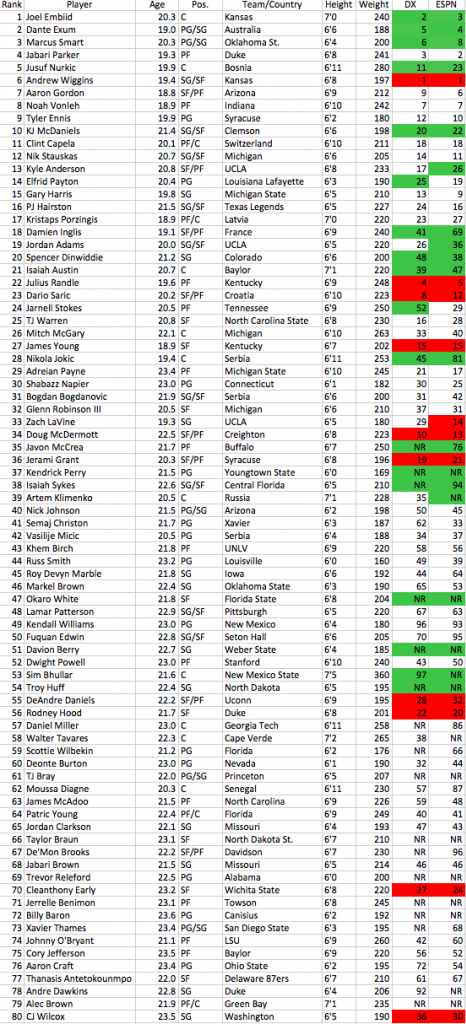
So now that we officially have the draft class set, I can publish my first big board specific to 2014!

Notes:
-Age is as of draft night
-This is not where I think players *will* get drafted, it’s where I think they *should* get drafted.
-I am aggressively thin slicing the international prospects and will modify my placement of them as I learn more about them.

Big Board

Before people new to the site get upset over my bold stances, I have detailed explanations for my contrarian positions.

Top Players: Save for Jabari Parker, all are underrated at this juncture: Joel Embiid, Dante Exum, Marcus Smart, Jusuf Nurkic

Overrated players: Andrew Wiggins, Julius Randle, Doug McDermott, Zach LaVine.

If you are wondering why some fringe first rounds such as Hood, Early, and Wilcox are buried so deep, I wrote about it in my post regarding the 2nd round lotto

Internationals:
-At age 19, Clint Capela was 2nd in French League PER narrowly behind 27 year old Ahmad Nivins. Good stats, good tools, and youth are the three important traits to seek in prospects on a macro level, and he checks all 3 boxes.

-Kristaps Porzingis is one of the youngest prospects in the draft. He is 7’0 and racks up steals and blocks and sometimes hits 3’s. He is fairly thin at 220 pounds and doesn’t rebound well, but his baseline package of height, defense, and shooting is rather compelling.

-Damien Inglis essentially shares LeBron James’s body with longer arms and merely decent athleticism. He doesn’t score much and his shot mechanics are questionable, but his small sample shooting stats are good and he gets good rebound, assist, and steal totals. He could become a stronger Nicolas Batum and appears to be vastly underrated.

-Nikola Jokic brings a high skill level and questionable tools. He is 6’11 253 with a 7’3 wingspan, but lacks speed and athleticism. He atones for this with good passing, shooting, and basketball IQ. His Adriatic League stats are strong in spite of struggling from 3 (15/68 = 22.1%). He has a similar skill set to Brad Miller.

NCAA:
–KJ McDaniels has been one of the most underrated prospects in the draft all season long and he is still underrated. He is a great defensive prospect with solid offensive potential as well

-DX and ESPN are finally catching onto Elfrid Payton’s goodness. He is a high upside PG with two way potential for the few teams that need a PG.

-Jordan Adams is such a weird prospect. He has great skill level and feel for the game but largely underwhelming tools. But his stats are so good for his age he is worth a gamble in the back end of round 1.

-Spencer Dinwiddie’s stock takes a slight hit due to him coming off an ACL tear, but he is an intelligent prospect who has the skills and tools to become a solid role playing SG that easily fits into any NBA lineup.

-Isaiah Austin is a rare top 5 recruit that is underrated at draft time. He has plenty of warts (poor finishing, mediocre rebounding, questionable feel) but he has an invaluable pairing of strengths: rim protection and 3 point shooting. I recently wrote that Julius Randle lacking these strengths submarines his stock in spite of his other goodness, and this theory applies in the opposite direction for Austin.

-I have a hard time getting excited for James Young. He requires significant offensive improvement to be worth anything, and even if he becomes a quality scorer his defense will still likely be a concern.

-Jerami Grant is somewhat difficult to peg. His value is largely based on defensive potential, which is difficult to assess as he played in the back of Syracuse’s zone. His other big question is: how does he fit into an NBA offense if he doesn’t develop surprising 3 point range?

-DeAndre Daniels’s stock has blown up following UConn’s title run. Color me skeptical. He is old for his class, rail thin, and never passes. His strengths are not strong enough to merit 1st round consideration. I prefer Okaro White who is slightly better in a similar mold, but projects to go undrafted.

-Sim Bhullar is 7’5 360 and is generally regarded as not draftable. I think he is worth a flier in the back end of round 2, as he has quite a bit of upside to improve his body and may be less stiff-like in the case that he successfully does so.

Posted by deanondraft | Filed under Big Boards

≈ 26 Comments

Top Posts & Pages

  • Is Luka Doncic The Best Prospect Ever?
    Is Luka Doncic The Best Prospect Ever?
  • Draft Combine Reactions
    Draft Combine Reactions
  • Where Does Paolo Banchero Fit in the Modern NBA and 2022 Draft?
    Where Does Paolo Banchero Fit in the Modern NBA and 2022 Draft?
  • The Meaning Of Tweener
    The Meaning Of Tweener
  • Marcus Smart: An Intelligent Defensive Player
    Marcus Smart: An Intelligent Defensive Player
  • Reactions From The Combine
    Reactions From The Combine
  • How Good Are the Thompson Twins?
    How Good Are the Thompson Twins?
  • The Draft Starts With Defense: The Curious Case of Doug Mc-No-D
    The Draft Starts With Defense: The Curious Case of Doug Mc-No-D
  • 2021 Final Big Board
    2021 Final Big Board
  • The Bigger O: is Oscar Tshiebwe a Sleeper in Round 2?
    The Bigger O: is Oscar Tshiebwe a Sleeper in Round 2?

Recent Comments

deanondraft's avatardeanondraft on Summer League Scouting: Cade…
Noble's avatarNoble on Summer League Scouting: Cade…
deanondraft's avatardeanondraft on 2023 Draft Mid-Season Boa…
cloudsean's avatarcloudsean on 2023 Draft Mid-Season Boa…
deanondraft's avatardeanondraft on Summer League Scouting: Cade…

Create a free website or blog at WordPress.com.

Privacy & Cookies: This site uses cookies. By continuing to use this website, you agree to their use.
To find out more, including how to control cookies, see here: Cookie Policy
  • Subscribe Subscribed
    • Dean On Draft
    • Join 57 other subscribers
    • Already have a WordPress.com account? Log in now.
    • Dean On Draft
    • Subscribe Subscribed
    • Sign up
    • Log in
    • Report this content
    • View site in Reader
    • Manage subscriptions
    • Collapse this bar