• Home
  • About
  • Big Board
  • NCAA
  • International
  • Miscellaneous

Dean On Draft

~ NBA Draft Analysis

Dean On Draft

Category Archives: Uncategorized

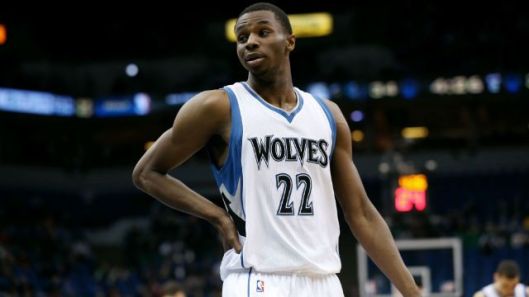
Andrew Wiggins is a Bust

29 Tuesday Nov 2016

Posted by deanondraft in Uncategorized

≈ 85 Comments

wigginsrest2

At age 21 Andrew Wiggins still has a long NBA career ahead of him, and a significant amount of time to improve his game. But with two full seasons and ~20% of a third under his belt, we have a substantial sample to assess the early returns on his NBA goodness.

It is fair to avoid extreme conclusion jumping after a player’s rookie season, but most stars show signs of their greatness in their second and third seasons, which will be the focus of this analysis. Let’s start with the rosiest statistical lense for Wiggins: PER. PER is the least predictive catchall statistic, and it overrates players who are precisely in Wiggins’s mold: high volume of shots at mediocre efficiency and little other value. First let’s compare him to the stud defensive wings with whom he was favorably compared pre-draft:

Player Y2 Y3
Leonard 16.4 19.4
Deng 15.8 18.7
Iguodala 14.8 18.1
George 16.5 16.8
Metta 13.6 15.8
Wiggins 16.5 15.7

He is dead last in season 3, but that is a smaller sample than year 2 where he was clustered with Paul George and Kawhi Leonard for the top spot. He has plenty of time to rise to the middle of the pack in year 3 with 65 games remaining, and overall this looks not bad for him. But you also see the limitations with PER when a player like Luol Deng is rated similarly to Kawhi Leonard and Paul George, and this isn’t an apples to apples comparison when Wiggins has a higher usage than any of these types. Now let’s compare him to wing stars who actually took shots:

LeBron 25.7 28.1
Durant 20.8 26.2
Carter 23.4 25
Pierce 19.8 22.3
Carmelo 16.7 22
McGrady 20.6 20
Wiggins 16.5 15.7
Gay 17.4 15.3

In year two Wiggins was in last place, and in year three he so far trails every player except Rudy Gay. Further, Rudy Gay had a lower usage over the same span (25.3 vs 27.6), which implies less artificial PER padding. This should not be surprising to anyone who read my comparison of Wiggins to Rudy Gay from July 2014.

In year two he was in last place and in year three he trails everybody other than Rudy Gay by a huge margin.  Further, Rudy Gay actually had a lower usage over the span (25.3 vs 27.6), which implies less artificial PER padding.

Overall the most optimistic lense does not look all that promising for Wiggins.

Now let’s look at WS/48 which places greater value on efficiency and team success. There’s no need to cluster scorers any more since WS does not have any biases toward high usage:

Durant 0.132 0.238
LeBron 0.203 0.232
Leonard 0.166 0.193
Deng 0.12 0.176
Carmelo 0.09 0.153
George 0.148 0.145
McGrady 0.143 0.129
Iguodala 0.116 0.12
Metta 0.039 0.079
Wiggins 0.069 0.059
Gay 0.08 0.054

Now all of the defense first types other than Metta World Peace have zoomed ahead of him. Other than Metta, Wiggins has Rudy Gay once again keeping him company at the bottom.

The most predictive metric to be found on basketball reference’s stat page is BPM. It highly values the intersection of rebounding and assists, as players who do both tend to be good and players who do neither tend to be bad. Intuitively it makes sense, as anybody who has the intersection of physical ability required to rebound and mental ability and skill level to accrue assists is probably good. Unfortunately Wiggins is bad at both, and this paints him in the most pessimistic light:

Player Y2 Y3
LeBron 8.3 9.3
Leonard 3.9 5.8
Durant 1.8 5.1
George 3.9 4.7
Iguodala 2.1 3.4
McGrady 4 3.2
Metta -0.7 2.9
Deng 0.9 2.7
Carmelo -1.2 1.5
Gay 0.8 -1.4
Wiggins -2.1 -4

Now this ordering makes the most sense. LeBron stands out as the superduperstar that he is, and the defensive stars finally get their due for their impact on that side of the ball. Kawhi Leonard won finals MVP in his third seasons and Paul George led the Pacers within one win of the NBA finals, which are examples of how BPM is much more reflective of the truth than PER.

Even Rudy Gay scoffs at Andrew Wiggins’ BPM. Wiggins does almost *nothing* other than score with limited efficiency, and BPM illuminates the myriad holes in his statistical profile. In his 2nd season he was approximately a replacement player, now early in his 3rd year he has been twice as bad as a replacement player.

Of course this is the most negative perspective from which to view Wiggins– but it is interesting food for thought. Everybody always assumed his downside was a better version of Rudy Gay, but what if he is actually a worse version of Rudy Gay?

What about RPM?

The only remaining argument is that Wiggins statistics may undersell his defensive impact, as his athleticism and quickness gives him the ability to prevent easy shots even when he is not racking up blocks and steals. But his defensive real plus minus this year is -2.4 and last year was -1.8, which implies that he is extremely bad on that end. This should not be surprising to anybody who read my pre-draft analysis that Wiggins was not a guaranteed defensive stud.

The upside is that his offensive RPM is slightly positive in both samples, so his overall RPM’s have been -1.2 last year and -2.1 this year. Since his year 2 is the bigger sample, that overall puts him above replacement but clearly below average. I believe this is a reasonable approximation of the truth.

But stats do not tell the whole story!

This is true, but even if he is secretly better than the stats portray, it is hard to find a perspective showing he is on the path to greatness. Every great player had some *clear* indication that they were on the path to greatness by now. Even most fringe all-stars had much better indicators at this stage.

The best source of hope is DeMar DeRozan, who has a similar physical profile and game to Wiggins. He was slightly weaker in PER, WS/48, and BPM in his first 3 seasons, and while he is a good athlete drafted in the lottery, he does not compare to Wiggins’s #1 overall elite athleticism. Both players thrive off of mid-range scoring and drawing free throws. If Wiggins follows DeRozan’s outlier developmental curve, he should peak as a slightly superior version of DeRozan.

But is it truly a happy outcome if he becomes DeRozan? Toronto had to max DeRozan to keep him around, and many intelligent people would argue that this was an unfavorable contract for him. If Wiggins becomes a better version, he may be worth the max by a hair, but that is also a highly optimistic outcome.

Conclusion

At this stage Andrew Wiggins is clearly not on the path to greatness. He has no chance of becoming a top 10 player, and the optimistic comparison is akin to DeMar DeRozan or something slightly better. This is a dreadful upside scenario for a former #1 overall pick.

It was clearly a massive mistake to draft him #1 overall with a generational talent such as Joel Embiid on the board. While Embiid’s ability to stay healthy long term remains in question, it is clearly a more worthwhile gamble than hoping Wiggins magically becomes good at basketball.

I believe that ranking him #7 on my 2014 final big board has been vindicated as a fair ranking.

The value of a #1 pick lies in the star potential of the player chosen, and thus far Wiggins has shown close to zero star upside. It is time to stop treating Wiggins as a potential star– at this point he is a just a super athlete who has a sliver of NBA upside that will not be franchise changing. Even if he may go on to have a decent career, given his draft hype and #1 overall selection it is not too soon to say that Andrew Wiggins is officially a bust.

2017 Draft Preview

20 Thursday Oct 2016

Posted by deanondraft in Uncategorized

≈ 9 Comments

3562503

The 2017 draft is an exciting time for tankers, as this year’s freshman class is full of all sorts of tanking prizes. It’s thin on upperclassmen and internationals, so its depth may be limited but the top 10 is particularly strong. Here are my lottery picks:

1. Markelle Fultz 6’4″ PG/SG Washington

Fultz has superstar written all over him, as he is long, athletic, and can do everything offensively. He also has potential to be good defensively, and he is one of the younger freshmen. He needs to continue to develop his outside shot and skill level, but there is little to dislike about him as he profiles as a more athletic D’Angelo Russell.

There is plenty of room for him to be unseated as the #1 pick by draft time, but as of right now he stands out as the only player in the class who is a strong bet to be an all-time great NBA player.

2. Josh Jackson 6’8″ SF Kansas

Jackson is an elite athlete who does everything off the ball that amounts to winning– rebounding, defense, passing, cutting. He also has potential as a scorer due to his elite athleticism, and overall it seems unlikely that he slides out of the top 5 based on how many things he does well. But there are concerns about his shot, he only has a 6’10” wingspan, and he is sophomore aged as he is 15 months older than Fultz. So it is possible that he develops into merely a great role player rather than a full fledged superstar.

3. Dennis Smith Jr. 6’2″ PG NC State

Smith appears to be a hybrid of Chris Paul and John Wall, as he offers the rare intersection of efficiency and athleticism. Offensively, his 3 point shot is unreliable but he is otherwise elite at creating high % shots for himself and others while maintaining a low turnover rate.

His wart is that he measured 6’1.5″ w/ 6’3″ wing at age 16.  He should be bigger by draft night, but still will be small even for a PG and will likely struggle to switch onto SG’s. The mitigating factor is that he has a reputation of being elite defensively, and this is supported by stats as he has a great rebound rate and outlier good steal and block rates for a little guy. He plays much bigger than his size, and he has a good chance of nevertheless becoming a positive perimeter defensive player.

If his shooting and efficiency are lackluster, the height and length puts a damper on his draft upside. But if he shows shades of Chris Paul offensively, he can be an exciting candidate for #1 overall.

4. Lauri Markkanen 7’0″ PF Arizona

Markannen is 7’0″ with elite coordination, which is an overpowered combination of baseline traits. He shares this intersection of traits in common with the top 3 prospects of the decade thus far– Towns, Davis, and Embiid.

Of course that’s where the similarities ends, as all three are great rebounders and shot blockers and Markkanen is not. But Lauri has his own bag of tricks, as he has great mobility, an elite 3 point shot, and excels at putting the biscuit in the basket from all parts of the court. He was hyperefficient for Finland’s FIBA u20 team this summer in spite of playing with limited help:

mins pts 2P% 3P% FT% TO
Lauri 186 187 54.9% 39.4% 83.3% 13
Not Lauri 1239 306 39.7% 24.2% 57.1% 115

He also led his team in rebounds, blocks, and steals– all by comfortable margins. His best game came in a win against eventual champion Spain. It was Spain’s only loss and Lauri scored 33 points using 21 possessions, and also had 5 steals and 2 blocks.

He accomplished this with elite shooting, touch, and footwork supplemented by a quick first step that enables him to attack off the dribble from the perimeter or the mid post.

The questions he will have to answer at Arizona revolve around his passing and defense. He only posted 7 assists for Finland, which isn’t the most concerning flag considering the disparity between his efficiency and that of his teammates. He seems to see the floor well based on his high steal rate and low TOV rate, but he still needs to prove that he could move the ball as a part of a more balanced offense.

Lauri lacks length, strength, and explosiveness, which limits him as a rebounder and rim protector. But he moves his feet well and can switch onto smaller players and force steals, so he nevertheless has upside to be a useful cog on this end– especially in a defense that switches heavily.

Frankly he has so much offensive upside he doesn’t need to play solid defense to be an exciting prospect. But since he does have a hint of defensive upside, he has a chance of entering the conversation at #1 overall.

5. Harry Giles 6’11” C Duke

Giles is an elite physical specimen, as his physical profile is similar to that of Dwight Howard. He also seems like a similar prospect to Dwight, as he uses his athleticism to rack up points and rebounds, but could stand to pass more often be more consistent on defense. It’s hard to say whether he will turn out closer to the Rockets version of Dwight or the Magic version, but that is nevertheless a compelling range of outcomes.

The lingering issue is that he already tore his ACL two times in high school, and recently had his knee scoped for a 3rd surgery and will miss the early part of the NCAA season. The injury frequency puts a dent in his prospect value, and may make GM’s squeamish about gambling on him early with so many other great players available.

6. Frank Ntilikina 6’5″ PG France

It’s hard to know what to think of Ntilikina since he is sheer potential. His prospect profile is similar to that of Dante Exum– his main tool is his combo of 6’5″ height with 6’11” length, and he is more of a smooth than explosive athlete. DX really gushes over his PG skills, vision, defense, intangibles, and also notes that he is a 85% FT shooter. Exum is a cautionary tale of overrating an unproven slashing wing with non-elite athleticism, but I do not recall any scouts writing as glowingly about his game like DX for Ntilikina.

Ntilikina predictably struggled badly as a 17 year old string bean PG in the French league. He appears to be improved in 15 mpg through his first 4 games of this year, and it will be interesting to see if he can supplement the scouting report with a respectable 18 year old season against professional adults.

7. Jonathan Isaac 6’11” SF Florida St.

Isaac is 6’11” with perimeter skill and the quickness to guard perimeter players, which gives him awesome upside. He is a notch down from the tanking tier because his production has not been as elite as the top players in the class, but with a strong freshman season at FSU he can ascend.

8. De’Aaron Fox 6’3″ PG Kentucky

Fox is a funky prospect– he has elite speed, quicks, defense, and has legitimate PG skills, but his rail thin frame and mediocre shot raise the valid question: can he score? Elite defensive prospects are often underrated, but he’s slightly small to guard SG’s and he needs to offer scoring upside to justify a top 10 selection. That said his athleticism gives him the possibility of such, and he becomes highly intriguing if he hints at a nice offensive upside.

9. Ivan Rabb, 6’10” PF California

Rabb is the lone upperclassmen who has a valid case as a lottery selection. He profiles similarly to Jakob Poeltl and the Zellers, as a elite complementary scorer on offense who has decent enough tools and smarts to be a solid defensive piece. He’s likely to be a quality NBA player, and the question for him will whether he has enough upside to sneak into the top 5.

10. Jarrett Allen 6’11” C Texas

Allen has all of the traits of a great role playing big– he can protect the rim, hold his own on switches, and has potential as a pick and roll finisher with soft hands and touch. He also is a giant at 6’11” with a 7’5.5″ wingspan and doesn’t turn 19 until April. He is not an elite athlete or shot creator, but he has the profile of a player who translates well to the NBA in spite of the current trend toward smaller lineups.

11. Lonzo Ball 6’6″ PG UCLA

Ball may be the weirdest prospect in the class. He has good height for a PG but is super skinny and lacks elite athleticism or scoring ability. But outside of athleticism and scoring he rocks at everything, as his elite vision and instincts causes him to stuff the stat sheet with assists, rebounds, blocks, and steals. He seems like a mini version of Kyle Anderson who moves at regular speed, and likely will be polarizing as his profile on draft night.

12. Jayson Tatum 6’8″ SF Duke

If you love Jabari Parker, then you will likely love Jayson Tatum too. They both specialize in isolation scoring with limited efficiency because they prefer to not take 3’s and can stunt the offense by stopping the ball and underpassing. Also while he has good enough instincts for decent steal and block totals, he is not a consistent defensive player. Further, he is more of a fluid athlete than an explosive one.

Unfortunately I do not love Jabari, and I am naturally skeptical of Tatum. He can prove me wrong by meshing with the Duke super team better than expected by moving the ball, attempting more 3’s, and playing solid defense. But until that happens I am a seller of Tatum as the clear fraud of the consensus top 5.

13. Marques Bolden 6’11” C Duke

Bolden profiles similarly to Jarrett Allen, as they have the same height (6’11”) and Bolden’s wingspan is just 0.5 inch longer (7’6″) and Bolden is 4 days older. They both project as rim protectors with capability to switch on pick and rolls, as well with soft hands and touch for finishing on offense. I slightly favor Allen because Bolden has rebounding and passing flags, and I am not sure consensus has it the other way around.

14. Rodion Kurucs 6’8″ SF Latvia

I’m running out of freshmen that I like, so let’s roll with an international that has stuffed the statsheet his his limited sample of overseas play, especially with steals and blocks.

Other freshmen of note:

Bam Adebayo 6’10” PF Kentucky

Bam is the one player who is a consensus lottery pick where I disagree. His physical profile is nice as he is 6’10” with great athleticism and strength, but he doesn’t seem to offer much outside of garbage play. His skill level is low, and his offense is limited to putbacks, transition, and bullying smaller players with his overdeveloped body.

Defensively he has the tools to be good, but lacks the reach to be a rim protector and the quickness to switch onto guards. Combined with questionable instincts and effort, he likely will be lackluster on this end in spite of his physical strengths.

He is a bit old for the class as he turned 19 in July, and seems to be the player who may struggle to translate up as his opponents become increasingly able to match up with him physically. It’s possible that his instincts are fine and he’s just a low skill albeit useful garbage man, but either way he does not inspire thrills.

Malik Monk 6’4″ SG Kentucky

Monk comes in the mold of JR Smith, as he is hyper athletic and elite at scoring, but has a reputation for playing lackadaisical defense. He did score high volume efficiently while being a willing passer in AAU, and if his offense translates well to the NCAA he could end up deserving a lottery selection.

Miles Bridges 6’6″ SF Michigan State

Bridges is a consensus late 1st rounder, and that seems about right as he could go either way between lottery and 2nd round. There are questions about his height, whether he has the skill to score efficiently, and whether he will play consistent defense. It is plausible he struggles on both ends and falls out of the first round.

But it is also plausible that he has more offensive polish than expected, and his defense could easily be good as he is a great rebounder and shot blocker for his size. He has clear two way potential, and can easily rise into the lotto with a strong freshman campaign.

Omer Yurtseven 7’0″ C NC State

Yurtseven is a Turkish import who has yet to be ruled eligible to play NCAA basketball this season. He is a smooth and skilled big man who is super young, as he turns 19 several days before the 2017 draft. He will likely not be a rim protector as he lacks length and explosiveness, but he is mobile and intelligent enough to hold his own on defense while contributing interior scoring and rebounding. I rate him worthy of a late 1st selection.

Rawle Alkins 6’5″ SG/SF Arizona

Alkins is the 5* recruit outside of draft radar most likely to establish himself as a 1st rounder. He offers a little bit of everything, and as far as I can tell does not have any glaring weaknesses. He is listed a 6’5″ 220 pounds and has great strength. He is a good but not great athlete, and overall seems physically comparable to Marcus Smart.

Statistically he profiles as above average but not elite across the board. He does a little bit of everything, and DX profiles him as a great defensive player.

His biggest weakness is that he does not have any one individual aspect about him that is elite, but other than that there are no immediately discernible flags in his profile. Alkins seems to be a solidly good player who has a myriad of subtle edges that up to more than scouts realize.

Terrance Ferguson 6’7″ SF Australia

Ferguson was a top 15 recruit who committed to Arizona, and then changed his mind to play professional basketball for Australia. His selling point is that he is a prototypical 3 + D wing, as his size, quickness, and athleticism gives him potential to be a defensive stopper.

The trouble with this narrative is that he is an especially weak rebounder. Between FIBA play, Adidas Nations, Hoop Summit, and his first 4 Australian games he has 57 rebounds in 639 minutes. This is a frighteningly low rate, as diminutive non-athlete PG’s such as Trey Burke, Tyus Jones, and Tyler Ennis posted higher rebound rates in their NCAA samples.

His lackluster steal and block rates do not assuage the rebounding concerns. The best defense is that he is young and only weighed 186 pounds at the Hoop Summit shortly before turning 18, and should improve as he ages and fills out his frame. But it is nevertheless difficult to envision any elite defensive player struggling so badly to corral rebounds, and in all likelihood his instincts and/or motor are broken to some extent.

Without elite defensive upside, he is not a compelling prospect. He is a good but not great shooter who scores low volume with poor efficiency inside the arc, rarely draws FT’s, and has as many TOVs as assists in spite of being largely a catch and shoot player offensively. His offensive limitations are extreme, and with such alarming defensive flags there is simply no justification for drafting him in round 1.

Deep Sleeper Freshmen:

All of the players outside of the top 25 are clear underdogs to become viable prospects, but here’s my quick hitting list of 4* recruits that could emerge onto draft radar if they perform above expectation:

De’Ron Davis is a 6’10” skilled PF for Indiana who uses his long arms to rack up steals and blocks and has a shot of developing into a stretch 4. He lacks athleticism and is sophomore aged, but is an intriguing prospect if he produces well.

Kevin Huerter is a 6’6″ Maryland SG who will still be 18 on draft night. He’s an elite passer and shooter, and has the physical tools to be hold his own on defense. He is not much of a ball handler and his 6’7″ wingspan inhibits his upside, but he has a great skill set for a role playing wing.

Trent Forrest is a 6’5″ Florida St. SG who turns 19 shortly before draft night. He is a good slasher, passer, rebounder, and defensive player whose big flaw is a lack of a jump shot. But if he shows flashes of shooting potential, he’s so young he becomes highly intriguing.

Robert Williams is a 6’8″ Texas A&M PF who uses his elite wingspan and athleticism to block loads of shots. Offensively he is raw, but has traces of passing and outside shooting ability which most pogo sticks normally lack. One caveat: I have no idea how old he is.

Tyler Cook is a 6’9″ athletic PF who appears to be a low post garbage player based on his AAU stats, but it sounds like Iowa intends to use him as point forward. If he shows legitimate perimeter skills, he will enter draft radar.

Let’s talk about Sophs

Outside of Rabb the class is thin with talent, but I will nevertheless highlight a few.

Edmond Sumner 6’5″ PG Xavier

At a glance it seems curious a former #140 RSCI who had a solid but unspectacular redshirt freshman season burst onto 1st round radar this offseason. But it’s easy to see why he fell through the RSCI cracks– he experienced a late 4 inch growth spurt in high school, and he was extremely thin as he measured 6’4″ 149 pounds. He redshirted his freshman year with knee tendonitis because of the growth spurt, so last season was the first time he was able to showcase his new body which is now 6’5.5″ 181 lbs.

He compares closely with Dejounte Murray, as they boast similar stats, bodies, and shiftiness. Murray has the key advantage of being 10 months younger, but Sumner is quicker and more athletic. If forced to choose I’d take Murray’s youth, but I like Murray and I believe Sumner is worthy of a first round selection. He has upside for one of the biggest leaps in NCAA basketball this season, and if he improves enough he could rise into the top 10.

OG Anunoby 6’8″ SF/PF Indiana

Anunoby is another RSCI whiff, as he was just #261. He is a young sophomore, as he will still be 19 on draft night, so his youth likely worked against him and he was perceived as a raw 6’8″ PF.  And he was still raw as a freshman, as he was mostly limited to putbacks and transition scoring. He did make 13 of 29 3PA, but his low rate and 48% FT imply his 3P% is not nearly sustainable. He also was a non-passer, and his offensive limitations cast doubt in his ability to fit into an NBA offense.

But his defensive versatility is extremely tantalizing, as he is long, strong, and quick and fits great into a switching defense. He also had good steal and block rates as a freshman, implying that his instincts are likely good. He’s a great defensive prospect, the only question is whether he can avoid being an offensive disaster in the NBA.

Jawun Evans 6’0″ PG Oklahoma St.

Evans is just 6’0″ with a 6’4″ wingspan and lacks elite athleticism, which means he needs to be extra special at something to contribute value in the NBA. Based on his freshman year, his PG skills seem to be special as he showed excellent passer vision and was also stellar at creating his own shot at the rim. He used his shiftiness, handles, and ability to convert tough shots in traffic into creating a large volume of offense.

He also rebounded well for a freshman and played solid defense. He did not shoot a high volume of 3’s, but he made 19/40 of his 3PA and 83% FT to imply some level of shooting potential.

His NBA upside is heavily inhibited by his physical limitations, and it will likely keep him from getting picked in round 1. But he showed an impressive level of basketball skill as a freshman, and if he continues to improve as a sophomore it may be worth rolling the dice on him in the late first.

Kerwin Roach Jr 6’3″ PG/SG Texas

Roach is one of the most athletic players in college basketball, and has potential for a breakout sophomore season. His big warts are that he’s small for a SG and lacks true PG skills. Also his outside shot need improvement, and he was heavily foul prone as a freshman due to poor defensive fundamentals.

But he nevertheless showed a strong degree of potential. He showed the ability to create offense and finish in the paint, draw FT’s, and he had solid rebound, assist, steal, and block rates. He especially improved in the 2nd half of the season, when he cut down on his turnovers and started scoring higher volume with vastly improved efficiency.

Now with veteran PG’s Isaiah Taylor and Javan Felix departed, the offense will run through Roach. He has a wide range of possible outcomes, but if he showcases improved shooting and better point guard skills than expected, he could skyrocket up draft boards.

Thomas Bryant 6’10” PF/C Indiana

Big man is a dying breed in the NBA, and the specific type that is dying the fastest is the Thomas Bryant type. He is efficient offensively, shows traces of a 3 point shot, and is a solid rebounder. But he can neither defend the perimeter nor protect the rim because he lacks quickness and explosiveness. His 7’5.5″ wingspan mitigates the problem defensively, but he is bad defensively and projects to be a major liability in the NBA.

1) NBA is trending toward heavily switching defenses– Bryant does not fit into such a scheme

2) Teams are learning to hunt weak links in opponent defenses. Kevin Love became unplayable in the finals because he was being so badly exploited on defense, and Kevin Love is an excellent offensive player.

Bryant was a super young freshmen, so it is possible he takes a sophomore leap. But even if his offensive game improves a boatload, he will never be better than Kevin Love offensively and most of the time he will be significantly worse. His defensive shortcomings are a significant achilles heel that prevents him from deserving a round 1 selection.

Dwayne Bacon 6’7″ SF Florida St.

DX currently has Bacon as their #40 pick and ESPN has him in the 31-35 range. I have two issues with this:

  1. He is already 21 years old
  2. He is not good at basketball

He was the #17 RSCI player, which in theory suggests he has upside for a big leap next year. He is a good athlete so this is plausible. But it is worth wondering whether his recruiting hype was due to him being more physically developed than his peers due to his age advantage. His tools are good but not good enough to be worth gambling on in spite of his poor production.

At the moment, Bacon is not a prospect and should be nowhere near draft radar.

Juniors and Seniors

This collection is also thin. They are all longshots to be lottery caliber:

  1. Luke Kornet
  2. Monte Morris
  3. Josh Hart
  4. Nigel Hayes
  5. Svi Mykhailiuk
  6. Keita Bates-Diop
  7. Jordan Bell
  8. Grayson Allen
  9. Devonte Graham
  10. Vince Edwards

Post Draft, Pre-SL Prospect Re-Rank

08 Friday Jul 2016

Posted by deanondraft in Uncategorized

≈ Leave a comment

I know there have been a handful of summer league games involving meaningful prospects, but I largely have not paid attention and this ranking does not price in any early games at all.

I rank all 60 drafted players plus top 2 UFA’s Gary Payton and Robert Carter. I am completely guessing on Michineau and Zhelin since I know next to nothing about them:

rank player draft
1 Brandon Ingram 2
2 Ben Simmons 1
3 Dragan Bender 4
4 Jamal Murray 7
5 Kris Dunn 5
6 Jaylen Brown 3
7 Marquese Chriss 8
8 Jakob Poeltl 9
9 Wade Baldwin 17
10 Chinanu Onuaku 37
11 Domantas Sabonis 11
12 Dejounte Murray 29
13 Caris LeVert 20
14 Juan Hernangomez 15
15 Furkan Korkmaz 26
16 Henry Ellenson 18
17 Taurean Prince 12
18 Buddy Hield 6
19 Timothe Luwawu 24
20 DeAndre Bembry 21
21 Patrick McCaw 38
22 Georgios Papagiannis 13
23 Skal Labissiere 28
24 Zhou Qi 43
25 Brice Johnson 25
26 Ivica Zubac 32
27 Malik Beasley 19
28 Thon Maker 10
29 Deyonta Davis 31
30 Ante Zizic 23
31 Denzel Valentine 14
32 Cheick Diallo 33
33 Guerschon Yabusele 16
34 Rade Zagorac 35
35 Paul Zipser 48
36 Demetrius Jackson 45
37 Pascal Siakam 27
38 Damian Jones 30
39 Isaia Cordinier 44
40 Gary Payton 61
41 Stephen Zimmerman 41
42 Malcolm Brogdon 36
43 Isaiah Whitehead 42
44 Malachi Richardson 22
45 Kay Felder 54
46 Robert Carter 62
47 Daniel Hamilton 56
48 Jake Layman 47
49 Petr Cornelie 53
50 AJ Hammons 46
51 Tyler Ulis 34
52 Diamond Stone 40
53 Joel Bolomboy 52
54 Isaiah Cousins 59
55 David Michineau 39
56 Marcus Paige 55
57 Tyrone Wallace 60
58 Michael Gbinije 49
59 Georges Niang 50
60 Ben Bentil 51
61 Abdel Nader 58
62 Wang Zhelin 57

Post Draft Perspective Update

25 Saturday Jun 2016

Posted by deanondraft in Uncategorized

≈ 2 Comments

635934019592092463-jamalmurrayarrow

The challenge with the draft is that there are limitless perspectives on each prospect to balance to attempt to discern the truth. It is common for me to completely overhaul my perspective on a player once viewing them in a new light. In 2014 I went from perceiving Aaron Gordon as an overrated and worse shooting Josh Smith to an underrated stud near the top of my big board after watching him play regularly. It is rare to precisely analyze a prospect at first glance, which is why I am perpetually updating my perspectives.

Honestly I don’t think my analysis this draft was particularly good. It was a last minute attempt to piece everything together, and I feel like I missed a number of key perspectives in a hasty attempt to resemble a respectable big board.

Jamal Murray

I ranked Jamal Murray 12th on my final big board on the premise that he is a one dimensional shooter who will be a defensive liability. This is a popular narrative in the draft contrarian world, but I have underrated players as one dimensional shooters such as Devin Booker and Rodney Hood in the past.


The key factor that separates Murray from Buddy Hield (aside from his youth) is his court vision. He did not have the burst or shake to regularly beat opponents off the dribble, and deferred PG duties to Tyler Ulis and Isaiah Briscoe, but he clearly has some level of PG skills and decent vision as he posted a solid assist:TOV rate for a young high usage SG.

He also was able to get to the rim at a reasonable rate, and posted a better ORB% than Jaylen Brown. His athleticism is not great, but it is also not bad, and his youth gives him plenty of time to develop into a complete offensive player.

Further his catch all  NCAA statistics were strong as he beat Brandon Ingram in PER, WS, and BPM while only being 6 months older.

He likely will be a defensive liability who struggles to switch onto bigger and quicker opponents, but he is not necessarily going to be a disaster. And either way it is easy to envision how he has the upside to become an offensive star to outweigh his defensive shortcomings.

So after a full season of Murray skepticism, I will finally acknowledge that he was likely the best player available at #7, and may even be better than Jaylen Brown or Kris Dunn. It was a massive error for New Orleans to draft Hield ahead of him.

Deyonta Davis

The most surprising slider on draft night, Davis was expected to go lottery and ended up dropping all the way to the 2nd round. My speculation was that he may have injury flags, but on second thought it is more likely that he just is not that good.

He was largely a garbage man on offense for Michigan State, and was the beneficiary of many lobs from the best passer in NCAA basketball. He had a frighteningly low FT rate, which could flag any number of flaws from toughness, to creation, to basketball instincts.

Defensively he had a good block rate, but he did so anchoring Tom Izzo’s worst defense since 2004. His steal rate was a flag and he simply might not be much more than a Skal type who tries to sway everything on that end.

But unlike Skal he is not 7′ tall, he is only a good but not great athlete, and he does not have a 3 point shot. His tools are good but not good enough to amount to much without much in the way of feel for the game or basketball instincts. He is a better rebounder than Skal and may have less broken instincts, but between the two of them I would rather gamble on Labissiere and his more unique strengths.

I had Davis ranked as 6th on my final big board, but after perceiving him through a negative lense he seems to be have been picked where he deserved to go. I drop him big time on a re-rank. Skal I would drop from 14th, but I nevertheless believe was a solid gamble at 28th overall.

Timothe Luwawu

I had him ranked 8th on my final big board, and he slid to 24th. There are logical reasons- he is 21 and his Adriatic stats are underwhelming. I had likened him to a poor man’s Jaylen Brown, but his tools are clearly inferior and he is not more productive at 1.5 years older. There is still reason to find him as good value in the late 1st, but there is good reason to temper expectations.

Caris LeVert

I had LeVert ranked 31st on my final big because he had no hype on DX and ESPN, and I assumed his medical flags scared teams off. But when the Nets reached for him at 20th, I took it as an indication that his medical records cannot be bad. I definitely like him as a 1st rounder if health is not a big concern, so I am bumping him up my board.

Denzel Valentine

I had him ranked 25th and he ended up going 14th to Chicago. If I could re-rank, I’d slot him even lower as I missed the concerns about his knee injury. This pick reminisces of the Bulls taking Doug McDermott in the lottery as they were desperate for a shooter ready to contribute now and instead took a shooter ready to contribute never. Valentine is a more dynamic offensive threat than McDermott with elite passing, so I rate this pick as slightly better. But he shares the same concerns with no slashing game and major defensive vulnerability, so with the knee injury as a cherry I’d grade this is a big reach by the Bulls.

Dejounte Murray
Chinanu Onuaku
Zhou Qi

These were my 3 super value picks who I maintain are super value. Onuaku and Qi were expected to go late for bad reasons, and statistical wizard Daryl Morey recognized this and wisely snatched them up. Onuaku is especially good value as he less of a mystery box and just blatantly good– there is absolutely no excuse for him sliding out of round 1.

Dejounte Murray is a boom or bust pick that I felt warm toward, and the fact that the Spurs took him re-affirms that notion for me. I had him 13th on my final big board, and he did slide all the way to 29th so perhaps I slightly overrated him. But more likely he was great value for the Spurs like always.


I Have No Idea What These Guys Are

I rated all of these players as early 2nd rounders, and they all went in the top 16. I really have no definitive conclusions for any of them, but I do have guesses!

Thon Maker

Thon Maker looked like a disaster sharing the floor in the Nike Hoop Summit, as he was badly outshined by Skal Labissiere, Cheick Diallo, and Stephen Zimmerman. If you had told me he would be drafted 18 slots before any of them a year later, my face would have melted off. He is 7’1″ with a decent skill set, but is unathletic and uncoordinated and does not seem teeming with upside. I cannot fathom that he would have drastically outshined any of the aforementioned three as an NCAA freshman, the laws of statistics and probability suggest that he likely would have been just as bad or worse. Further there is the concern that he is much older than 19 years old.

But here we are with Maker going 10th. I strongly suspect that Maker is benefitting from lack of statistical proof of badness, and is getting a big benefit of the doubt from good intangibles and interviews and that this was a terrible pick. But with only one game of watching him more than a year ago I cannot state this with extreme confidence, and it is possible that his skills have developed well and the Bucks have good reason for gambling this high.

Georgios Papagiannis

Papagiannis is just a huge mystery box but he is super young and super large, and it sounds like his stock skyrocketed into the 1st round at the last minute. That said he was drafted by the most dysfunctional franchise, so the safest assumption is that he is a fair selection in the first round but likely belonged somewhere in the 2nd half with the Kings reaching. But that is pure guesswork.

Juan Hernangomez

Juan Hernangomez is one of the weirder prospects in the draft. He is a combo forward who seems to lack the ball skills to play offense on the perimeter, and the rim protection to play defense in the paint. My gut instinct is that he is a pick overrated on motor, intangibles, and teams valuing shooting too heavily over ball skills. But he has potential as a perimeter defender, and apparently his ACB coach is to blame for a number of his shortcomings. So this may be a perfectly decent pick after all, even if it feels meh to me from afar.

Guerschon Yabusele

Guerschon Yabusele seems like a dud due to his inability to defend anybody whatsoever. On one hand, Danny Ainge tends to highly value defense in the draft and it is possible that he is less of a disaster on this end than the scouting report suggests. On the other hand, the Celtics were constraining themselves to players willing to be stashed, which made this pick unlikely to be good value to begin with. I only feel inclined to bump him up marginally from his 44th overall rank.

Final Final 2016 Big Board

23 Thursday Jun 2016

Posted by deanondraft in Uncategorized

≈ Leave a comment

I made a few minor changes based on late feedback because why not:

Tier 1 : Possible Stars

1. Brandon Ingram (DX: 1, ESPN: 2)

Ingram’s main concern is that he may not be that good, which is somewhat understandable since he is excellent at nothing and is not an explosive athlete either. But I believe he’s better than implied by his stats.

Ingram has multiple outs to create offense, as his extremely long arms give him the ability to shoot over most defensive players, and his handle and long strides provide him an ability to create off the dribble in spite of non-elite burst. He complements this with solid vision and passing as well as good defense and versatility to switch onto a wide range of matchups.

The fear is that he never develops into a great shooter, and his lack of athleticism prevents him from being a stud creator or defender and he is merely a decent role player rather than somebody who justifies a top 2 overall selection. This is a plausible outcome, which is why I rate him as a below average #1 overall choice. But he is super young with reportedly elite intangibles, and if he works on his skills and body diligently he can become a star. It is unlikely he lives up to the Kevin Durant comparison, but I see him as a player who has a strong balance of strengths with no real weaknesses in the vein of Millsap. And there is clear potential to pass Millsap as he offers superior height, length, and shooting.

2. Ben Simmons (DX: 2, ESPN: 1)

Simmons is clearly more talented than Ingram, and if he had Ingram’s intangibles he would be an above average #1 pick. But between LSU’s dismal team performance and reports that his intangibles are sorely lacking, there is sufficient evidence to devalue him to an average or worse #1 pick. Frankly it is sheer guesswork to determine much he should be devalued without full information and thorough analysis. My guess is more bearish than consensus, but it could be wrong if Simmons locks in defensively in the pros. And if he develops an 3 point shot this ranking could look especially silly in retrospect. But LSU’s defense was just so bad without much of an offensive spike with an alleged stud PG playing center, that I err on the side of pessimism and rate him behind Ingram.

3. Dragan Bender (DX 3, ESPN: 6)

As much as I want to love Bender and put him #1 on my board, there is simply not enough available information to put him above Simmons and Ingram who would both have viable cases for top 2 picks in an average draft. But there is nevertheless much to love here.

–He can guard all 5 positions
–He is an elite passer
–He appears to have a strong chance of developing into an acceptable NBA 3P shooter

The only other player in the NBA who fits these qualifications is Draymond Green, and he nearly just won finals MVP. And while it is dangerous to read too heavily into his 16 year old 9 game FIBA sample, they don’t just imply that he fits in with the top 3– they imply he may be better than Ingram and Simmons combined.

Since he appears to be a real threat of falling out of the top 5, I am erring on the side of caution and ranking him #3. But it is a strong #3 ranking, and I believe it is an unequivocal error to draft any player other than Simmons and Ingram ahead of him.

Tier 2: Pretty Good Prospects That Should Not Be Top 5 in a Normal Draft

4. Kris Dunn (DX: 4, ESPN: 3)

Dunn provides a baseline of great defensive upside to defend either guard position and elite floor vision to make him the default choice at #4 overall. But there are some pink flags regarding his ability to score. He shot 37% from 3 as a senior on low volume, and he took a number of long 2’s a step inside the arc. It seems he is more comfortable inside the arc, and he may not have a reliable shot from NBA 3 point range.

Further, for such a toolsy and experienced point guard, he created a surprisingly middling volume of layups for himself in the half court. If he struggles to get to the rim vs. NBA defenses he may be relegated to a mid-range chucker who cannot score efficiently enough to capitalize on his vision.

If Dunn can create layups and make NBA 3’s, he should become a nice 2 way player. But if neither happens he is merely a defensive specialist, which is why he is such a weak option at #4 overall.

5. Jaylen Brown (DX: 5, ESPN: 7)

Statistical models are not particularly fond of Brown, neither are most writers in the draft nerd community. But there are a number of factors that mitigate his lackluster statistics:

–He shot much better than his 29% 3P% and 65% FT% at Cal, as DX has him at 39% from 3 and 70% FT in 1,144 pre-NCAA minutes
–He is a better defender than his steals and blocks suggest, as Cal had the #17 kenpom defense with an anemic team steal rate and no elite shot blockers
–He has elite physical tools and the versatility to defend all positions 1-4
–He can create his own shot at the rim, just not at an efficient clip

He still is just an average rebounder and passer, and an inefficient chucker on offense. He may never become good at NBA basketball. But if he becomes a solid 3P shooter, a good and versatile defensive player, and he cleans up his shot selection and decision making on offense, he has as much star potential as anybody outside the top 3.

There’s a good chance I regret ranking Brown this high, but with such meh other options why not gamble on the scarce upside.


6. Deyonta Davis (DX: 11, ESPN: 16) 

Deyonta Davis is tall, athletic, and defensively versatile, with efficient garbage man skills on offense. He has a good assist:TOV rate for a young big and an acceptable mid-range/FT shot, and has nice 1.5 way potential as a valuable piece for switching defense that is not a complete liability on offense.

7. Marquese Chriss (DX: 6, ESPN: 5)

Chriss is slippery, as his youth, size, athleticism, and shooting offer promising upside while his poor rebounding, vision, and defense counter with frightening downside.

I tend to be bearish on players who cannot pass, rebound, or defend. But Chriss was actually a better offensive rebounder than Ben Simmons or Henry Ellenson, and DRB% can be a bit funky to predict (see: Andre Drummond who has ~doubled his NCAA DRB% in the NBA). His lack of vision and defensive fundamentals loom as concerns, but he is too young for his limitations to condemn him at such a young age. He may never overcome them, but the behind the scenes feedback doesn’t seem to deter teams from wanting to gamble on him.

Overall I feel there is more risk than upside, but there’s enough to like such that he is a fine gamble as a boom or bust player in the mid-lotto.

8. Timothe Luwawu (DX: 12, ESPN: 26)

Luwawu strikes me as the French Jaylen Brown. He’s older and not quite as toolsy, but he offers a similar package of defensive versatility and offensive upside if his skills progress smoothly.

9. Wade Baldwin (DX: 14, ESPN: 17)

Nearly every draft nerd loves Wade Baldwin, and his monster 6’11.25″ wingspan gives him great defensive upside. He also has good floor vision and is a good shooter, and is a strong bet to become a useful NBA player. But he lacks the burst and handle to create his own shot at the rim, and his slow trigger resulted in a bizarrely low 3PA rate at Vanderbilt. While he is a strong bet to become a useful NBA player, he may not have the offensive upside to become a 2 way star. Also he may be struggling to gain lottery traction due to concerns about his leadership skills. But his PG skills, shooting, and switching upside provide enough to be valuable without scoring much, and I like gambling on him anyway.


10. Jakob Poeltl (DX: 9, ESPN: 12)

I have written about Poeltl as an undervalued piece, and I still like him. He has been likened to the 3rd Zeller brother, which is a reasonable comparison. It does make it hard to see his upside, but if he emerges with better defense, rebounding, and passing than your average Zeller those can add up to make a difference.


11. Chinanu Onuaku (DX: 38, ESPN: 37)

There are some pink flags chipping away at his prospect value– he’s slightly short, cannot shoot, is not an explosive athlete, and he has a minor heart condition. But collectively these do not add up to a ton in comparison to how awesomely good he is for such a young player. He still projects to slide to round 2 but I’m not hedging on this one– Onuaku is my clear favorite to be the steal of the draft.

12. Jamal Murray (DX: 7, ESPN: 4)

He’s a stud shooter, but his limited height, length, and quickness makes him project to be a significant liability as an NBA defensive player. The key question for him as a prospect is whether he can complement his shooting with his PG skills. He has a decent handle and good vision, but in college he struggled to get past quicker matchups and was relegated to a spot up shooter with Tyler Ulis running the offense.

There is wiggle room for him to justify his early lotto projection if he develops into a good shot creator and passable defensive player, but with just one proven dimension I believe he is slightly overrated.

Tier 3: Let’s Get Deep

13. Dejounte Murray (DX: 30, ESPN: 9)

Murray is a boom or bust candidate, as his profile is highlighted by his slithery slashing ability, good vision, and SG size. He also offers solid rebounding and defensive potential, and if his shooting, decision making, and strength improve he could be a home run selection.


14. Skal Labissiere (DX: 10, ESPN: 14)

Part of me feels compelled to call Skal a lock bust, but he allegedly has serious Channing Frye shooting potential as a hyper athletic 7’0″. How bearish can you be on a player like that? Whatever the answer is, mine is the maximum. He is an anemic rebounder, non-passer, has bad instincts, and is exceptionally foul prone because he tries to block everything on defense. In spite of his tools he could manage to match Frye’s shooting and still be a worse overall player. Conversely he could also manage to be a rich man’s Frye because of his tools, so I am tempering my desire to sell. My inkling is that he offers more boom than bust, but without many (or any?) prior prospects with his combination of burst, height, and shooting this cannot be stated with certitude. In spite of his woeful flaws his strengths make him a bit of a unicorn, and this gives him some special appeal.

15. Furkan Korkmaz (DX: 20, ESPN: 13)

Korkmaz offers a compelling combination of shooting, youth, passing, and solid wing height and athleticism. The concern is that he is a bit one dimensional as a shooter, and is too skinny to ever not be a liability on defense.

16. Zhou Qi (DX: 36, ESPN: 47)

We live in a world where Clint Capela was selected 25th, Rudy Gobert 27th, and Nikola Jokic 41st. It seems clear that NBA teams are scared by funky international big men, and Qi is as funky as it gets with monster height and length which is complemented with mobility and shooting ability rarely seen in giants. He is plagued by an outlier rail thin frame and lack of aggressiveness to scare off scouts and keep him out of round 1.

I have no idea if he can stick in the league or not– he could easily be a complete flop. But how many players have been failed with his combination of reach, mobility, and shooting? I assume the answer is none because I cannot think of any with his intersection of strengths. Once the lottery is done, why not gamble on the outlier prospect with an outlier upside over another vanilla 3 + D prospect? There is no reason that a player with an unprecedented intersection of strengths such as Qi should slide to round 2.

Much like Labissiere, Qi has unicorn strengths that give him extra upside over the more vanilla prospects.

17. Domantas Sabonis (DX: 18, ESPN: 10)

He’s young, he can rebound, he can score, and he has a good chance of having an NBA career. But he has such short arms, limited athleticism, and limited defensive versatility that I just don’t see the star potential to justify his rise to a possible top 10 pick.


18. Henry Ellenson (DX: 13, ESPN: 11)

Ellenson has been slowly sliding down draft boards, and it is hard to disagree. He offers a compelling offensive package for a 7’0″ player, but still is not yet particularly good at anything. He is average at passing and shooting and shot a hair under 50% from 2P%, so he still has a ways to go to put it together on this end. And even if he does he sounds like a strong bet to be a defensive liability. Ellenson’s upside scenario remains attractive but it requires such a parlay of good development that my optimism for his NBA prospects remains tempered.

19. DeAndre Bembry (DX: 27, ESPN: 20)

Bembry offers a little bit of everything between his athleticism, passing, rebounding, defense, shot creation. His shot is below average, but if it improves to average he should provide a nice return on any non-lotto pick.

20. Ivica Zubac (DX: 16, ESPN: 25)

Zubac is a funky prospect highlighted by his great size, hands, and touch which provides elite interior scoring upside. He’s only 19 and also has solid potential as a passer, shooter, and rebounder as well. Defense is his biggest concern, but if he becomes decent on this end he could provide a load of goodness without any gaping weaknesses.

21. Taurean Prince (DX: 19, ESPN: 34)

Prince is a prototypical 3 +D prospect, as he offers the versatility to guard either forward position, an acceptable 3 point shot and passing ability, and not much else. He won’t become a star but he could easily become a useful cog that fits in any NBA lineup.


22. Buddy Hield (DX: 8, ESPN: 8)

I have written about Hield as my clear choice for most overrated top 10 pick. He brings elite shooting volume and accuracy, but even if he replicates Klay Thompson’s shooting (which is close to his absolute upside since Klay converted most 3P of all time for any non-Curry in 15-16), he still lacks Klay’s size, court vision, defensive aptitude, and defensive versatility. This would be enough to make him a useful rotation piece. But unless his slashing game develops into a legitimate weapon, it is hard to see an upside tail that justifies his top 10 hype.

23. Patrick McCaw (DX: 29, ESPN: 32)

McCaw is a 3 +D prospect similar to Prince but smaller– he has versatility to defend either guard position and possibly SF’s once he adds bulk. He complements this with adequate passing and shooting but lacks the creation ability to become a star.

24. Brice Johnson (DX: 30, ESPN: 29)

Brice Johnson is Jeremy Evans Deluxe, as his profile is highlighted by his elite leaping and finishing ability. He is a bit bigger and was much more productive at North Carolina than Evans was at North Carolina. If Evans’ finishing translated to such respectable NBA production, Johnson’s analogous upside is tantalizing.

Of course there is a reason why Evans is not a regular rotation player, and Johnson has similar concerns. He is a prone to bullying from other PF’s but lacks the defensive fundamentals to adequately guard the perimeter, and also lacks perimeter skills offensively. This makes him an awkward fit into NBA lineups, and it may prevent his statistical production from translating into positive value for his team.

Johnson is another slippery prospect, but he is in the conversation for most athletic player and most productive NCAA player in the draft (kenpom’s algorithm rated him as player of the year) and is still just 21. Those are inarguably nice check marks for a late 1st gamble.


25. Denzel Valentine (DX: 25, ESPN: 22)

I want to love Denzel Valentine– it is rare that a player with his intersection of passing, shooting, and rebounding is available outside of the lottery ever. But at the same time he projects to be a major liability defensively and is inept at getting to the rim on offense.

26. Malik Beasley (DX: 23, ESPN: 21)

Beasley is an athletic shotmaker and slasher who offers surprising rebounding and competes enough on defense to amount to a useful NBA guard. His intangibles appear to have elevated his stock to the 12-20 range. But he is an undersized SG without much PG skills, so I do not see a tempting enough upside tail for him to be near the top of my list in that range.

27. Gary Payton Jr. (DX: 48, DX: 56)

The Mitten turns 24 in December, but his elite rebound, steal, and block rates cannot be ignored and he offers just enough offensively to have upside as a 1.5 way PG. His PG skills are not great, but he used his athleticism to get to the rim with regularity and complemented this with a good assist to turnover ratio. His biggest wart is his shot, as he shot 30% on limited 3PA volume and 65% FT, and he may be too old to improve this to an adequate rate. But if his shot experiences a mini-leap forward, he could be highway robbery in round 2 given his athleticism, ability to defend either guard position, and PG skills.


28. Cheick Diallo (DX: 24, ESPN: 24)

Diallo is an exceptionally smooth and coordinated big, and after dominating the high school all star circuit I was sky high on him entering NCAA season. Then he spent the year buried on Kansas’s bench, he still is too short to play center, and he lacks the passing and shooting to play on the perimeter. This makes him slippery to peg, but he could be a bigger and better Faried and he is an intriguing fringe 1st round gamble.

Tier 4: I Wish I Could Rank All Of These Guys Higher

29. Paul Zipser (DX: 26, ESPN: 57)

Zipser is the European Taurean Prince, as he offers defensive versatility as a combo forward and enough shooting and passing to fit in on the perimeter as a solid 3 + D type.

30. Rade Zagorac (DX: 33, ESPN: 45)

Zagorac provides an interesting offensive blend of creation, passing, and shooting for a 6’9″ athlete. There are questions about his defense given his weak frame and limited quickness, so I am not quite as high on him as other intelligent people. But it is easy to see how he strengths could sum into a nice NBA piece for a late 1st/early 2nd flier.

31. Caris LeVert (DX: 46, ESPN: 41)

LeVert is a consummate role player, as he does a little bit of everything among passing, shooting, defense, rebounding, and secondary creation. He lacks strength, athleticism, and durability as his past two seasons ended prematurely due to separate leg and foot injuries. But if he can stay healthy, his small strengths could stay into a surprisingly positive role player and he is consequently one of my favorite 2nd round sleepers.

32. Demetrius Jackson (DX: 17, ESPN: 31)

Jackson’s package is highlighted by athleticism, shooting, and PG skills. But he is almost 22, excellent at nothing, and too small to guard SG’s. He is good enough to justify a late 1st or early 2nd selection, but too bland to be an exciting choice.

33. Juan Hernangomez (DX: 15, ESPN: 18)

Hernangomez is a late riser based on his PF size, non-stop motor, great intangibles, and ability to space the floor. I am skeptical of this rise as I believe talent evaluators are expecting him to fit on the perimeter due to his shooting when his awful assist to turnover rate is the more important signal for swing forwards to translate to the next level. Further he is not a lock stud defensive player, as he is a non-rim protector and has mediocre reach for a PF. My inclination is that he lacks the ball skills for SF and size or burst to defend PF, but perhaps his quickness, shooting, and motor enable him to find an NBA niche nevertheless.

34. Ante Zizic (DX: 22, ESPN: 23)

Zizic is a 19 year old with decent center tools and tantalizing scoring, rebounding, and shot blocking stats in the Adriatic league. The downside is that his steal and assist:TOV rates suggest seriously flawed instincts. He appears to be a pure garbage man which limits his upside, but he is so good at his role it is easy to envision him finding a niche in the NBA.

35. Robert Carter (DX: 44, ESPN: 54)

One of the draft nerd darlings of the 2nd round, Carter does a little bit of everything. With his 7’3.25″ wingspan and balanced game, he has a tiny sliver of equity to be a Millsap level steal.

36. Isaia Cordinier (DX: 39, ESPN: 44)

Cordinier is a mystery box but his scouting report resembles one that may possibly contain a boat: athleticism, vision, shooting, competitive defense, intangibles. He is an intriguing early 2nd gamble.

37. Damian Jones (DX: 21, ESPN: 27)

Toolsy centers with good bodies and athleticism require little skill to succeed in the NBA. DeAndre Jordan and Andre Drummond offer examples of players who slid in the draft and then translated better than expected. But Jones does not match their levels of athleticism and offers nearly nothing in terms of skill and feel. In spite of his tools he has weak rebounding stats and shockingly low steal and block rates. If he could defend Vanderbilt’s defense would rank much better than #34 as he had the privilege of playing alongside Wade Baldwin and Luke Kornet.

His best skill is his scoring, but he is a poor FT shooter, lacks 3P range, and is a poor passer even if he has become a more willing one. He doesn’t turn 21 until shortly after the draft and is still salvageable, but I do not believe he’s enough of an athletic freak to become a quality starter in spite of his basketball playing limitations.


38. Georgios Papagiannis (DX: 50, ESPN: 46)

It is hard to keep up with all of these late emerging internationals, but Papagiannis is huge, 18, and not obviously super bad so let’s just stash him here on my board and be happy with it.

39. Stephen Zimmerman (DX: 40, ESPN: 40)

Zimmerman looked like he had decent potential in the 2015 Hoop Summit, but then he was a disappointment for UNLV. He battled through injuries and two bad coaches so perhaps he is still salvageable, but there’s not much to love about his freshman performance.

40. Thon Maker (DX: 40, ESPN: 19)

He is 7’1″ and has some semblance of a skill level, but in the 2015 Hoop Summit he looked nothing near an NBA prospect as it appeared he had hands for feet and feet for hands. Being uncoordinated and unathletic is a tough pair of weaknesses to overcome, and he was outshined by a number of players who struggled as NCAA freshman.

He apparently interviewed well and it may be easy to talk yourself into his upside without proof that he is bad, but there is even less proof that he is good. It is possible he’d be firmly in the undrafted ranks with a full NCAA season, so he likely belongs somewhere in round 2.

41. Kay Felder (DX: 56, ESPN: 49)
42. Fred VanVleet (DX: 83, ESPN: 61)
43. Tyler Ulis (DX: 28, ESPN: 23)

Ulis’s high stock seems to be an overcorrection to Isaiah Thomas’s success as the #60 overall pick, but this neglects that Isaiah Thomas is arguably the best player < 6′ in NBA history and he still commanded limited FA and trade value after early successes. Further, IT’s success is predicated on elite speed to get to the rim and crafty finishing as he carried a monster usage for good efficiency in Boston. Neither are part of Ulis’s repertoire, as he created a low volume of layups for himself at Kentucky.

Ulis is going to be a harmful player defensively, and it is hard to see how he atones without creating a high volume of offense on the other end. His great floor general skills and outside shooting create an ounce of intrigue, but he has such extreme limitations to overcome he does not deserve to get selected in round 1. Frankly he is not an exciting round 2 flier either– 43rd is a generous ranking which is convenient for the sake of comparison to fellow small PG’s.

Kay Felder is a diminutive PG with better odds of success as his superior athleticism and creation ability give him a clearer path to a big offensive impact.

Fred VanVleet is a few inches taller than Ulis or Felder at 6’1″, but he has the same wingspan and is the least athletic of the three. But he is likely a better prospect than Ulis as well, as he shares a similar assist to turnover ratio while projecting to be much better defensively with superior height, strength, and instincts. He is also a better rebounder and finds his way to the rim with greater frequency.


44. Guerschon Yabusele (DX: 32, ESPN: 30)

Yabusele has a good PF body, athleticism, and shooting. But he lacks the quickness to guard the perimeter and is neither a rim protector or generally regarded as good on defense, and there is too much disaster potential on this end to consider him in round 1. But if he can clean up his act and become respectable on this end he is an interesting flier.

45. Malachi Richardson (DX: 35, ESPN: 15)

My most disliked green room invite, I’m softening my anti-Malachi stance on the premise that he might be better than his on paper scouting report. If he has good intangibles it is not impossible to envision him sticking in the NBA. He can slash to the rim and possibly be a solid 3 point shooter and decent wing defender. His assist to turnover ratio wasn’t terrible, and if he can clean up his awful mid-range shot selection he may become a serviceable 3 +D wing after all.

I still don’t see how he merits a first round selection, but it is easy to argue that he is solidly draftable.


46. Malcolm Brogdon (DX: 42, ESPN: 38)

Brogdon is super old and unathletic, but he was one of the best players for one of the best NCAA teams. His length, BBIQ, and shooting give him some hope of sticking as a 3 +D player.

47. Isaiah Whitehead (DX: 57, ESPN: 52)

Whitehead is an incredibly erratic offensive player, as evidenced by his 39% 2P% and poor turnover rate. But he has some PG skills, 3P shooting, and defensive upside, and has sneaky potential if he can find a real coach and clean up his decision making on offense.

48. Prince Ibeh (DX: 51, ESPN: 88)

Ibeh is a complete zero offensively, but he is draftable based on his stunning tools and defensive potential alone.

Tier 5: Fliers
49. Derrick Jones Jr. (DX: 70, ESPN: 86)
50. Troy Williams (DX: 73, ESPN: 75)

I am not sure how these guys are rated so lowly. They are both super athletes with potential to be good defensive pieces. Williams does enough things on offense to possibly fit in on the perimeter, and Jones is young enough to have time to figure things out.

The behind the scenes information on these players must be ugly because on paper they are both easily worth a 2nd round flier. With good intangibles they are both 1st rounders to me.

51. Diamond Stone (DX: 31, ESPN: 33)

Stone grades decently well according to some statistical models, but I just don’t think his tools are good enough for him to fit in defensively in the NBA. At 6’10.25″ he is too short to play center and without much burst or quickness he does not figure to find a niche in modern NBA defenses.

52. Pascal Siakam (DX: 52, ESPN: 43)

Nothing jumps off the page about Siakam, but he does enough things well to merit a shot in round 2.

53. AJ Hammons (DX: 43, ESPN: 45)

A number of intelligent people seem bullish on Hammons based on his body and stats, but I believe he is too old, indifferent, and lacking in instincts to be much of a sleeper.


54. Alex Caruso (DX: 84, ESPN: NR)

One of the most underrated players in NCAA this past season, Caruso doesn’t have great length or athleticism but he has great PG height, vision, and defensive instincts. He has a chance of being a reliable NBA 3P shooter, and I believe he’s too good to not merit a late 2nd flier.

55. Petr Cornelie (DX: 37, ESPN: 50)

Cornelie seems bleh to me, but DX and ESPN think he is draftable so why not include him in my top 60.

56. Jake Layman (DX: 49, ESPN: 48)

He has good size, athleticism, shooting and not much else.

57. Jameel Warney (DX: 100, ESPN:78)

Warney strikes me as a Spurs-ian type who thrives on feel and skill to post monster stats for Stony Brook as an undersized PF. He is probably too short and slow to cut it in the NBA, but his measurables are identical to Millsap so his sliver of poor man’s Sapquity requires mentioning.

58. Daniel Ochefu (DX: NR, ESPN: NR)
59. Ron Baker (DX: 78, ESPN: 60)
60. Jared Uthoff (DX: 59, ESPN: 36)

Some more super productive seniors who I like more as NCAA players than NBA prospects

Just Missed the Cut: Josh Scott, Isaiah Cousins, Dorian Finney-Smith, James Webb, Elgin Cook, Anthony Barber, Joel Bolomboy, Josh Adams, Michael Gbinije, Tyrone Wallace, Thomas Walkup, Wayne Selden

75ish. Ben Bentil (DX: 45, ESPN: 36)

Bentil is the player consensus to be drafted that I like the least. He has meh athleticism, meh rebounding, meh passing, no defense, and just doesn’t offer a whole lot outside of medium efficiency volume scoring when he was consistently set up by Kris Dunn.
Gallery

2016 Final Big Board: List Format

23 Thursday Jun 2016

Posted by deanondraft in Big Boards, Uncategorized

≈ Leave a comment

This gallery contains 2 photos.

2016 Big Board

03 Friday Jun 2016

Posted by deanondraft in Uncategorized

≈ 10 Comments

Now that I have gone on a binge of writing words, I will post an attempt at a big board with DX and ESPN rankings for comparison.

One note on this board is that it is extremely hard to have rankings that I feel good about while thin slicing these prospects. There is such a thin margin between being the #15 and #30 prospect in this draft, it is nearly impossible to correctly value the key nuances from afar. I can make a good effort with the available pieces and logical analysis, but the draft process entails loads of luck even with the thick slice. When thin slicing and filling in the blanks with guesswork, predicting NBA futures feels like a complete variance fest. But it is a fun variance fest, so here are my rankings:

rank player DX ESPN
1 Dragan Bender 3 5
2 Brandon Ingram 1 2
3 Ben Simmons 2 1
4 Kris Dunn 4 4
5 Wade Baldwin 15 16
6 Jakob Poeltl 8 12
7 Chinanu Onuaku 38 36
8 Deyonta Davis 10 15
9 Furkan Korkmaz 21 13
10 Timothy Luwawu 14 35
11 Jaylen Brown 5 8
12 Jamal Murray 6 3
13 Henry Ellenson 13 9
14 Marquese Chriss 11 6
15 Zhou Qi 28 71
16 Brice Johnson 30 34
17 Domantas Sabonis 17 17
18 Dejounte Murray 32 10
19 DeAndre Bembry 29 20
20 Denzel Valentine 12 22
21 Buddy Hield 7 7
22 Taurean Prince 18 37
23 Ivica Zubac 20 25
24 Patrick McCaw 31 27
25 Demetrius Jackson 16 26
26 Cheick Diallo 25 29
27 Caris LeVert 46 43
28 Malik Beasley 24 18
29 Ante Zizic 23 21
30 Tyler Ulis 19 23
31 Gary Payton 48 53
32 Isaia Cordinier 39 47
33 Damian Jones 22 24
34 Skal Labissiere 9 11
35 Guerschon Yabusele 34 30
36 Diamond Stone 33 32
37 Troy Williams 76 70
38 Thon Maker 40 19
39 Stephen Zimmerman 35 42
40 Rade Zagorac 36 51
41 Juan Hernangomez 26 31
42 Jameel Warney NR 74
43 Jake Layman 49 52
44 Isaiah Whitehead 57 39
45 Fred VanVleet 85 60
46 Robert Carter 44 45
47 Daniel Ochefu NR NR
48 Malcolm Brogdon 41 38
49 Kay Felder 56 44
50 Prince Ibeh 51 88
87 Malachi Richardson 37 14

The top 3 are all below average #1 picks but above average for #3. They can be reasonably ranked in any order. It is probably a horrible idea to rank Dragan Bender #1 based on a small sample of FIBA stats and highlights of touchdown outlet passes, but I like to live life on the edge. He could be a Darko level flop and make me feel bad about this ranking, or he could also be a generational star in a world where Brandon Ingram is Luol Deng-ish and Ben Simmons is an enigma, so let’s gamble. Ingram is the safest pick but the least sexy, and then Simmons is roughly taller Rajon Rondo which means he will land somewhere on the scale of incredibly frustrating to awesome.

Wade Baldwin is beloved by every draft nerd and should rise on ESPN and DX’s respective boards. I feel similarly toward Baldwin as I did toward Marcus Smart– he may not have the burst and ball skills to be a true superstar, but he has wiggle room for surprise upside and at least he is unlikely to provide a bad return for the drafting team.

I wrote about Jakob Poeltl and Chinanu Onuaku as two of my favorite bigs.

I have no Furkan idea where to rank Korkmaz, but he is 18, 6’7″, can shoot, pass, and jump which is a super nice intersection of traits. I do not understand why he does not have more draft hype in a world where the intersection of shooting and athleticism causes traditional scouts to drool all over themselves. You would think the rest of his game is awful, except youth, passing, and good wing height further bolster his profile to the point where he feels like he may merit consideration at #4 overall. His weaknesses are strength, defense, and ball handling, all of which seem readily improvable given his age. Yet here we are, with Chad Ford ranking him one slot ahead of Malachi Richardson and DX not even having him top 20. Shrug.

Timothy Luwawu is another international guy that seems like a better gamble from afar than these crappy young NCAA guys.

Jaylen Brown, Jamal Murray, Henry Ellenson, and Marquese Chriss make up my tier of baby NCAA players who I am not particularly fond of, but all have outs to become good NBA’ers so I am not relentlessly selling.

Zhou Qi is another international who just seems like he is a better shot in the dark than most NCAA guys. He has monster height and wingspan, skill, and basketball IQ, yet DX barely has him in round 1 Chad Ford has him ranked behind loads of 23 year old NCAA players who are locked into D-League careers. Especially after seeing foreign bigs like Jokic and Capela providing awesome draft value recently, why get so bearish on a guy with a unique collection of good traits?

Brice Johnson is my pet sleeper. He is young for a senior, and is in the conversation for both best NCAA player this past season as well as most explosive leaper in the draft. Any time both of those things are true, how bad can it be to draft him? He is Jeremy Evans deluxe– Evans always had solid stats, and I imagine if he was a bit bigger and more well rounded like Brice that he would be a useful pro.

Denzel Valentine is weird. On one hand, a guy who is great at passing, shooting, and rebounding seems like a great gamble in the mid-1st. On the other hand, how good can a guard be while being a statue on defense and unable to get to the rim on offense?

I have written about my doubts regarding Buddy Hield.

I like everybody in the #22-32 range. Most of them I wish I could move up, but I’m not sure to move down. This is a section where I wish I was more familiar with nuances, so I could have a more accurate ranking. Instead I may as well randomize it.

Damian Jones has a great body and athleticism and is a young junior, but suffers from being bad at basketball. As a regular Vanderbilt watcher, he was incredibly frustrating as the game of basketball simply does not come natural to him. He has a basic scoring repertoire and has become a willing passer. But his poor instincts are reflected in his lackluster rebounds, steals, and blocks, as well as the fact that Vandy only had the #34 defense in spite of Jones sharing the floor with more talented players such as Wade Baldwin and Luke Kornet.

Like Damian Jones, Skal Labissiere has great tools but little in the way of basketball playing ability. The only area where he stuffed the statsheet is blocks, and that is largely because he jumps at everything. His anemic rebound, assist, and steal rates indicate his awful feel for the game, and as an old freshman he seems nearly hopeless to me. His best skill is his decent mid-range/FT shot. It is hard to write off an explosive 7’0 player at age 20, but outside of height and athleticism there is approximately nothing to work with. He is just 9 months younger than Jones, skinnier, has a shorter wingspan, and more frightening statistical craters. His tools leave him some shot of having a successful NBA career, but color me pessimistic.

What happened to Troy Williams‘ stock? His 6’8.25″ wingspan is meh, but other than that he has the tools to be a wing stopper defensively. There are questions about his perimeter skills offensively, but if his handle and shot progress well he could be a steal. I had him as a 1st rounder pre-season and his junior year wasn’t bad, so I am not sure why he fell off the radar.

My familiarity with Thon Maker comes from the 2015 Hoop Summit, who looked like he had hands for feet and feet for hands. Maybe I am selling him short, but as far as I can tell his selling points are that he is 7’0″, young, and sometimes attempts to dribble and shoot. With such poor coordination and hands, it is hard to see him becoming good.

Juan Hernangomez is meh to me. He is a 3/4 tweener whose terrible assist to turnover ratio implies that he lacks the ball skill to succeed as an NBA perimeter player, in spite of him being an acceptable shooter. Without exceptional defense or athleticism to make up for this flaw, I remain unexcited.

Jameel Warney is the Paul Millsap flier of the draft. His NCAA statistics are not as strong as Millsap’s and he will likely not develop into a player who can make 3’s and defend the perimeter, but he has similar measurables and posted more assists than turnovers three seasons in a row as an efficient volume scorer for Stony Brook. He is a not bad under the radar sleeper in round 2.

Daniel Ochefu is the guy totally off the radar who I believe is most likely to carve out a rotation role in the NBA. He was among the best NCAA players in the country, and at age 22 is not insanely old for a senior. He has center size and does a little bit of everything. DraftExpress thinks his poor flexibility prevents him from switch onto smaller players. This may be a death knell for his NBA odds as heavy switching becomes increasingly popular, but there is enough to like to gamble on him in round 2 anyway.

Life hack: if you are Chad Ford, try swapping Malachi Richardson and Zhou Qi on your big board before the draft instead of 4 years after.

2016 Baby Bigs: Don’t Sleep Onuaku

29 Sunday May 2016

Posted by deanondraft in Uncategorized

≈ 14 Comments


Let’s kick this off with the NCAA Box Score Plus Minus leaders from this past season. BPM is a useful stat because it is adjusted for strength of schedule and is likely the most predictive of any catchall stats, as well as the most likely to correlate with draft models:

Player BPM Age
Denzel Valentine 16.5 22.5
Thomas Walkup 14.1 23.4
Chinanu Onuaku 13.9 19.5
Daniel Ochefu 13.8 22.5
Brice Johnson 13.4 21.9
Gary Payton 12.5 23.4
A.J. Hammons 11.9 23.7
Caris LeVert 11.9 21.7
Jonathan Holton 11.6 24.5
Ben Simmons 11.6 19.8

These are mostly seniors, and most of them are going to get drafted. Valentine is a potential lottery pick, Brice Johnson is a possible 1st round pick in spite of being stuck in a skinny PF body, Caris Levert would likely go round 1 without injury concerns, and Payton and Hammons have 2nd round stock.

The players who project to not get drafted are Thomas Walkup who has obvious physical limitations and accrued most of his stats vs. low major competition, Daniel Ochefu who definitely deserves to be drafted, and Jonathan Holton who is ancient.

Then there are two teenagers on the list: possible #1 pick Ben Simmons who is often accused of posting empty stats and then the younger, statistically superior Chinanu Onuaku who is currently slated to go 2nd…round (ESPN: 36th, DX: 38th).

Consider the insanity of this for a moment. Onuaku may be a sophomore but he is freshman aged, and over the past six seasons only four freshmen have posted a higher BPM than him:

Player BPM Draft Slot
Anthony Davis 18.7 1
Karl-Anthony Towns 17.3 1
Joel Embiid 14.9 3
Nerlens Noel 14.6 6
Cody Zeller 12.5 4
Marcus Smart 12 6
Steven Adams 11.9 12
Gorgui Dieng 11.7 21
D’Angelo Russell 11.7 2
Ben Simmons 11.6 1.5

The top 2 players on the list are historically good #1 overall picks followed by two other bigs who would have been clear choices at #1 overall without injury concerns. Over six seasons, no freshman has posted a better BPM without deserving a #1 overall selection.

After that it’s a slew of lottery picks who rank comfortably behind Onuaku plus Dieng who was a 21 year old freshman and has nevertheless become a useful NBA rotation player.

The sample is small, but there are not any false positives for elite BPM at a young age making an unworthy NBA prospect on its own legs. Nevertheless BPM is far from perfect, and win shares and PER paint a less glowing portrait of Onuaku. Also prospect profiles extend beyond statistics, so let’s dive into why he may not be as good as his statistics suggest.

Warts

Onuaku has three noteworthy flaws: he is an inch shorter than ideal for center, he is an average athlete, and he is a poor shooter who has resorted to shooting free throws underhanded.

Tools

He is 6’10” with a 7’2.75″ wingspan, which is about an inch shorter than ideal for center. Since he cannot shoot, teams will look at him as a slightly undersized center without great athleticism to compensate. While his lack of size and burst harm his upside, Onuaku is not a misfit physically. He has great mobility and strength, and overall his physical tools are clearly adequate to play center at the NBA level, especially as teams trend toward lineups with smaller centers.

Skills

Onuaku is an inept shooter who was largely invisible on offense as a high school aged freshman. As a sophomore, his offensive stats spiked across the board as he became an efficient medium usage scorer with a good assist to TOV ratio (2.7 vs 3.4 per 40) for such a young center. He still does not have a mid-range shot in his game, but he did elevate his FT% from 47% to 59% by shooting underhanded.

At this point his only clear weakness offensively is his shooting, so I am not sure if his freshman limitations still linger on his scouting report. Another plausible explanation is that he is not a positive in any of the three most coveted traits of size, burst, and shooting which causes him to drift toward the bottom of the scouting pile.

How He Compares To Peers

It’s fair to devalue Onuaku’s statistically implied upside based on these limitations. But the statistics imply that he is the #1 pick in the draft, and there is no way that these problems are so terrifying that his stock should plummet out of the first round. He is a clear plus at defense, rebounding, passing, rim finishing, strength, mobility, and has some semblance of post creation ability. This is a strong base package and his fellow baby bigs projected to late lotto hardly appear more appetizing.

Deyonta Davis

Davis is currently rated as the #10 prospect by DX and #15 by ESPN. I believe he deserves a selection in the back end of the lottery. Davis is a bit more explosive than Onuaku, has a slightly greater hope of developing a mid-range game.

Both players have similar bodies, ages (Davis is a month younger), and molds as players. Onuaku anchored a much better defense (#2 vs #52) has better statistical indicators of feel (1.9% vs 0.8% STL, 12.6% vs 7.5% AST), had a higher DREB%, and created more offense for himself as he did not have a Denzel Valentine feeding him lobs.

If you are particularly bullish on Davis’s athleticism and defense it is arguable that he is slightly superior to Onuaku, but it is difficult to argue that he is drastically ahead of Onuaku.

Marquese Chriss

Chriss is a different mold, as he checks off scouts’ two favorite boxes of athleticism and shooting which instantly commands boatloads of attention. While he undoubtedly has significant advantages over Onuaku in both categories, he is outlier good at neither. He is a solidly good athlete but not a freak. He shoots well for a big man making 35% of 3’s on a small sample of 60 3PA and 69% of FT’s, which doesn’t nearly guarantee that he becomes an above average NBA 3 point shooter.

Chriss is also 9 months younger, but Onuaku crushes him in all other areas. Chriss is an anemic rebounder and passes scarcely (whereas Onuaku is great at both), and it’s rare for players to be poor in both areas and valuable as a player. Onuaku is also 2.5 inches longer and is a much better defensive player.

The case for Chriss is that if he makes an outlier leap in rebounding and passing from his young freshman to sophomore (or NBA rookie) season like Onuaku, his edges in shooting and explosiveness give him an extra degree of upside. This is a fair point in his favor, except the more likely case is that he doesn’t and remains clearly inferior to Onuaku for their entire careers.

The only way that Chriss should rate above Onuaku is with significant advantages in work ethic and intangibles that are invisible from afar. The most likely case is that Onuaku is equal or better, and Chriss is currently rated higher due to a Boolean Bias where his athleticism and shooting boxes are rated as “true” and Onuaku’s as “false.”

Skal Labissiere

Labissiere is similar to Chriss with his athleticism and shooting battling poor rebounding, passing, and instincts. He’s 2 inches taller and longer, but also was slightly worse statistically while being 1.3 years older and lacking 3 point range. I rate him worse than Chriss and comfortably below Onuaku.

Bottom Line

Onuaku is outlier good at basketball for his age, and he doesn’t have any glaring red flags that will preclude him from success in the NBA. He has pink flags that deflate his upside, but I cannot see how he should ever slide out of the lottery. He is 3 years younger than Kris Dunn and Buddy Hield, and was arguably a more valuable NCAA player this past season.

He could potentially be a beast defensively and rebounding with a respectable offensive repertoire of passing, finishing, and post scoring to preclude him from being a drain on that end due to his shooting. Even if his lack of size and burst limit him to being a casually good defensive player, he could nevertheless be a great return on a top 10 pick in a weak draft.

I believe that ESPN and DX are wrong about his value. I wouldn’t be surprised to see him shoot up draft boards in June, and whoever picks him is likely getting awesome value. He’s a top 10 prospect on my board.

Who Should Go #1: Simmons or Ingram?

27 Friday May 2016

Posted by deanondraft in Uncategorized

≈ 19 Comments

The 2016 draft may not be rife with talent, but it does provide a rare occasion for a legitimate #1 overall debate. I am not certain which player is truly the correct pick, as having access to interviews, feedback from coaches, workouts, etc. would be helpful information toward discerning the correct pick.

Brandon Ingram is the straightforward prospect, who offers height, length, shooting, youth, and no discernibly debilitating weakness in his game. Given that he will only be 18 on draft night, there is some non-zero  (albeit exceptionally small) chance that his game develops well enough such that he becomes a Kevin Durant doppelgänger. On the downside, he isn’t an exceptional athlete or skilled enough such that it’s guaranteed that he becomes a star, and he is more likely t0 approximate Marvin Williams than Durant. But he becomes an all-star or fringe all-star a significant frequently enough to be a comfortable pick at #1 overall, albeit a below average #1 overall. This is aided by the fact that his shooting and defensive versatility make him a comfortable fit in any NBA lineup.

Ben Simmons is the enigmatic prospect of the duo, as he has the talent to be as good as LeBron James but the red flags to be as disappointing as Michael Beasley. He is 6’10” with elite speed, athleticism, ball skills, rebounding, and touch near the rim. The only skill that separates him from LeBron is shooting, which is something that he is not hopeless to acquire given his youth.

His glaring concerns are his lack of competitive drive and defense, which are difficult to quantify from afar. But a quick look at LSU’s bottom line is not encouraging. In 2013-14 with freshmen Jordan Mickey and Jarrell Martin, LSU was the #58 kenpom team in the country. In 2014-15 they were the #44 team before losing both to the NBA draft and replacing them with Ben Simmons and Antonio Blakeney.

Simmons vs. Martin and Mickey

It may be natural to think that Martin and Mickey are NBA players and Blakeney is not, so some level of decline should be expected. But the summation of Simmons (11.6) and Blakeney’s (1.6) BPMs exceed that of Mickey (5.5) and Martin (5.3), and with other returning players progressing it is easy to argue that LSU should have taken a leap forward. Pre-season projections tended to agree, as they were projected #30 by SI.com, #32 team rankings, and #49 kenpom. Yet the Tigers instead fell off a cliff finishing #92 in spite of Simmons exceeding expectations statistically.

This does not necessarily prove that Simmons’ statistics are empty, as key wing Keith Hornsby missed 13 games, and Simmons was playing out of position at center where he is not a rim protector like Mickey. But LSU’s defensive 2P% in conference play was 14th out of 14 at an abysmal 54.7%, far behind #13 Missouri (52.4%) and 12th Auburn (49.0%).

It’s fair to expect a decline from their #4 ranking (44.7%) the prior year after losing Mickey, but plummeting like that bodes ill for Simmons’ defensive performance. And even if you want to shift the blame to his teammates, coach, and Mickey’s goodness– it doesn’t explain why the offense barely improved from #77 and #84 in the prior two years to #69 with their center now having superstar PG skills.

Where does this leave us?

It leaves us with a 6’10” player that anchored an awful defense and couldn’t even compensate by leading a particularly good offense even though PG skills are a key selling point on his prospect profile. At best he is a serious risk to land in the dreaded intersection of poor defense and poor shooting, and at worst he is simply not hardwired to make winning basketball plays.

I did not watch enough LSU basketball to have a strong opinion on the matter, but when statistical trends align with behind the scenes narratives it is easy to hop on the skepticism train. If he does not have great competitive drive, do you really want to gamble that he learns to shoot and/or defend? And if he proves to be poor in both of those areas, how good can he truly be since his PG skills more conducive to producing highlights than efficient offense.

I cannot say with certainty that he will not be great. He is clearly the most talented player in the draft, and perhaps both statistics and narratives overstate concerns about his NBA future. This is a thinly sliced argument, after all. But if I were an NBA executive immersed in the evaluation process, I *suspect* the conclusions I would arrive at are:

  1. Brandon Ingram is a better prospect than Ben Simmons
  2. I would rather roll the dice on Dragan Bender at #2 overall (to add an even more thinly sliced prospect to the equation!) than gamble on Simmons’ talent overcoming his warts.

I do not believe there is a 3rd prospect who merits consideration about Simmons, but my gut feeling is that he is an underdog to become a clearly positive NBA player. Again, this is all thin analysis from afar and it could be wrong, but it’s my foggy perspective and I am in the mood to share it.

2016 Preseason Big Board (#’s 1-20)

21 Monday Sep 2015

Posted by deanondraft in Uncategorized

≈ 5 Comments

1. Dragan Bender (ESPN: 7, DX: 5)

Dragan Bender is the 2016 poster child of being far more beloved by stats than scouts. He is not an elite athlete nor does he have a go to scorer skill set, so DX and ESPN rate him below the top freshmen and Chad Ford goes as far as to rate him below Malik Pope. But his 261 minute FIBA u18 sample nets him a historically elite 17.4 according to Layne Vashro’s EWP model, which is 4th all time behind Shaq, Anthony Davis, and Nerlens Noel.

His EWP score comes with an large shaker of salt since it is such a small sample, and  FIBA has a smaller sample of future pros than NCAA to project from. But his performance is nevertheless intriguing– in 29 mins/game he posted good statistics across the board with an especially impressive 4.9 assists vs. 1.7 turnovers per game, which is amazing for a 16 year old 7’0 prospect. One of his main critiques is that he is too passive, but his stats suggest that he may have a better feel for optimal team play than scouts who criticize him.

Even without elite explosiveness, he has the size and mobility to become an elite defensive player. And even without an elite scoring skill set, his passing ability and tendency to avoid mistakes gives him a high floor and high ceiling offensively. He seems destined to be perpetually under appreciated by casual fans, but I love his potential as a player who makes intelligent, winning plays. One of the top freshmen may vault ahead of him with a strong NCAA performance, but based on current information he is the highest floor highest upside prospect in the draft.

2. Ben Simmons (ESPN: 1, DX: 2)

There are four prospects who can be argued as the top incoming freshman, but I easily favor Simmons. He has the quickness, athleticism, skill level, and (reported) intelligence to thrive as a point guard, except he has a power forward body. His physical tools and passing both look great to my eye. His primary critique is that he is a mediocre outside shooter, but he has hope of becoming a competent 3 point shooter so this is not a backbreaking flaw. Simmons stands out as Hoop Summit player with the biggest upside tail, as well as the one I am most excited to watch this season.

3. Brandon Ingram (ESPN: 4, DX: 4)

Ingram appears to be Kevin Durant lite. His level of dilution compared to the real thing remains to be seen, but he is more than 1 year younger than Simmons and 1.5 years younger than Labissiere. His mold has plenty of upside and I am putting him above Skal because I have an inkling that there is an age bias that causes scouts to underrate the age gap as these players are all being evaluated side by side. And his intersection of reach and shooting mesh for an awesome upside tail, especially given that he appears to have good feel for the game.

4. Skal Labissiere (ESPN: 2, DX: 1)

He is an explosive 7’0″ and based on John Calipari’s recent history with elite big recruits of Karl Towns, Anthony Davis, and DeMarcus Cousins, Labissiere will probably have an awesome freshman year. But at the Hoop Summit he only measured 216 pounds and 7’1.5″ long, and as an older player he has less room for growth in these categories than his peers. And while it is a useful skill, I believe his mid-range shooting tends to get overrated since scouts often use it as a proxy for overall skill level which is simply wrong.

Labissiere nevertheless seems very good, as his mediocre length does not appear to inhibit his shotblocking as he racked up 6 in the Hoop Summit. And based on his tools and short-mid range scoring, he has easily enough positives to ultimately end up #1 on my big board. He just doesn’t glow with upside the way Simmons does. I could go either way with Skal vs. Ingram, and I erred on the side of youth for a slightly contrarian perspective.

5. Jaylen Brown (ESPN: 3, DX: 3)

Brown has the necessary tools, skills, and (reported) intelligence to become the #1 overall player in the class. But he also is the player who has the greatest risk of falling flat as a disappointment. He was unimpressive in the Hoop Summit– this could have just been a bad game, but Brown may not be as good as a tabulation of his strengths would suggest. It is possible that I am being overreactive to one performance, but I rate him as clearly the weakest of the top 4 freshman at this stage.

6. Cheick Diallo (ESPN: 12, DX: 12)

Diallo is a bit undersized for a center and underskilled for a PF, but I am a buyer nevertheless. He has an awesome intersection of motor and coordination, and this enabled him to stuff the stat sheet in all three all-star games. I anticipate an awesome statistical freshman season from him. There will be some minor translation concerns, but his footwork gives him sneaky upside.

7. Jakob Poeltl (ESPN: 10, DX: 10)

The mobile 7’0″ big showed strong potential as an NCAA freshman with elite finishing, offensive rebounding, and defense. His offensive game is limited to work inside the paint, as he shot 44% FT and averaged just 1.2 assists per 40. But his finishing ability yielded a 68% FG on slightly above average usage– his offensive rebounding and pick and roll finishing nicely complement his ability to anchor the defense. There’s clear upside for him to make a positive impact on both sides of the ball.

8. Henry Ellenson (ESPN: 8, DX: 9)

Ellenson is a mobile and athletic big with perimeter skills as he can handle, pass, and make 3s. There are questions about his defense, but based on his physical profile and skill level he easily has the upside to become a star while being a defensive liability. On paper he sounds like a slightly lesser version of Ben Simmons who could easily vault into the #1 conversation, so the main question is whether he has the feel for the game to parlay his skills into production.

9. Jamal Murray (ESPN: 5, DX: 6)

The skilled combo guard skyrocketed his value with a strong Hoop Summit and Pan-American games. He can handle, pass, and shoot, and he looks like he may be this year’s (likely inferior) version of D’Angelo Russell. His primary deficiency is that his average athleticism inhibits his slashing upside in the NBA, and e has mediocre length at 6’7″. It is worth wondering whether a few strong recent performances are causing draft consensus to overlook his pedestrian physical tools, but either way he is one of the more appealing incoming freshmen.

10. Kris Dunn (ESPN: 13, DX: 8)

He has great tools, floor vision, and defensive potential. His stock is slightly hurt by the PG depth in the NBA, but his 6’4″ height and 6’9″ length give him the versatility to defend either guard position. The main concern with Dunn is if he is good enough to be a primary ball handler at the next level, as he does not have best handle and is also turnover prone. He needs the ball to capitalize on his vision, and his limited shooting range calls into question how effective he will be off the ball.

11. Zhou Qi (ESPN: 21, DX: 14)

I do not understand how we live in a world where Kristaps Porzingis is seen as an acceptable selection at #4 overall but Zhou Qi is seen as a mid-late 1st rounder in a weaker draft. He has monster measurements at 7’2″ with a 7’7″ wingspan as well as a good skill level, so he has loads of upside. He warrants some level of skepticism due to being rail thin, but he doesn’t *need* 30 to 40 pounds of muscle to succeed if his strengths outweigh his literal weakness. I haven’t scouted him enough to rank him higher, so I am being conservative by ranking him 11th for now.

12. Furkan Korkmaz (ESPN: 11, DX: 13)

Korkmaz is a skilled, athletic wing who performed well for Turkey in FIBA u19 games. He has a well rounded offensive repertoire as his shooting and cutting makes him a great option off the ball, and his passing ability and athleticism gives him creation upside. His defense is currently a weakness but he at least has the instincts and athleticism to generate a high steal rate. He has a strong complementary skill set with star upside with significant improvements to his defense and ball handling.

13. Nigel Hayes (ESPN: 20, DX: 21)

Hayes measured 6’7.5″ in shoes and 7’2″ long in 2011, which makes him slightly undersized for a PF and earns him the dreaded tweener label. But he likely has the quicks and perimeter skills to play SF, so I prefer to qualify him as a versatile combo forward. With lineups trending smaller, he could be nice value if his height deficiency receives too much attention.

14. Ivan Rabb (ESPN: 25, DX 23 in 2017)

I am a bit confused by Rabb’s standing– after the Hoop Summit his draft stock crashed as there appeared to be consensus that he is not as good as expected. Yet in the recruiting world, he remains the #5 RSCI prospect ahead of consensus lottery picks Cheick Diallo, Malik Newman, Diamond Stone, and Henry Ellenson. Further, Jaylen Brown did not tumble nearly as much in the draft world with an even worse Hoop Summit.

There are concerns about his value as a pro, as he is a dreaded PF in a C body. He currently is 6’10” with 7’2″ wing and weighs 216. But his height/length is only slightly small for a center– given that he still has room for growth, the NBA is trending small, and skinny centers often thrive defensively, Rabb has hope to thrive as an NBA 5.

What he does offer is shot blocking, rebounding, and a smooth finishing ability. He does not have the perimeter skill set of Henry Ellenson, but he does have soft hands, smooth footwork, and good touch near the rim. He has potential to be a suped up Tyler Zeller which would be a nifty asset.

I am not certain that the draft consensus is wrong. But it is so sudden and drastic, I want to see hard evidence that he merits such a fall before following suit.

15. Demetrius Jackson (ESPN: 16, DX: 15)

An athletic, skilled point guard, Jackson finally gets to show off his ability to run the offense with Jerian Grant departed to the NBA. At 6’1″ he is too small to guard NBA SG’s which places a damper on his stock and is a key quality setting him behind taller PG’s such as Kris Dunn. But unlike Dunn, he does not have concerns over ability to play off the ball after a highly efficient sophomore season sharing the backcourt with Grant. The key for his 2016 draft stock is how well he performs running the offense by himself, as big spikes in his assist and usage rates are expected.

16. Caris LeVert (ESPN: 26, DX: 19)

LeVert is not the sexiest prospect, but between his defensive versaility, outside shooting, passing, and small doses of creation he has potential to be a highly useful 3 + D wing.

17. Malik Newman (ESPN: 9, DX: 7)

By all accounts he is a Monta Ellis doppelgänger, and I do not see why NBA teams should be enthusiastic to spend a top 10 pick on a chucker whose arms are too short to defend anything but PG’s. It does sound like he will be a better shooter than Monta, so maybe he finds a way to justify a lottery selection. But his hype is likely a simple example of scoring being overrated and defense being underrated.

18. Diamond Stone (ESPN: 14, DX: 11)

I am shading Stone down from consensus because his main selling point is low post scoring, which is overrated by traditional scouts. On the flipside, it is possible he nevertheless lives up to or exceeds the hype. ESPN’s list of his strengths make his game sound well rounded in the vein of a poor man’s DeMarcus Cousins who is incidentally his NBA role model.

19. Taurean Prince (ESPN: 45, DX: 27)

Baylor tends to recruit top 100 prospects that disappoint, but Prince bucked the trend as a 3 star recruit with a surprise breakout last year. He stuffed the stat sheet in an 868 minute sample, with his PER jumping from 16.2 as a sophomore to 25.6. It will be interesting to see how well he sustains his surprising success as a senior, but he certainly is on the map as a 3 and D prospect. He alleged locked down DeMar DeRozan among other perimeter players at the Nike Skills academy this summer, and he has prototypical SF size. His defensive versatility for a competent 3 point shooter is the highlight of his prospect profile. The only question is how much his lack of elite explosiveness, creation, and passing ability will detract from his NBA performance.

20. Domantas Sabonis (ESPN: 24, DX: 22)

Sabonis displayed excellent interior scoring and rebounding as a freshman, and complements this with great mobility. His main concern is that in spite of being 6’10”, he has questionable PF size with a 6’10.5″ wingspan and limited offensive ability outside the paint. A favorable comparison would be Mitch McGary, except McGary had slightly superior measurables and over double the NCAA steal and block rates. As nice as his freshman stats are, Sabonis’s warts temper his appeal.

← Older posts
Newer posts →

Top Posts & Pages

  • Is Luka Doncic The Best Prospect Ever?
    Is Luka Doncic The Best Prospect Ever?
  • How Good is Ja Morant?
    How Good is Ja Morant?
  • Should NBA Teams Worry about Brandon Miller's Role in Fatal Shooting?
    Should NBA Teams Worry about Brandon Miller's Role in Fatal Shooting?
  • I'm Switching to Substack
    I'm Switching to Substack
  • 2016 Final Big Board With Writeups
    2016 Final Big Board With Writeups
  • 2022 Big Board
    2022 Big Board
  • Delon Wright: A Synergistic Blend of Tools and Skills
    Delon Wright: A Synergistic Blend of Tools and Skills
  • Summer League Scouting: Cade Cunningham
    Summer League Scouting: Cade Cunningham
  • Where Does Paolo Banchero Fit in the Modern NBA and 2022 Draft?
    Where Does Paolo Banchero Fit in the Modern NBA and 2022 Draft?
  • 2018 Big Board
    2018 Big Board

Recent Comments

deanondraft's avatardeanondraft on Summer League Scouting: Cade…
Noble's avatarNoble on Summer League Scouting: Cade…
deanondraft's avatardeanondraft on 2023 Draft Mid-Season Boa…
cloudsean's avatarcloudsean on 2023 Draft Mid-Season Boa…
deanondraft's avatardeanondraft on Summer League Scouting: Cade…

Create a free website or blog at WordPress.com.

Privacy & Cookies: This site uses cookies. By continuing to use this website, you agree to their use.
To find out more, including how to control cookies, see here: Cookie Policy
  • Subscribe Subscribed
    • Dean On Draft
    • Join 57 other subscribers
    • Already have a WordPress.com account? Log in now.
    • Dean On Draft
    • Subscribe Subscribed
    • Sign up
    • Log in
    • Report this content
    • View site in Reader
    • Manage subscriptions
    • Collapse this bar
 

Loading Comments...